
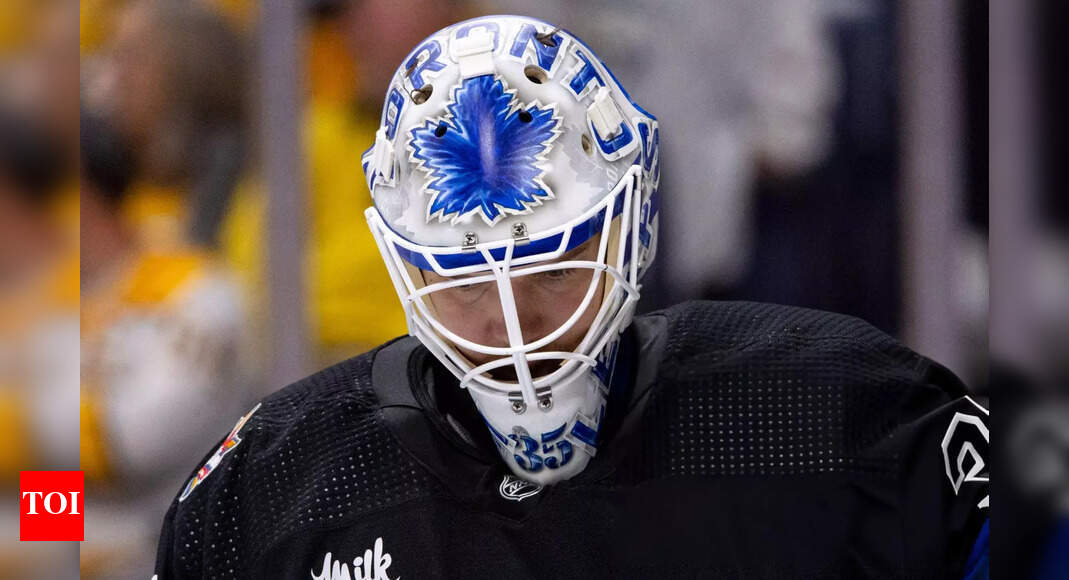
 View of the goalie mask worn by Ilya Samsonov #35 of the Toronto Maple Leafs against the Nashville Predators (Image Source – Getty Images) NHL Goalie Week is happening from September 2 to 7. This celebration, organized by NHL Social, pays tribute to the art of goaltending in the National Hockey League. The event showcases the unique talents and creativity of goalies throughout the decades.
Jacques Plante and the First Accepted Mask
This incident occurred when Andy Bathgate’s high backhand shot caught Plante in the nose, needing seven stitches.The game was put on hold for 45 minutes because there were no backup goalies available at that time.Plante was adamant about not coming back without his mask, which coach Toe Blake had only permitted during practice until then.After Andy Bathgate’s high backhand cut Plante’s nose, he needed seven stitches. The game was put on hold for 45 minutes because there were no backup goalies available at that time. Plante wouldn’t go back in without the mask, which coach Toe Blake had only permitted during practice until then.This wasn’t the very first mask ever used. According to reports, Clint Benedict sported a protective leather mask during the 1929-30 season after he broke his nose and cheekbone.
Gerry Cheevers’ Stitches
Gerry Cheevers from the Boston Bruins had one of the most memorable looks in hockey. His white mask was adorned with black stitches. This all started back in 1967 during a Bruins practice. After a high shot hit him in the face, trainer John Forristall drew stitches on the mask where the puck made contact. They kept adding more stitches every time Cheevers got hit.This wasn’t the first time a mask was painted. However, Cheevers’ stitches brought a unique character to goalie masks. This innovation influenced many designs in the following 15 years. For instance, Ken Dryden sported a Canadiens-themed “target” mask from 1975 to 1979. Also, Gilles Gratton’s 1976 Tiger mask, which he wore with the Rangers, is now displayed in the Hockey Hall of Fame.
Doug Favell’s Introducing Color
Doug Favell, who played for the Philadelphia Flyers, was the first in the NHL to bring some color to the game. He painted his mask a bright orange for a Halloween match in 1970. While Plante’s mask from 1959 had a flesh-tone hue, Favell’s was the first to feature such striking colors. Shooters claimed that the bright mask was distracting. The next year, he switched to an orange and white starburst pattern. Similar to Cheevers, Favell was a pioneer in making masks a form of art.
Dave Dryden’s Innovation
Tony Esposito, playing for the Chicago Blackhawks, added metal bars to his fiberglass mask back in 1978. But it was Dave Dryden from the Edmonton Oilers who really pushed the design forward. He collaborated with mask maker Greg Harrison, who had painted masks for Bromley and Gratton. They came up with the first “combo”: a snug fiberglass mask with a metal cage, a larger opening, and a back plate harness.Materials have advanced to carbon fiber, Kevlar, impact-absorbing foams, and 3D-printed liners. The Dryden-Harrison design has a big impact on modern masks. Other than Plante’s debut, this is the most important change. Dryden died on October 4, 2022.
Hasek and Osgood
Before the combo, goalies sported a “birdcage” helmet-and-cage setup. Vladislav Tretiak donned one for the Soviet Union during the 1972 Summit Series. It made its NHL debut in 1976.Some players continued using it. Dominik Hasek wrapped up his Hall of Fame career in Detroit with a custom fiberglass helmet made by Gary Warwick, which was painted and attached to his birdcage. Chris Osgood hunted for discontinued Cooper helmets, even purchasing some on eBay. A Red Wings trainer had Soviet models stashed in his garage. Osgood hung up his skates in 2011 as the last player to wear a genuine birdcage.
Ed Belfour’s Eagle
Ed Belfour, who played for the Chicago Blackhawks, kicked things off with an eagle design created by Greg Harrison. This design was inspired by Eddie “The Eagle” Edwards from the 1988 Calgary Olympics. The name and design remained with Belfour as he switched teams, collaborating with artist Todd Miska.This trend can be seen in others as well. Curtis Joseph has his “Cujo” dog designs. Felix Potvin sports “The Cat” design by Harrison. Martin Brodeur has a mask themed after the New Jersey Devils. Andrei Vasilevskiy features a lion design by Sylvie Marsolais, with some changing colors on the ice.
Johan Hedberg
Johan Hedberg’s moose-themed masks turned into his trademark. It all kicked off after his trade to the Pittsburgh Penguins from the Manitoba Moose in the International Hockey League on March 12, 2001. He kept the mask, which got him the nickname “Moose.” The character changed its outfits based on the team.
Carey Price’s Mechanical Skull
Carey Price from the Montreal Canadiens sported different styles throughout his 15-year career. One that really catches the eye is the “Mechanical Skull” designed by Jordon Bourgeault of JBo Airbrush. Although he didn’t wear it all the time, its intricate design influenced many others.For instance, Markstrom’s knitted Heritage Classic mask with the Calgary Flames is a great example. Then there’s Frederik Andersen’s “angels and devils” mask for the 2023 Navy Federal Credit Union NHL Stadium Series against the Washington Capitals.Also Read: Pat Maroon returns to the Tampa Bay Lightning as team ambassador after winning 3 Stanley Cups across four seasonsMask art represents NHL Goalie Week by showcasing the creativity and history of the position. Although many goalies lean towards basic logo designs, detailed ones continue to exist. These designs could easily belong in an art museum, preserving the tradition.