
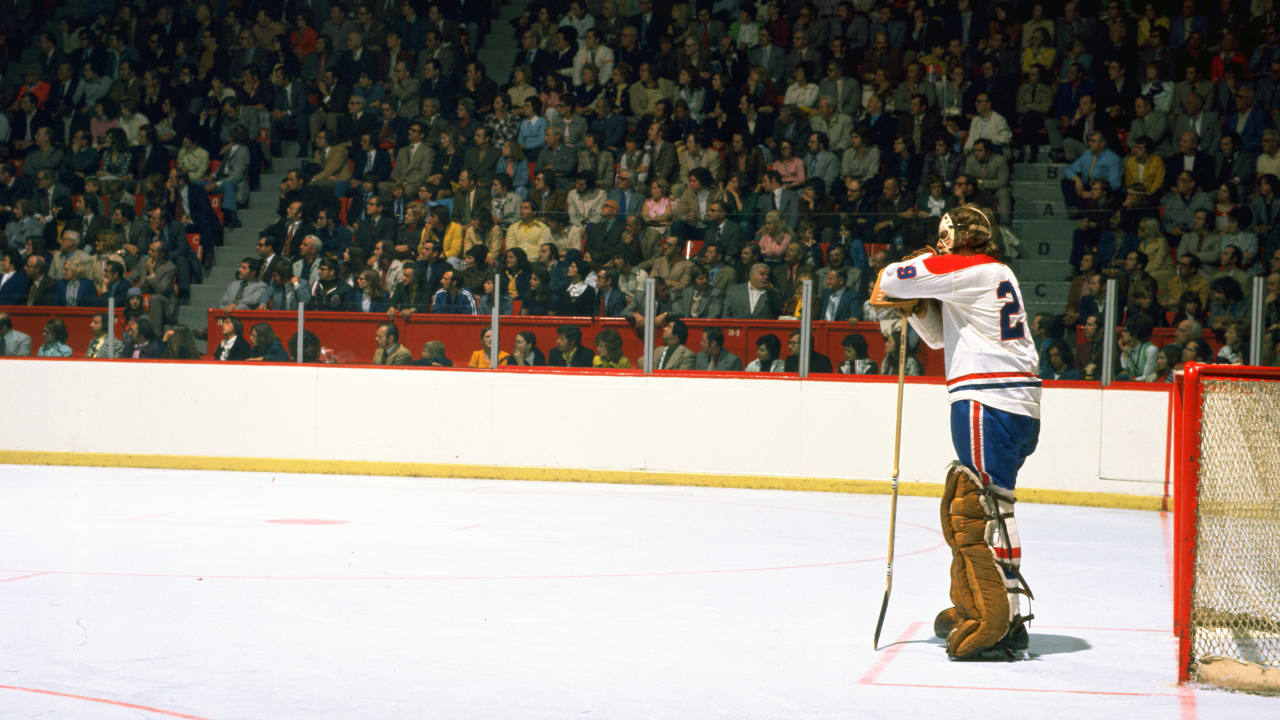
Those performances were the Canadiens’ reward for their patience. The Boston Bruins selected Dryden in the third round (No. 14) of the 1964 NHL Draft, but quickly traded the 16-year-old’s rights to the Canadiens.
However, Dryden put hockey on hold and decided to pursue a college degree at Cornell University rather than attend Canadiens training camp in a decision that was unusual for its time. He went 76-4 with one tie and a 1.59 goals-against average in 83 games during three seasons for the Big Red, then played for Canada at the 1969 IIHF World Championship.
Not until 1970 did Dryden join the Montreal organization. He went 16-7 with eight ties in 33 games for the Montreal Voyageurs of the AHL in 1970-71 to earn his chance with the Canadiens. He was named as Montreal’s starter in the playoffs and led the Canadiens to an upset of the League-leading Boston Bruins in the NHL Quarterfinals, followed by a six-game win against the Minnesota North Stars and a seven-game victory against the Chicago Blackhawks in the Stanley Cup Final.
The Canadiens won the Cup again in 1973, with Dryden going 12-5 in the playoffs after helping the Canadiens win the Vezina Trophy as the top defensive team in the NHL during the regular season. But Dryden didn’t report to training camp in the fall of 1973; instead, unhappy with the Canadiens’ contract offer, he announced his retirement at age 26 and went to work at a Toronto law firm.
He returned to Montreal in the fall of 1974. The following season, he and the Canadiens began a run of four consecutive Stanley Cups by sweeping the Philadelphia Flyers in the 1976 Final. The 1976-77 Canadiens became the first team in NHL history to win 60 games during the regular season, then capped what’s regarded by many as the best season in NHL history by sweeping the Bruins in the Final. They defeated the Bruins again in 1978 and knocked off the New York Rangers in five games in 1979 for their fourth consecutive title.
Dryden still was at the top of his game. But instead of being on the ice in the Canadiens’ push for a fifth straight Cup in 1980, he was in the TV booth. He served as an analyst for the 1980 Lake Placid Olympics and was paired with Al Michaels for the telecast of the United States’ upset win against the Soviet Union in the “Miracle on Ice.” Dryden also served as an Olympic analyst in 1984 and 1988.
In 1983, he became a best-selling author when “The Game,” a first-person account of Dryden’s 1978-79 season with Montreal, was published. More than three decades later, it’s still regarded as one of the best books ever written about hockey. He also was inducted into the Hockey Hall of Fame that year.
After several years away from hockey, Dryden returned to the NHL in 1997 when he was named president of the Toronto Maple Leafs. He left the team in 2004 to run for a seat in Canada’s Parliament on the Liberal Party ticket in the riding of York Centre. Dryden won his parliamentary seat in a landslide and was named Canada’s Minister of Social Development. He was re-elected in 2006.
The Canadiens recognized his on-ice success on Jan. 29, 2007, when his No. 29 was raised to the rafters at Bell Centre. He received the Order of Canada in 2012.