
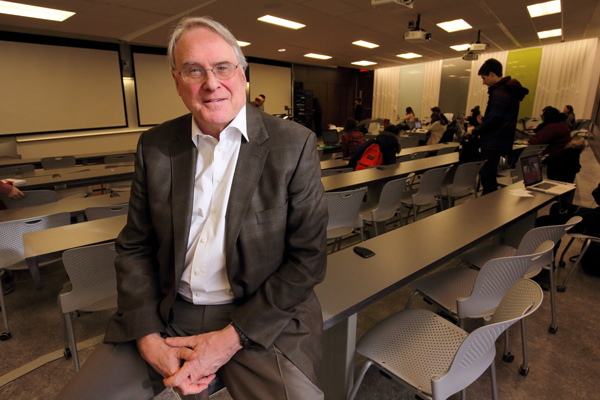
 Ken Dryden taught his Making the Future class at McGill for five yearsOwen Egan
Ken Dryden, the iconic Montreal Canadiens goaltender, lawyer, federal cabinet minister and passionate advocate for education, climate and civic engagement, died of cancer Sept. 5, at age 78. A towering figure literally and figuratively, Dryden was not only a Hockey Hall of Famer, but someone who displayed an unshakable commitment to public service, intellectual inquiry and the next generation of Canadians. His deep and enduring connection to McGill University – where he earned a law degree and later inspired countless students – was central to his story.
“Ken Dryden’s achievements both on and off the ice were extraordinary. As a lawyer, author and parliamentarian, he brought the same commitment and integrity to public life that defined his athletic career,” said President and Vice-Chancellor Deep Saini. “At McGill, we are especially grateful for his years of service on the President’s International Advisory Board and his deep care for our students. His loss will be felt across our community, but his legacy will continue to inspire future generations.”
Balancing law and pro hockey
Born Aug. 8, 1947, in Hamilton, Ont., Dryden rose to prominence as a goaltender for the Montreal Canadiens in the 1970s, backstopping the team to six Stanley Cups in just eight seasons and winning five Vezina trophies as the NHL’s top goaltender. He also played for Canada in the 1972 Summit Series against the Soviet Union. Known for his calm demeanour, analytical mind and signature “leaning-on-the-stick” pose, Dryden became a legend in net, his career both brief and brilliant. Even as he soared to stardom in the NHL, he pursued academics with equal intensity.
At the start of his NHL career, Dryden was already pursuing a law degree at McGill. It was a demanding combination of academics and athletics that will likely never be seen again.
In 2018, when McGill conferred upon him an honorary degree, Dryden opened his Convocation address reminiscing about his own McGill graduation ceremony.
“It was here in Place des Arts. It was in June 1973, and about two or three weeks before that, we were parading through Montreal with our second Stanley Cup,” he said. “It was a nice month,” he said with a smile.
Balancing professional hockey with the demands of legal study, he embodied the ideal of the scholar-athlete. As Tina Piper, Dean of McGill’s Faculty of Law, noted:
“Whether donning the iconic bleu-blanc-rouge or serving in Canadian public life, Ken Dryden embodied the ideal of dedicating oneself to something greater – be it a team, a sport, community or justice. As a law student and professional athlete in the 1970s, he was a trailblazer, famously presenting our then-dean, the late John W. Durnford, with a unique challenge: ‘How do we accommodate a student who’s playing in the Stanley Cup Final during law exams?’ In redefining what it meant to be a student-athlete, Ken Dryden set a standard that continues to inspire.”
Life after hockey
His time at McGill not only shaped his worldview but also became a launchpad for the many chapters of his post-hockey life. After retiring from the NHL in 1979, Dryden went on to become president of the Toronto Maple Leafs, and wrote several acclaimed books including The Game, considered by many to be the finest hockey book ever.
In 2004, Dryden turned his focus on politics and was elected as Member of Parliament for York Centre. Serving in the cabinet of Prime Minister Paul Martin as Minister of Social Development, Dryden championed national child-care strategies and social equity initiatives.
Dryden never lost his passion for education. In the 2010s, he returned to McGill to teach a popular course called Making the Future, which challenged students to move beyond reflection toward action. In his 2018 Convocation address, he recounted how he told students of that class, “don’t just give me a vision. Visions are easy. Tell me at least some of the steps you’ll have to take to get there.”
Pushed for the creation of key climate course
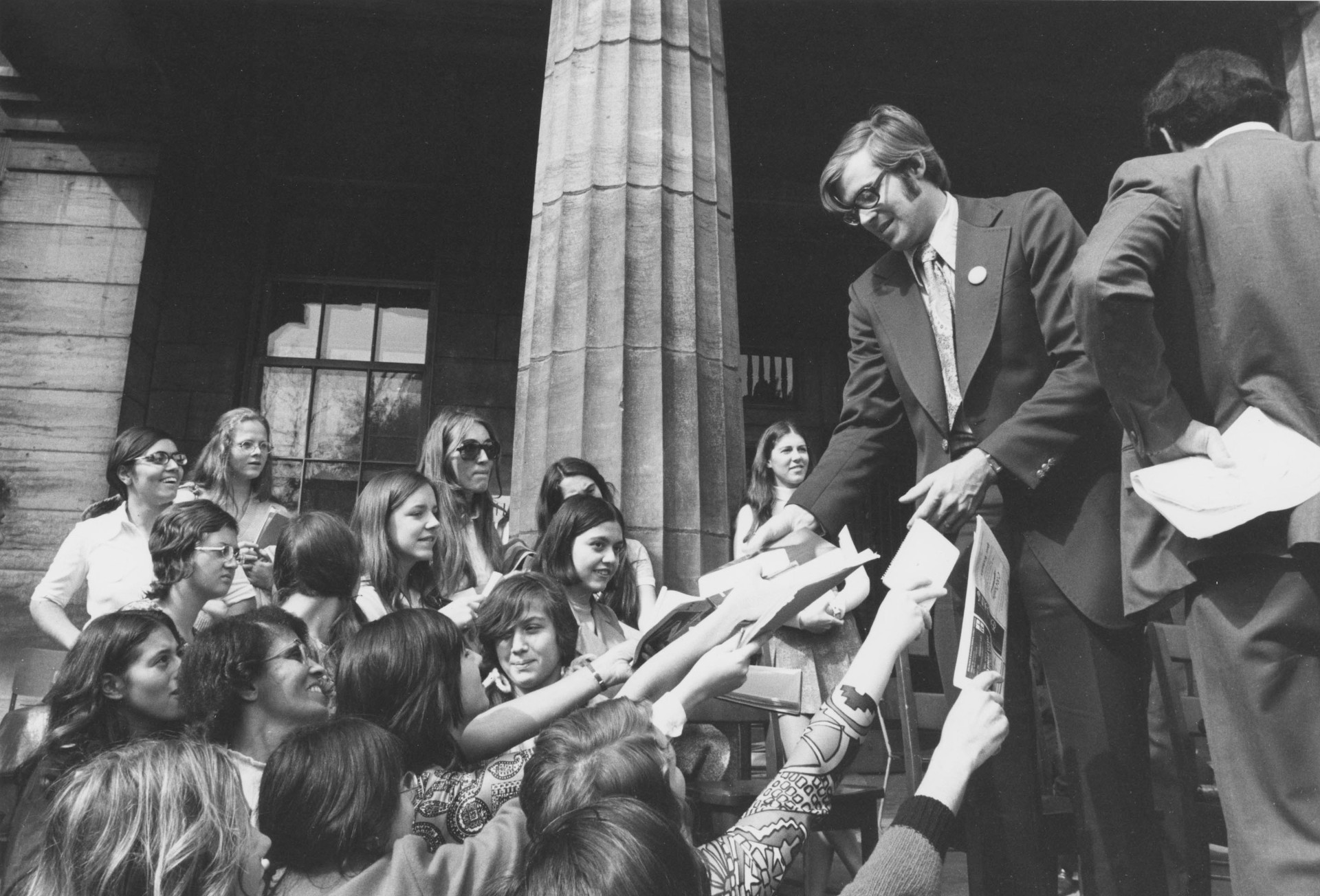 Ken Dryden at McGill’s Open House in 1971 McGill University Archives
Dryden’s insistence on action over abstraction resonated deeply with colleagues and students. Christopher Buddle, Associate Provost (Teaching and Academic Planning), recalled one such moment that occurred during the pandemic:
“Over the lunch break one day, I went for a bike ride on some quiet country roads. It was around that time Ken Dryden was pressuring me to get moving on creating a climate-focused course at McGill. He called me while on the bike ride, and I stood at the side of the road, overlooking a stunning landscape, and we talked, debated and disagreed on a few points, and notably I was defensive about the slow processes around course creation. I found it difficult to disagree with Ken; he was persuasive,” said Buddle. “About a week later, and upon reflection, I realized he was right, and that was a turning point. Next time we talked was extremely productive, and in addition to discussing the climate course, he asked (with a chuckle) whether I had been on my bike again.”
The result of those conversations was FSCI 198: Climate Crisis and Climate Actions, a landmark course at McGill that continues to influence student thinking on environmental issues.
“Ken Dryden was deeply passionate about the need to act urgently and purposefully in light of climate change,” Buddle said. “Few people know this, but conversations with him several years ago were foundational to the development of that course. Part of his legacy and impact at McGill, and by extension the world, is the students who took, or will take, that course.”
A humble, deeply principled man
Pierre Boivin, McGill Chancellor and former Montreal Canadiens president, said we may never see another like Ken Dryden.
“He was one of the greats,” Boivin said. “Not just as one of the best goaltenders in NHL history, but as a Renaissance man – educated, family-oriented, a public servant and an author. We’ve lost a great man, a great Canadian and a cherished member of the Canadiens family.”
Boivin recalled that during his first months as Habs president, Maurice Richard died, and his body lay in state at the Bell Centre. The line of fans stretched nearly to de Maisonneuve Blvd.
“A security guard told me Ken Dryden was in that line,” Boivin said. “I rushed out and offered him the VIP entrance. Ken smiled and said, ‘That’s very kind of you, Pierre, but I want to pay my respects avec le peuple.’ I saw him two hours later at the casket. That moment captured who he was; humble, respectful and deeply principled.”
The power of possibility
Dryden often spoke about the power of possibility, especially for young people trying to chart their own paths. In his 2023 book The Class: A Memoir of a Place, a Time, and Us, he wrote:
“If I had an impact at all, it’s that I played and I did this while I went to law school. It was because one or 10 or 100 or 1,000 kids who loved hockey, but also kind of liked math or music or something, or who liked math or music, but also kind of liked hockey, could see it was possible … and that those kids themselves might come to believe, might feel, they had the right to try to do more than one thing and learn lots of things … which would change them, which would change their kids, which would change their grandkids.”
Dryden is survived by his wife, Lynda, their two children, and a legacy that spans ice rinks, courtrooms, classrooms and the Canadian conscience. Whether teaching, playing or advocating, his life was marked by quiet determination and the drive to help others first imagine a better world, then do the work to build it.
 In 2018, McGill conferred an honorary degree upon Ken Dryden as part of Fall Convocation.Owen Egan/Joni Dufour