
Training camp season is upon us, and that means the start of the NHL regular season is that much closer. The Minnesota Wild are deep into their training camp at this point, with over half of their preseason games finished. While some can’t wait for training camp to be over, others want it to stretch out so they have more time to show what they can do.
For those who have followed hockey for quite some time, they know the results of preseason don’t actually matter. It’s more of a time for both rookies and veterans to get their legs back in a competitive setting, and of course, see how players handle different situations, especially the rookies. In this article, we’ll take a closer look at some differences and similarities between training camp and regular season practices for both players and coaches, but mainly, how training camp isn’t just preseason practice. We’ll start with how training camp is a time for players to prove themselves.
Training Camp Is a Time to Prove
While some may view training camp as just an early-season practice, especially for the veteran players who basically already have their job solidified, it’s more than that. It’s true that a lot of the veterans don’t have to worry about a roster spot, but there are some who do. Those who didn’t have a great showing last season now have to prove they are worth their spot on the roster. For the Wild, Yakov Trenin is a prime example. It’s safe to say he struggled to acclimate to the roster a bit last season, but this season, he’s come in with something to prove.
“Get ready and be best shape I can be since game 1, don’t wait for game 10 or game 20. Just Game 1 right away,” Trenin said when asked about what he wants to get out of training camp. So far, he’s impressed with his play as well as his speed since he spent the offseason getting into better shape.
There are also players like defenseman Jack Johnson, who was invited to camp on a Professional Tryout Offer and isn’t guaranteed to make the final roster. He’s a veteran with a lot of experience, but his career isn’t what it once was, so he has to prove himself when it comes to making the cut.
“I’m just looking to be myself. Obviously, I’ve been around for a while, there’s experience, good and bad experiences, and you kind of learn how to roll with a lot of them, but I think this team’s looking to get over a hump and contend for the Stanley Cup. I’ve been fortunate to be on a couple teams that go into the expectations of going for the Stanley Cup and just looking to be a piece, help out any way I can, whether it’s on the ice or in the locker room. Off the ice, away from the rink, kind of helping what I know what it takes to get to that place you want to be,” said Johnson about what he wants to bring to the team.
Finally, after the veterans, there are the young players hoping to be good enough to make the roster. Zeev Buium was one of those players last season, but now he seems to have solidified a spot, and after him, there’s Danila Yurov, Hunter Haight, Riley Heidt, and a few others. While only a few of these players are likely close to taking a spot, they all want to showcase what they can do in a short amount of time, which means having the best training camp they can.
Practice Doesn’t Mean Time to Relax
On the flip side, while training camp isn’t just a preseason practice, a regular-season practice doesn’t mean every player is safe either. For some players, especially the younger ones who may be playing due to an injury call-up, they have to play like they did in training camp to keep their spot. If they slack back or don’t continue to prove themselves, they will be sent back down. It’s not a time to relax just because they made the cut; it’s time to find another notch and continue to improve their game, and that’s when the real workload begins.
A player like Jesper Wallstedt, who stated in an interview during training camp that while most say his spot is secure, he doesn’t believe it is. He knows he has to come in to training camp and earn it, but if he makes the final cut, which is likely, he’ll have to continue to play at a high level to keep his spot.
 Jesper Wallstedt, Minnesota Wild (Photo by Matthew Pearce/Icon Sportswire via Getty Images)
“You never know, I wouldn’t say my spot is safe or anything. There’s a spot there, and it’s up to me to show that I want to be that guy, and I’m deserving of that spot, and that I show that I’m in a good spot to compete for it. I think I just gotta be out there every day, show that I want to save every puck, and I’m going to be early at the rink. I’m staying here late to work on my body and the things that I have to do. But on the ice, it’s about every puck and competing…” said Wallstedt about how he has to prove himself worthy of a spot.
Players like Nico Sturm and Vladimir Tarasenko, who were brought on to be part of the final roster, have to prove themselves to not only the fans but also their teammates. Just because they’re considered on the team, it doesn’t mean they don’t have something to prove. Sturm has been battling back issues since the start of camp, while Tarasenko has been showing his shooting skills.
“..Makes stuff like camp a little bit more enjoyable because you can actually truly worry about the stuff on the ice and the things you need to improve on and not trying to do things just to stand out if that makes any sense just to get noticed…,” Sturm said in regards to knowing his role already rather than having to worry about going too hard at training camp. He still has something to prove, but not as much as the guys on the verge of being cut.
Training Camp Doesn’t Last Long
A lot of fans may think training camp drags out when in reality it’s only two to three weeks long, but for some rookies, it lasts less than a week. The Wild started their training camp on a Thursday, and by the following Monday, they had already made cuts. Now, realistically, some of these players were brought up just to get some experience and be put on the radar of some coaches. For those players, it’s a great opportunity to practice with some of the top guys and gain that valuable experience, and most importantly, learn, but it can also be tough mentally, knowing you’re not staying.
While it’s not a long time for the players, it’s also not a long time for the coaching staff. They brought in 61 players initially, and while they have their thoughts on every single one, they are still evaluating and watching all through camp. In reality, it doesn’t seem like much time to figure out what players they want on the roster, but they’ve also been watching these players far before training camp even began. For those players who are on the verge of being cut or making it, training camp is their time to shine, and they can’t hesitate.
A time like training camp gives these young players a chance not only to show their skills, but also to show they can elevate their game to match that of their NHL veteran teammates. Of course, they won’t be perfect, but if they can come close or if they can’t is important in showing their ability to transition their game to the highest pro level.
Practice Has Time to Fine-Tune
Training camp is quite fast-paced, and there’s not a lot of time to focus on certain details. While they can work on items like power play, penalty kill, zone entries, etc. It’s harder to really fine-tune not only those items but also other details, such as faceoffs, positioning for different areas, pairing players, etc. All of these items require time and one-on-ones, which is difficult to do in training camp, especially if a lot of these players aren’t going to make the final roster.
However, regular-season practice is where all of that work begins, and it’s why these players practice as often as they do. They will sometimes spend an entire practice working on one thing, like the penalty kill, the power play, etc. In training camp, they do work on that some, but it’s really hard to do with a limited amount of time, and players changing quite a bit. Sometimes a line will be certain players and then the next practice it’ll be different in training camp, but during the regular season, it can stay the same unless things aren’t working as they want.
Practice also allows time for errors; players can make certain mistakes and have time for a coach to correct those issues. This is a big thing for the goaltenders. While in training camp, they do work with the goaltending coach on positioning and the items they need, but practice is where they can truly break it down. However, on the flipside of that, during training camp, there are more goaltenders on the ice at a given time, so it’s easier to have one doing drills with the team and one doing work by themselves, but regular-season practice also allows that also because you typically always have two goaltenders.
Training Camp is Busy
The regular season moves along at a pretty good pace, but training camp flies by in comparison. There are only a few weeks for coaches to observe players and make decisions. Again, as mentioned above, players who aren’t guaranteed a spot on the roster only have a short time to show their skills, but that also means it’s a short window for the coaching staff.
Related: Wild Owner Craig Leipold Discusses Kaprizov, TV Deals, Arena Renovations & More
It is important to remember, though, that while the Wild’s main coaching staff is comprised of a handful of people, there are many more working behind the scenes. Most of these players have been scouted for quite some time already, and the coaching staff has people dedicated to providing them with information on these players that they can’t necessarily see. While there’s a lot of staff behind the scenes, it’s also difficult when the coaches can’t see the players for themselves.
They trust the information being given to them, but it’s a lot different seeing it for yourself versus hearing it via word of mouth. One of the best examples from this season’s training camp is Vladimir Tarasenko’s shot. Everyone heard he had a strong shot, but it still caught everyone by surprise when they saw it in person, especially his teammates.
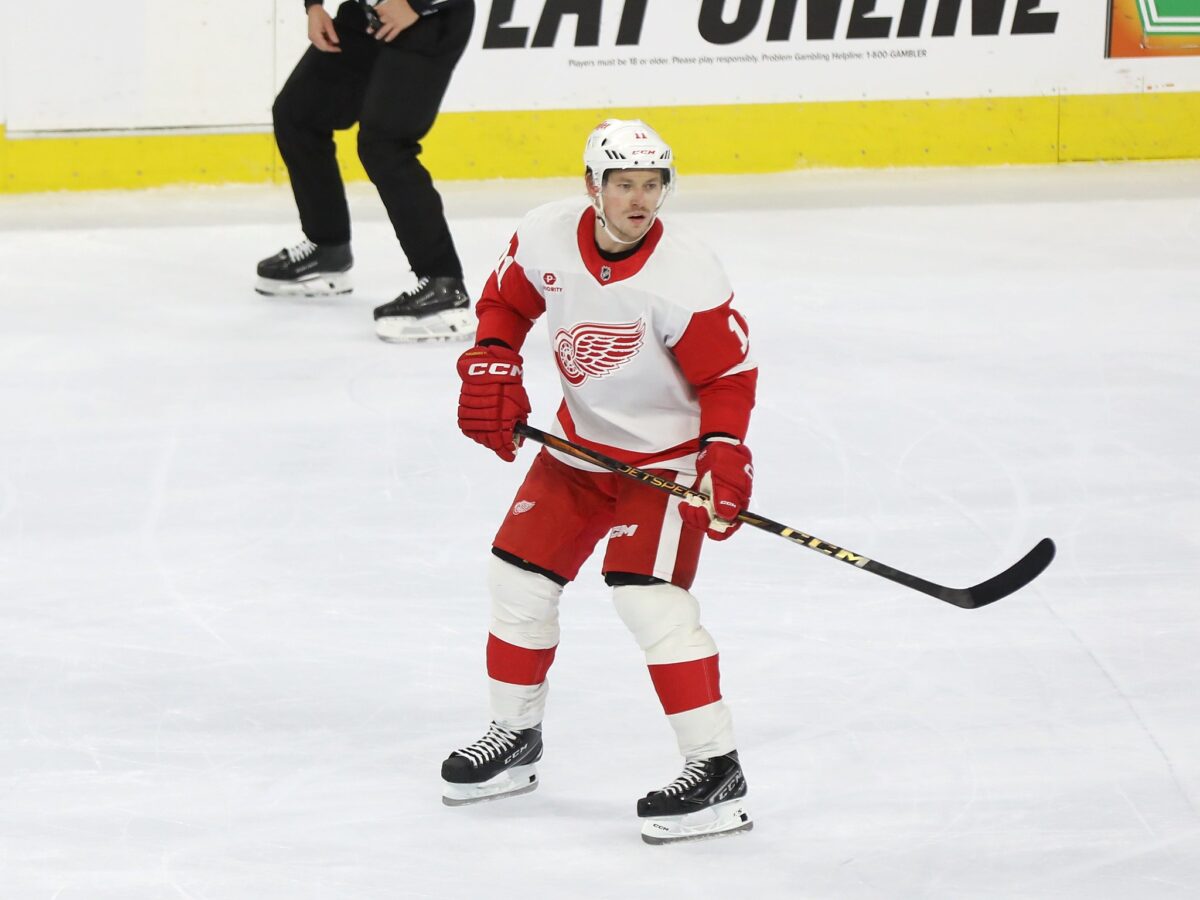 Vladimir Tarasenko, former Detroit Red Wings, current Minnesota Wild (Amy Irvin / The Hockey Writers)
“I thought his release was good playing against him, but I think seeing him on a day-to-day it’s even better on a day-to-day basis when we get to watch him and how he shoots the puck. Smart guy, I didn’t realize how strong and thick he was, he’s a big Russian bear, and I hope, we all hope that we can give him that positivity, that confidence where we want him to be, that scorer that he’s known for. Just a lethal shooter, it’s one of those shots that’s heavy; it can go through goalies. When it hits the net, it seems like it’s going to rip through. We hope that he gets in positions this year where he can release it and feel comfortable doing it,” said Marcus Foligno about what he thought of Tarasenko’s shot.
The other aspect that can be hard for coaches is not being able to focus on just one thing, like they can in practice. They have all of these players to work through drills, but they have to pick the kind of drills that showcase as many skills as possible so they can see them in all situations. Again, it’s not like they haven’t seen these players work before, but not in this situation with other different players around them than where they normally are during the season.
Training camp is truly a one-of-a-kind time where players have to prove they can make it in the big league while other veteran players are trying to get back in game shape. Most of these players work out all summer long, but it’s different getting back onto the ice for a game, and they need time to adjust. As for coaches, they have to be on their game to make sure they’re watching for who they want to keep and who they want to send down, with limited time to see everything. All of these reasons are why training camp is more than just a preseason practice, but an important time for everyone involved.
