
By Shayna Goldman, Sean Gentille and Dom Luszczyszyn
In June 2024, after another disappointing loss in the Stanley Cup playoffs, Chris Drury sounded like a man ready for wholesale, meaningful change.
“To me, nothing’s off the table,” the New York Rangers president and general manager said. “We’re trying to reach the ultimate goal here.”
It took another season — and an ugly one, at that — but Drury made good on his word. The Rangers, in the last year, have added a new No. 1 center, made three roster-reshaping trades and, at long last, hired Mike Sullivan as head coach. Time to see if it was all enough to make a difference.

The projection
Can the Rangers return to the playoffs? Probably, and Sullivan is a big reason why. Without his potential impact factored in, the Rangers’ playoff odds would sit just a shade under 50 percent. He’s a difference-maker behind the bench.
The team he’s taking over isn’t all bad either; it just greatly underachieved last season. The chances of falling back down to those depths is 23 percent. The Rangers should be a lot better this season.
Just returning to the playoffs, though, shouldn’t be the goal. Aspirations need to be a lot higher. The 2023-24 Presidents’ Trophy winners, with an aging core and Artemi Panarin facing free agency, must actually contend.
Whether New York pulls that feat off is questionable, with a one-in-three chance of advancing past the first round and an equal shot at being a 100-plus point team. After last season’s misery, contending is far from a given.
The big question
Can Alexis Lafrenière regain his momentum?
If you were to glance at Lafrenière’s stats from last season, context-free, you wouldn’t notice much year-over-year difference. His 2024-25 was similar to his 2023-24, particularly at five-on-five. He dipped from 19 goals to 15 and 42 points to 40. A little worse in some spots, maybe, but decent enough on balance.
The stat line, though, doesn’t take into account just how primed Lafrenière seemed to be for a forward leap, or the seven-year, $7.45 million AAV extension he signed ahead of the season. It doesn’t reflect his own opinion, either.
“I struggled to be consistent in my game and didn’t really make a difference,” Lafrenière told reporters after the season. “I’m obviously disappointed in my year. We can have a long summer, we can work on a lot of stuff and come back next year and have a big year.”
The disappointment, no doubt, should stem from Lafrenière’s inability to build on the momentum he’d earned for himself the year before. “Similar, but a little worse” isn’t any sort of progress, let alone what many expected from him. In 2023-24, the former first-overall pick set career highs in goals (28) and assists (29) and, beyond simple hockey-card numbers, became a significantly more dangerous, well-rounded player.
Lafrenière, according to All Three Zones tracking data, wasn’t just the Rangers’ best rush player — he was one of the best in the league, generating tons of chances, both high-danger and otherwise, and helping drive play overall.
That all helped him finish the regular season with an Offensive Rating of plus-6.6 and a Net Rating of plus-3.9, both career highs. He kept that momentum rolling into the playoffs, where he finished second only to Vincent Trocheck in overall goals and points despite minimal power-play time. In terms of points per 60 minutes, the distance between him (2.59) and second place on the Rangers (Trocheck at 1.92) was greater than the difference between second place and seventh. In terms of on-ice impact, Lafrenière was on for 3.36 goals per 60 minutes, which led all Rangers by a wide margin, netting him a 59 percent goal rate. His 52 percent expected rate led the team, too.
A little less tangibly, he often looked like the most dangerous skater on the ice, and certainly like a guy who was set to break out even further in 2024-25, especially if he could secure more power-play time and improve his defensive impacts. Neither of those came to pass, and Lafrenière’s effectiveness as a play-driver offensively dipped, too. As a unit, Panarin-Trocheck-Lafrenière was good, but not great — and certainly not better than in the previous year.
Still, despite the change around him, Lafrenière occupies a fundamentally similar space on the Rangers’ roster; there simply aren’t many players in the mix who have his ceiling. There are skating concerns, sure, and there likely always will be — but ultimately, he remains a young, gifted playmaker with a very real, very recent stretch of legitimately needle-moving five-on-five play.
It’ll be interesting to see how Sullivan decides to use him. Early returns are positive — he’s going to start the season on the top power-play unit and back in his usual role on the right of Trocheck and Panarin. Whether that helps Lafrenière find the consistency he seeks remains to be seen. If we’re having a similar discussion a year from now, though, after more time spent in neutral, it won’t be a good sign for him or anyone else involved. Momentum, after all, can swing both ways.
The wild card
What will a new coaching staff do for the power play?
There’s no point in pretending that the Rangers were anything but bad with the man advantage last season; they converted at a 17.6 rate (28th in the league) and scored 6.56 goals per 60 minutes of play (25th) despite being fifth in expected goals. Power-play units are judged on how many times they find the net and how frequently they find it.
Exacerbating those issues was the unit’s quality in the recent past; power-play success, along with Shesterkin’s play, was the engine for the Rangers’ overall success. Goaltending and man-advantage goals, for a mediocre five-on-five team, are a way out of the mud.
There are reasons to think that the needle is pointing in the right direction for 2025-26; David Quinn, the Rangers’ head coach from 2018-21, is back in the building as Sullivan’s top assistant — and a highly functional power play, with some of these same players, was part of his calling card. Quinn ran Pittsburgh’s power play last season, when it went from one of the least productive in the league to the middle of the pack. Some of that had to do with a shooting percentage uptick, but the operation looked undeniably improved with Quinn at the helm.
In New York, Quinn (and Sullivan) will have access to a full season’s worth of J.T. Miller, which won’t hurt. They’ll also be working with a more flexible group of players; Sidney Crosby and Evgeni Malkin are long-set in their ways, and Erik Karlsson has never looked like a seamless fit alongside them. Better results wouldn’t be surprising.

The strengths
Year after year, the Rangers’ greatest strength remains the same: their backbone in net.
By traditional metrics, Igor Shesterkin had an “off” year in 2024-25, after earning a career-low .905 save percentage. That doesn’t capture just how challenging his environment was, behind the Rangers’ defensive chaos. Among starters, only Lukas Dostal and Alexandar Georgiev (after being traded to the Sharks) faced a tougher workload in terms of expected goals against. Still, Shesterkin earned a GSAx of 28.5, which ranked sixth in the league.
Shesterkin is a game-breaker who can thrive no matter his surroundings. So a bounce back, by surface-level metrics, is a safe bet. An Adam Fox one is more controversial.
The knock on Fox is how he differs from Cale Makar and Quinn Hughes. He isn’t as electric or up-tempo, nor does he have their athleticism. Usually, he can make up for that with his vision, anticipation and poise; that stylistic difference allows him to influence the game in his own unique way. Last year, it burned him because he looked exposed at times on a crumbling blue line in New York, and at the 4 Nations Face-Off.
Even with those lows, Fox was still one of the Rangers’ best players, and he had some of the best relative xG impacts among all defensemen on both ends of the ice. His recent history provides a bubble of Norris-caliber play for support, too. That all goes into his plus-17.4 projected Net Rating, third only to Makar and Hughes on defense. That kept him in Franchise territory, despite considerable pushback in this year’s Player Tiers.
And now, Fox should have some help on a thin blue line with the addition of Vladislav Gavrikov.
On paper, Gavrikov is exactly what the Rangers need: a No. 2 defenseman who can bring defensive stability in a shutdown role, whether he plays alongside Fox or opposite him on the second pair to spread the wealth. How much of an upgrade is this for New York? Gavrikov has a plus-3.4 Net Rating, compared to Ryan Lindgren’s projected value of a minus-5.5. The only question now is how his game will hold up away from the Kings’ structure; Gavrikov, at least, has experience playing for defensively challenged teams — just take his time in Columbus.
The Rangers are also top-heavy up front, with Panarin leading the way. While his all-situations scoring dipped last year, most of that can be chalked up to struggles on the power play. His 2.62 points/60 at five-on-five were in line with his average pace in New York over the last five years. Panarin’s play in all three zones still popped, between his transition game and elite puck-moving, even as his linemates regressed.
With Panarin holding the top spot, J.T. Miller slots into a more fitting No. 2 role in New York. And his presence will shift Mika Zibanejad back to wing to start the season.
After an awful start to 2024-25, Zibanejad’s turnaround actually started before Miller’s arrival. Around New Year’s Day, something clicked; his scoring rate jumped from 1.92 points/60 to 2.79 after January 1. Then, shifting to Miller’s wing still seemed to agree with Zibanejad. Together, they earned a 52 percent xG rate and outscored opponents 14-12; neither one was above break-even in expected or actual goals when separated. Pair that with a potential David Quinn effect, since Zibanejad played some of his best hockey under him, and there is a path back to impact status.
If Will Cuylle can build on his last year, he should round out the top six. He was one of the few sparks in a miserable season, between his puck battles, physicality and much-needed secondary scoring. He is one of six forwards with a positive Offensive Rating on the Rangers, which helps move the needle up to 10th in the league.
The weaknesses
Having star power is one of the most important ingredients to contention. But teams also need a deep supporting cast to help get through four grueling rounds of playoff hockey.
And that’s what the Rangers seriously lack.
While Zibanejad seemed to have turned his game around in the second half of last season, there are still some concerning trends to keep an eye on, like how much his play-driving trailed. Was it a symptom of Peter Laviolette’s system, or age-related declines?
Is a shift to wing enough to change that across a full season? That’s what the Rangers are banking on, even though it weakens the team’s center depth. The Player Tiers panel isn’t buying it, with insiders calling him “washed” and not worthy of a Tier 6, if we had one.
That puts more pressure on a bounce back from Trocheck.
Like Panarin, Trocheck’s scoring dips are primarily due to last year’s power play struggles. But below the surface, there were a couple of concerning trends, like his xG rate dropping below break-even to just 47 percent. The Rangers generated less in his minutes and gave more up; and unlike years’ past, Trocheck didn’t get his team out of danger as often. If anything, his failed puck retrievals and zone exits were a part of the problem.
Below him, the Rangers still don’t have a real replacement for Filip Chytil down the middle of the third line (unless Zibanejad moves back to center). Juuso Parssinen, as it stands, doesn’t project to be fourth-line caliber, let alone hold such a pivotal position. Noah Laba has impressed in training camp, but he could still start the year in Hartford.
What makes the 3C situation trickier is the uncertainty on the wings. Gabriel Perreault, Brennan Othmann and Brett Berard are all vying to start the year at the NHL level, instead of Hartford. While each one has offensive potential, that has to translate to readiness to make an impact at this level. The difference between one of these risers making it, versus say, Conor Sheary, Taylor Raddysh and Jonny Brodzinski, is that their development is key in the big picture — it just may take some growing pains to get there, and this team may not have the patience for it after last year.
Third-line scoring is key, because the Rangers’ fourth line — likely some combination of Sam Carrick, Adam Edstrom and Matt Rempe — has limited upside. While they outscored opponents 4-0 last year, that may not be sustainable without more substance behind it.
A top-heavy blue line complicates things even further for a team with playoff aspirations.
Fox brings a plus-14.7 Offensive Rating to the fold; the other five defensemen almost cancel that out with a combined minus-13. Below Gavrikov, no one has the defensive chops to make up for it.
So, unless Scott Morrow surprises and makes the team, there won’t be much dimension in the bottom four. Instead, each pair will be anchored by a righty (Will Borgen and Braden Schenider) who carries a minus-3.1 Defensive Rating.
Considering how chaotic the Rangers were in their own zone under Laviolette and Phil Housley, a coaching change could help this group outperform their projected values — but that alone may likely not be enough for a contender-caliber blue line.
The best case: 107 points
Sullivan fixes the defense and gets the team’s top offensive gear going again. The Rangers prove last year was a fluke and make an immediate return to contention — and the conference final. Shesterkin wins the Vezina.
The worst case: 82 points
Last year’s struggles are unfixable as the team’s veterans continue to age out with no progression from young players to fill the void. The Rangers’ defense group continues to be a mess, and they miss the playoffs again. Panarin walks in free agency.
The bottom line
Just how much damage can one disappointing year do to a team’s trajectory? That’s what the Rangers have to answer this year. Under Sullivan, a playoff return looks very possible — but this team has a lot to prove to get back into the contender’s circle.
References
How the model works
How the model adjusts for context
Understanding projection uncertainty
Resources
Evolving Hockey
Natural Stat Trick
Hockey Reference
NHL
All Three Zones Tracking by Corey Sznajder
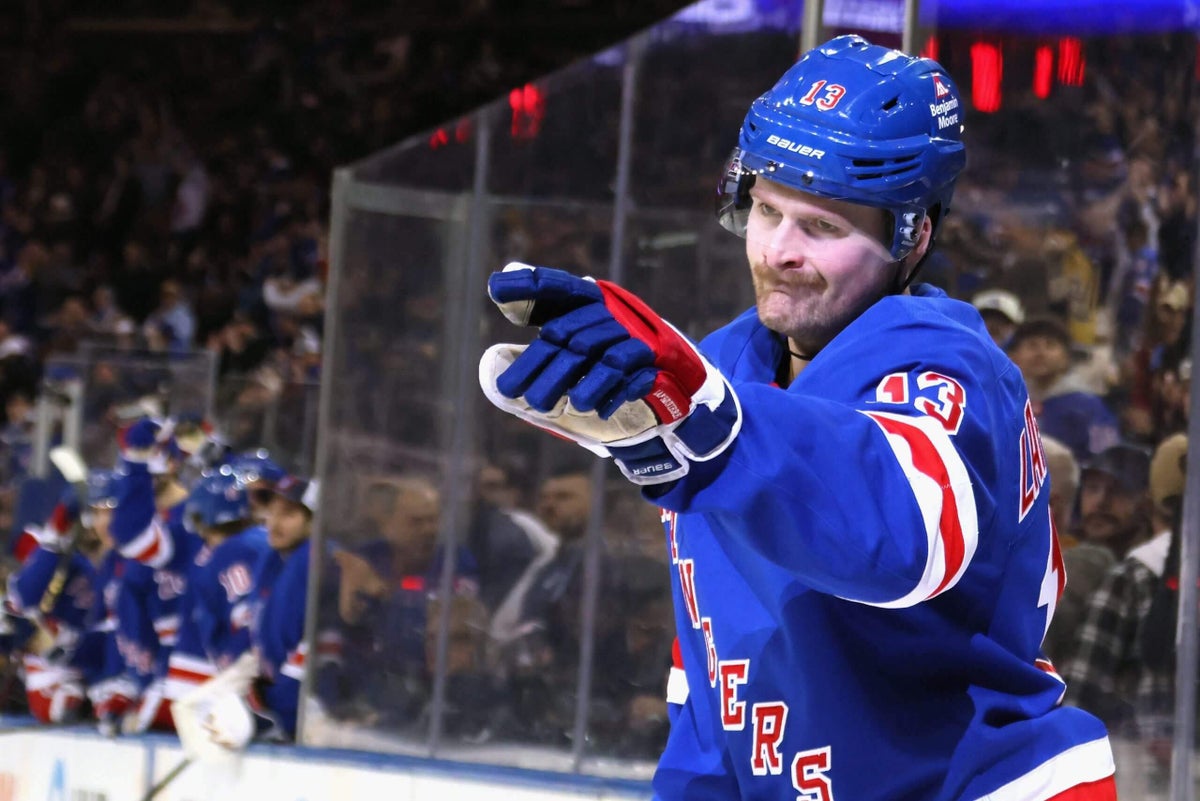
(Top photo of Alexis Lafrenière: Bruce Bennett / Getty Images)