
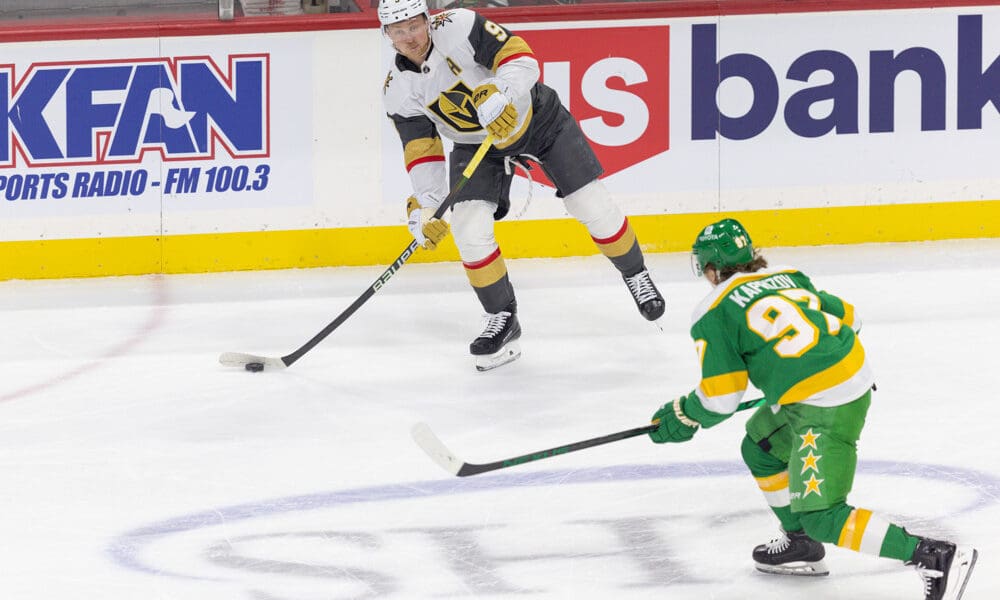
The first domino on the 2026 Free Agent board has fallen. On Monday, the Minnesota Wild announced that they had signed superstar winger Kirill Kaprizov to an eight-year, $136 million contract. That’s an average annual value of $17 million per year.
This is not your father’s NHL. Gone are the days when the best players in the league made less than $12 million a year.
As soon as the Kaprizov extension announcement began circulating on social media, a chill went down the spine of every Vegas Golden Knights fan online. With Jack Eichel still unsigned, every extension has the potential to reset the market and raise his asking price. And if Kaprizov signed for $17 million, how much might Eichel command?
Read More: Latest on Jack Eichel Contract Talk
I’m here to tell you to take a breath. Yes, $17 million is a lot of money. But the salary cap isn’t set at $56 million anymore.
Listen, the song remains the same– for as long as the salary cap has existed, stars have signed for 12-17% of it. It’s just that in today’s NHL, the salary cap is much higher; thus, stars make more money. And because the salary cap is projected to rise to $104 million next season, $17 million is 16.35% of the cap.
Want an example? Let’s hop in our DeLoreans for a moment. It’s the start of the 2009-10 season, and Sidney Crosby’s legendary $8.7 million contract isn’t looking as team-friendly as it will in 2025. In today’s NHL, Crosby’s contract is just 9.11% of the $95.5 million cap. But back then, the salary cap was just $56.7 million, and Crosby’s same AAV took up 15.34% of it.
Right now, Kaprizov’s contract looks like an obstacle that will keep the Wild from contending for a Stanley Cup. But the salary cap will continue to rise, and the value of Kaprizov’s deal will rise with it.
In 2008, Alex Ovechkin signed a $9.54 million contract that took up 16.82% of the cap. However, because the salary cap had increased, when he finally lifted the Stanley Cup with the Washington Capitals in 2018, that same deal only accounted for 12.7% of it.
Kirill Kaprizov cost the Wild only a little less than the Aviators stadium cost the Howard Hughes Corporation. However, to this point, no one thinks that Jack Eichel is asking for anything close to $17 million.
Elliotte Friedman, Chris Johnston, and Frank Seravalli have all projected Eichel’s deal to come in between $13 and $14 million. That sounds like a lot of money– and it is– but it would only account for 12.5-13.46% of the projected $104 million cap in 2026. That’s a reasonable asking price for a perennial Selke candidate who flirted with 100 points last season.
But will Kaprizov’s deal change that and reset the market?
Honestly, I don’t think so. For one, when Eichel spoke about his contract situation, he didn’t exactly sound like he was itching to leave Vegas. Instead, he spoke highly of the city and the fans and praised the organization top to bottom.
When Eichel signed his last contract in 2017, he didn’t exactly take the Buffalo Sabres for all their worth. He signed for $10 million, which was 12.58% of the salary cap. Since then, Eichel has registered four point-per-game seasons and hoisted a Stanley Cup. He deserves a raise, and he’ll get one.
Sure, Eichel might ask for $15 million. I imagine the Golden Knights would pay him, because he’d be worth every penny of it. But it seems much more likely that he’ll sign for the projected $13.5 million.
The Golden Knights have always done right by Eichel, and it sounds like he wants to return the favor. And in today’s NHL, $13.5 million is a team-friendly contract for a superstar to sign.