
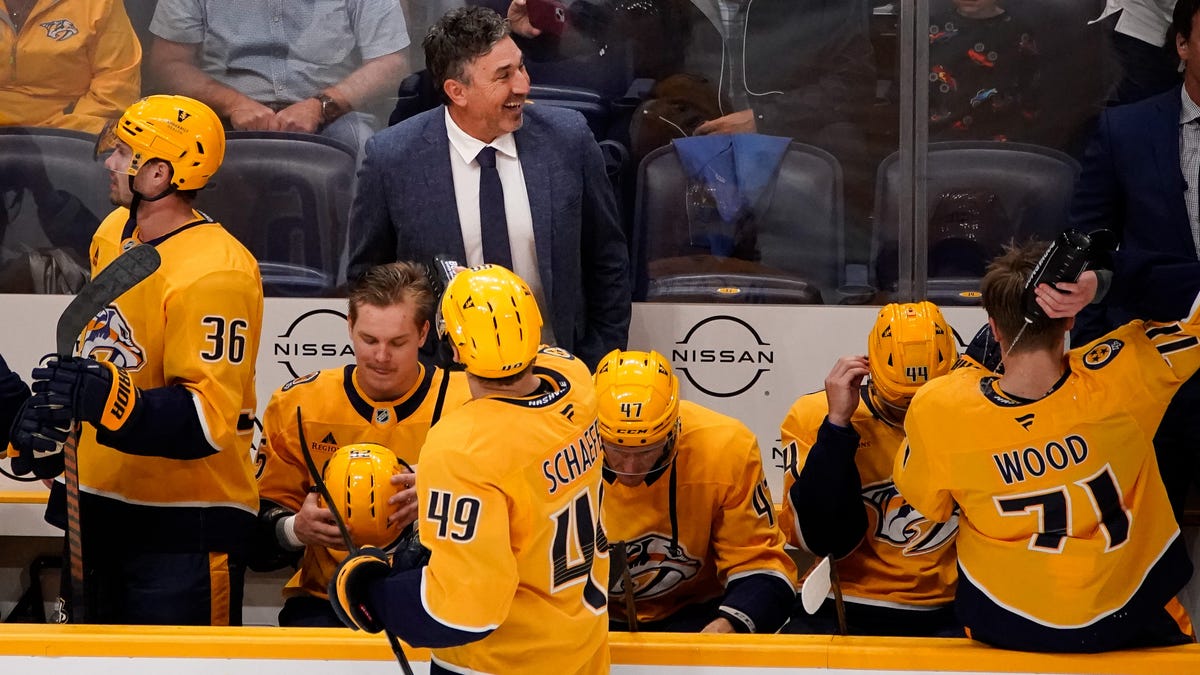
Andrew Brunette knew taking the Nashville Predators coaching job two years ago was risky.
“You know you’re terminal once you take the job,” he said. “The life expectancy of an NHL coach is, what, 2½ years?”
Now, nearly 2½ years after he was hired by general manager Barry Trotz, Brunette enters Year 3 — and he needs a big season to make it to Year 4. Last season, the Predators finished 30-44-8 and were out of the playoff race by early March. It’s a disappointing finish in any season, but especially poor considering that summer’s $100 million spending spree on free agents, including Steven Stamkos.
“Internally, you know you’re not doing well,” Brunette said. “But you try to shut the noise from the outside. We’re not done here.”
As Nashville moves on from a miserable 2024-25 season, he has spent this summer adding to his coaching tool belt, building better relationships with his players and fortifying his belief in himself. In an interview with The Tennessean on Sept. 20, Brunette explained his mindset entering an important season with Nashville.
“Where we’re at, when things are going like they did last year, you have to have an inner belief that you’re still a good coach,” he said.
Andrew Brunette disagrees with Barry Trotz calling him ‘too nice’
In May, when re-committing to Brunette as coach of the Predators, Trotz said he thought Brunette, 52, might be “too nice” in dealing with his players. That was part of Trotz’s summer homework for Brunette: Get a little meaner.
“Sometimes we’re all too nice,” Trotz said on May 5. “But when I don’t have to be a nice guy, I don’t have any problem with that.”
Brunette doesn’t exactly agree with Trotz’s assessment.
“I don’t know (what he meant),” he said. “I guess you’d have to ask him, but I think I’m who I’ve always been. I think there are things that I’m not nice about. I have my standards and what I believe in, but also feel that I’m authentic. I am who I am. And if that’s what he meant by ‘too nice,’ it’s really hard for me to answer that.”
A “nice coach” wants his players to like him above all else. He placates. He avoids tough conversations in order to keep the peace in the locker room. A “not nice coach” doesn’t care if his players like him. He provokes in order to extract greatness. He punishes players when they play poorly.
Brunette believes he’s perfectly capable of being a “not nice” coach — in fact, he thinks he already shows it. He scratches players, decreases ice time, implements punishment practices. But he also believes a coach’s temperament is only part of the equation.
“I think every player is different and you’ve got to treat them differently,” he said. “That’s the heart and the beauty of coaching, that everybody’s different and you have to treat players the best way to get the best out of them.”
For example, last season, Jonathan Marchessault publicly complained about lineup decisions and the team’s offensive tactics. Brunette dealt with that in a way he believed would most reach Marchessault: He responded publicly and in the media, rather than taking away ice time. But he might have acted differently were it another player.
“Some players, you could embarrass them in front of your teammates, and they may respond. But a lot of other players won’t. So you have to find ways to connect with them,” Brunette said.
The bottom line is accountability, something Brunette writes off as a buzzword, tossed around only during losses.
“When you lose and things aren’t going well, everybody wants accountability,” he said. “Nobody talks about accountability when you’re winning.”
Brunette isn’t worried about ‘hot seat’ status with Predators
Outside the Predators’ organization, Brunette’s job has been in question since December. His “hot seat” temperature rose so much that Trotz had to publicly defend his coaching hire at least twice. He tripled-down in May, announcing Brunette would be back for 2025-26.
With his job safe, Brunette focused on how to improve himself during the summer. He took some time away from the rink — an eight-day “no phone” camping trip through the Ontario wilderness was his only real getaway — before preparing for training camp.
But there’s no rest for the weary. The NHL coaching waters are often turbulent. During and after the past season, nine were fired, including former Predators coach Peter Laviolette, let go by the New York Rangers.
When the season opens against the Columbus Blue Jackets on Oct. 9, Brunette will be back on a list of coaches deemed most likely to be fired in-season. Fair or not, Nashville’s circumstances haven’t changed much in six months — and he’s the one who will be held accountable.
For now, Brunette isn’t worried about that.
“I don’t think you can (think about being fired) and do a good job,” he said. “Billie Jean King said pressure is a privilege. I’m in this job because I love it, right? I want to do it. And with it comes a lot of these things and you have to accept it.”
This moment of Brunette’s career is like so many others. He wasn’t the fastest skater or the biggest kid as a youth hockey player. He wasn’t drafted high as a junior player or as a potential NHL prospect. Yet he managed a 16-year career, amassing 733 points in 1,109 games played. He has had plenty of “back against the wall” moments like these, and he overcame the circumstances.
“I’m going to get up and be the best coach I can be today,” Brunette said. “Be the best person I can be today, try to build these relationships, get every player on my team to be better. That’s my mindset.”
Alex Daugherty is the Predators beat writer for The Tennessean. Contact Alex at jdaugherty@gannett.com. Follow Alex on X, the platform formerly called Twitter, @alexdaugherty1. Also check out our Predators exclusive Instagram page @tennessean_preds.