
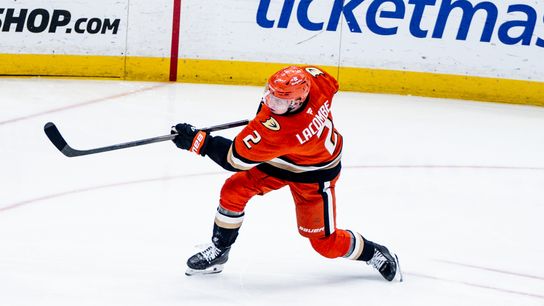
IRVINE, Calif. – In the first answers of both Ducks defenseman Jackson LaCombe’s and general manager Pat Verbeek’s media sessions discussing LaCombe’s team-record eight-year, $72 million contract on Thursday, one shared word stood out: “comfortable.”
Verbeek was comfortable in handing over the richest contract in franchise history to his 24-year-old No. 1 defenseman.
“I think it came together pretty quickly,” Verbeek said of the early deal. “I think what we’re all trying to gauge is the landscape of where salaries and that sort of thing are going. So I feel really comfortable with the contract and the character of Jackson LaCombe. And I still think there’s still lots of upside and growth in his game. I think the best is yet to come from Jackson”
LaCombe was comfortable getting locked up ahead of the season and not having a potential arbitration-eligible restricted free agent summer lingering over his whole year.
“I think for me, I just like to be comfortable,” LaCombe said, “and obviously it’s a great deal and I’m really excited about it, but I’m really happy to get it done and I don’t have to kind of worry about that going into the season, so I’m really happy.”
Aside from the franchise-record price tag–highest overall value and fourth-highest per-season salary behind only Ryan Getzlaf, Corey Perry and Paul Kariya–the most striking thing about LaCombe’s deal is the timing.
After monthslong negotiations with Mason McTavish dragged into training camp, the team locked in its No. 2 center to a six-year, $42 million deal last weekend. It was the third time in Verbeek’s tenure that an Anaheim RFA negotiation drifted into the preseason.
With five players set to be RFAs next summer, including LaCombe, No. 1 center Leo Carlsson and speedy sniper Cutter Gauthier, it was imperative that the Ducks tried to sign some deals before the end of the season. Verbeek had said this preseason that the team was “kicking that around internally,” but no one expected anything so quickly.
“I was going to start to try and work ahead of this stuff,” Verbeek said. “Jackson’s the first domino to fall. We’re working on other stuff as well, so we’ll see what happens. As last week (with McTavish), things can change pretty quickly, so we’ll just keep getting after it.”
LaCombe said seeing the long negotiations with McTavish during this training camp and Trevor Zegras and Jamie Drysdale in 2023 played “a little bit” into pushing for an early deal, but in the end, things just picked up fast and everyone was happy where they were.“I love it here. I love being here. I love playing here,” LaCombe said. “I love all my teammates here too, so for me, it was an easy decision, and I’m just not going to look back. I’m looking forward to it, and I’m really happy.”
The other angle of the timing is LaCombe’s tenure in the league.
Last season was just LaCombe’s second full year in the NHL, but it was a breakout campaign.
Year one saw LaCombe finish as a minus-24 with just over 19 minutes a night. It was an admittedly “tougher” year for LaCombe adjusting to the NHL.
In year two, once LaCombe earned an every-game spot in mid-December, the Minnesota native shot off with the most goals by a Ducks defenseman since 2010-11 and driving a five-point improvement in even-strength shot share and a three-point improvement in even-strength expected goals share for Anaheim with LaCombe on the ice. All of that while leading the team in ice time, posting an even plus/minus and quarterbacking the Ducks’ power play.
It was a quick rise, but enough to earn a spot on Team USA at this summer’s World Championships–where the Americans won their first gold medal in 93 years–earn an invite to Team USA’s Olympic orientation camp and earn this team-record contract.
“I think I noticed the big difference after his first year coming into training camp last year,” Verbeek said. “The growth in him. I saw it. And then his world championships took off, and now he’s on the radar to make the Olympic team. There’s just a lot of positives and then his training camp here, watching him in the games. I mean, he’s just going to be an outstanding defenseman for us.”
LaCombe didn’t focus too much on those Olympic possibilities, choosing instead to focus on the immediate future for himself and a promising Ducks season.
“I think everyone obviously wants to make it, wants to play, wants to compete there,” LaCombe said of Team USA. “So, just give it the best I can and focus on the now. There’s so many good players that can make it. So I think we’re all just going to play our best, and then, whatever happens happens, but I’m just looking forward to getting going with these guys and so I’m really excited.”
That long-term future is in the hands of Verbeek and those other four pending RFAs: Carlsson, Gauthier and young defensemen Pavel Mintyukov and Olen Zellweger.
Does knocking out LaCombe’s deal this early portend any of those getting inked during this season? Not necessarily.
“Well, it’s hard to say,” Verbeek said. “We’ll have some talks, but I’m not sure, at this point, where any of this will go. It might have to wait till after the season and then we’ll try and pick it up from there. So it’s hard to say.”
The hard work remains ahead of the Ducks opening the 2025-26 season one week from today.
Below is a full transcript of the media call with Ducks general manager Pat Verbeek on Saturday (questions and responses edited for clarity):
What did it take to get this done as quickly as it did?
Pretty quickly. I think both sides were looking at long-term deals, so I think it came together pretty quickly. I think what we’re all trying to gauge is the landscape of where salaries and that sort of thing are going. So I feel really comfortable with the contract and the character of Jackson LaCombe. And I still think there’s still lots of upside and growth in his game. I think the best is yet to come from Jackson, so it’s exciting for the organization to get Jackson under contract for a long term.
When we had talked previously, when we were going through the McTavish stuff, you had said that you guys were working on negotiations with other upcoming RFAs.
Like I said, I was going to start to try and work ahead of this stuff. Jackson’s the first domino to fall. We’re working on other stuff as well, so we’ll see what happens. As last week, things can change pretty quickly, so we’ll just keep getting after it.
What gives you the confidence to make LaCombe the first one out of the gate with this?
Well, I’ve been watching Jackson for a long time. I’ve watched all of his college career, and then watched his first year here and then how he really transitioned. And I think I noticed the big difference after his first year coming into training camp last year, the growth in him. I saw it. And then his world championships took off and now he’s on the radar to make the Olympic team. There’s just a lot of positives and then his training camp here, watching him in the games. I mean, he’s just going to be an outstanding defenseman for us.
Compared to negotiations in the past, like McTavish’s, for example, how did these differ?
They’re different circumstances. All the circumstances are different, so every negotiation’s different. You’re dealing with different pressures, different variables. So this one was different. And so it was nice for it to come together quickly.
Why did it make sense to get this done now as opposed to maybe during the season?
When you can try and get stuff knocked off the plate, we knew we were going to try and get some deals done. Jackson’s camp just decided it was a good time to do it, so we agreed. So that’s why we’re here.
You mentioned LaCombe’s camp saying that this was a good time to do it. When we talked to McTavish last week, he kind of said that some of the ball was in his court when it came to signing that. How much of this getting done quickly was from LaCombe’s side of things?
Well, you need two sides to agree on something, and I think the players are viewing what’s going on here. They’re excited and they want to be a part of it. Sometimes, when you get $72 million, it’s a good reason to sign.
How many guys do you put into the category as core pieces? It used to be five people talked about as those core pieces.
No, we consider our core bigger than that. Probably look at seven or eight guys, what I would target as our primary core guys.
Did any of the other deals that went down during the week, whether it was McTavish or Luke Hughes, kind of play into getting this done quick?
No. That didn’t have any bearing on it. We’ve been working on it for a little bit. Things happen when they happen. It’s like I said before, with Mason, things all of a sudden come to a head and get finished.
Is there any anticipation that you’ll be able to get some of these other ones done quicker? Whether it’s Leo (Carlsson) or others.
Well, it’s hard to say. We’ll have some talks, but I’m not sure, at this point, where any of this will go. It might have to wait till after the season and then we’ll try and pick it up from there. So it’s hard to say.
With how tightly compact the schedule is this year, does that make it harder to try to negotiate something during the season than it would in years past?
Not really. I don’t think that really has any bearing on it. The agents are always available and, most of the time, I’m available to talk, and, you know, we can hash things out. So, not really with the schedule. A lot of times, it’s just the preference of whether the player wants to wait till the season’s over to do this and not get distracted by it. Some players, it doesn’t bother them, and they can kind of continue to work through some of this stuff. So, a lot of times, the player’s camp will kind of dictate that, if they want to talk, or if they want to wait.
When it comes to setting those benchmarks for what the rest of the structure is going to be like, do you see that with McTavish? Do you see that with LaCombe as baselines? You look at the forwards right now, McTavish, Terry and Granlund all making the same amount per season. Is that sort of a ceiling you’ve put on those things?
Not really. Like I said, every negotiation is different. Every player, they all have different stats. There’s different variables. So the market sometimes dictates different numbers, too. You have to deal with all of it and you have to deal with it within your team structure. But you also have to deal with outside pressures, too. So there’s a lot that you have to work through to kind of get a deal done.
Are there any trade clauses or anything attached to the LaCombe deal?
Yeah, there’s modified trade clauses in there, the usual.
Leading up to today, how long were you and (LaCombe’s agent) Pat Brisson in discussions for this whole thing?
I really don’t like to talk about that, but it came together pretty quick.