
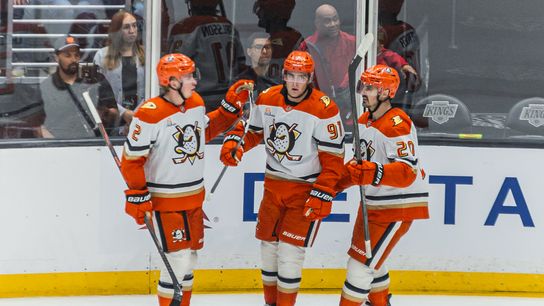
ANAHEIM, Calif. – Throughout the course of training camp, it was second-year winger Cutter Gauthier who provided the most direct assessment on the state of the Anaheim Ducks franchise.
“I feel like we can say we’re out of the rebuild, and we’re here to make the playoffs.”
It was more than the pressure exerted by Ducks owner Henry Samueli in May, when there were still some forward-looking future tenses being used. Although, it was still a fair amount of pushing forward in telling Verbeek, “You don’t have to pinch pennies anymore. Do what it takes to make us a contender.”
Gauthier’s statement wasn’t one of “hoping” or a gesture of “turning the corner.” It was a declaration, and while some of that may be youthful exuberance, it is a sign of a vibe shift in the Anaheim locker room.
After a summer of change, the goal of snapping a franchise-worst seven-season playoff drought is now more tangible than ever, and the Ducks’ time is now.
“Saying it in the past, it’s felt sort of like, ‘oh, well, you know, hopefully, myself included, like some guys can take steps.’” said Troy Terry, who is now the longest-tenured Duck in the winger’s eighth season with the franchise. “It’s less guessing hopefully that it all kind of comes together. It’s a team that I think knows what it’s capable of now, and we’ve added some veteran experience and some big time hockey players. It’s an exciting time. It feels different.”
These are all the moves of a franchise no longer content with simple improvements. These are moves done with the intent to win.
“I think there’s a little bit more pressure on us this year with some of the moves we made this offseason,” Frank Vatrano said. “I think this is their third year for our younger guys getting under their belts. There’s a lot of expectations from them–and I think for them and even me and us older guys–that it’s time to win now. We’re done rebuilding and even if you’re a team that’s not even expected to make the playoffs, you’re not coming into the season expecting not to make it.”
“Anything could happen in this league.”
Now, even with all the moves and all the intent, there is still plenty that needs to go right for this specific “anything” to happen for the Ducks.
Let’s dive in and preview what all of that looks like for the 2025-26 Anaheim Ducks:
COACHING: Joel Quenneville returns to an NHL bench
When the Anaheim Ducks open their season on Thursday in Seattle, it will have been 1,443 days since Joel Quenneville last coached an NHL game as the bench boss of the Florida Panthers on Oct. 27, 2021.
Those Panthers started 7-0-0 before Quenneville stepped down as head coach due to the findings of an independent investigation into alleged sexual abuse by a video coach against a Blackhawks prospect during the Chicago’s run to the 2010 Stanley Cup. Quenneville and other Blackhawks executives were subsequently banned from the NHL before being reinstated in the summer of 2024.
Quenneville went through that list with the media at his introductory press conference, and Verbeek and Samueli both committed to Quenneville and the team continuing that work in the coach’s return. Quenneville reiterated that at the opening of training camp last month.
“It’s been an ongoing process for over four years,” Quenneville said. “I did a lot of work and talked to a lot of people. That’s an everyday thing and I think as a group here, we want to make sure that we’re going to apply these lessons as we go along here, and make sure that on our watch, something like that doesn’t happen again.”
Now Quenneville and the Ducks set their sights forward to on-ice goals and the hockey reasons he was hired.
The top-level statement from Quenneville on what this team’s identity was to be was simply about effort.
“We want to be the hardest-working team in the league,” Quenneville said. “It’s easy to say that, so that’s an everyday thing to prove that that’s what we’re at. So you’ve got to bring it every day, and leave it out there.”
That’s been evident at every single practice from Day One through the preseason. There are few if any moments of standing around for anyone on the ice. Fast-paced, up-tempo and constant movement in a shorter than usual NHL practice.
“Joel’s borderline out of breath out there because he’s just constant energy, pushing the pace of the practice,” Terry said early in camp. “It’s just been go, go, go. Just trying to get all those habits back in part of our DNA again.”
Along with Quenneville, a new set of assistant coaches were hired namely Jay Woodcroft and Ryan McGill to overhaul the Ducks special teams. Former Edmonton head coach Woodcroft was part of the head coaching search and did enough to get a whack at revamping the Ducks moribund power play unit, and McGill, a former assistant with Vegas and New Jersey, is deemed a penalty kill whiz.
The practices and coaching have created a new energy around the Ducks locker room that has spread from the top down.
“The energy around the building, the optimism,” Kreider said, “that makes it that much easier and that lifts everyone up and you’re going to have good competitive up-tempo practices when guys are excited to be here, excited to work, excited to get better.”
LINE-UP: Projected Opening Night Lines
Chris Kreider-Leo Carlsson-Troy Terry
Cutter Gauthier-Mason McTavish-Mikael Granlund
Frank Vatrano-Ryan Strome-Alex Killorn
Ross Johnston-Ryan Poehling-Beckett Sennecke
Scratches: Sam Colangelo, Nikita Nesterenko
Jackson LaCombe-Radko Gudas
Olen Zellweger-Jacob Trouba
Pavel Mintyukov-Drew Helleson
FORWARDS: Impact Veterans, Expected Youth Growth
The stated top priority of the offseason for Verbeek and the Ducks’ front office was acquiring scoring.
Anaheim’s offense was simply in no shape or form good enough over the course of last season. Despite some late season improvement, the Ducks finished 30th in actual goals per game and 21st in expected even-strength goals per game.
To address that, the Ducks’ most notable acquisitions came in their top six forwards, in trading for Kreider and signing Granlund. Two very different players–in size (Kreider at 6-foot-3, 232 pounds and Granlund at 5-foot-10, 193 pounds) and skill set–come to Orange County in Verbeek’s quest for a more cohesive and balanced forward corps.
“Production,” Verbeek said of what these new Ducks forwards bring. “If you look at all their production, I think Kreider’s last year was, well, probably an anomaly for me in the sense that he had a tough season. I think every player you’re going to look at through their history, they come across a tough season. The one thing about change, and players being excited, it’s fresh. I’m expecting a big bounce back season. He’s going to be able to give us things that we haven’t had.”
Kreider’s 22 goals in a drama-filled and injury-plagued season for the Rangers last season was a recent low following 52 goals four seasons ago and back-to-back 36-plus-goal campaigns. However, it would have tied for the Ducks’ team lead with McTavish.
Granlund also netted 22 goals with San Jose and Dallas last season, and his 66 points bested Terry’s team-high 55 points.
However, neither one should be on top of the Ducks ledger this season. That’s not to say they won’t provide impact. As Verbeek said himself, he expects they will, but they should augment and compliment the Ducks’ young corps.
Anaheim was the only team in the NHL to have three 20-goal scorers aged 22 or younger in McTavish (22 goals), Carlsson (20) and Gauthier (20), and each one of those players are expected to improve.
Anaheim actually had five 20-goal scorers last season for just the second time in franchise history, with the first being the 2006-07 Stanley Cup championship season. The Ducks were also just one of seven teams without a 30-goal scorer last season.
Carlsson will drive the top line, and to start the season, he’ll be flanked by Kreider and Terry. After a 45-point sophomore campaign, it’s not unreasonable to look for a 60-point campaign at minimum from the young Swede, who will likely head to the Olympics in February and is a restricted free agent next offseason.
McTavish and Gauthier pair back up after both seemingly sparked each other last season halfway through the year, and they’ll be joined by the speed and skill of Granlund. Again, simply more is expected from McTavish and Gauthier as they grab hold of their mantles in this organization, especially with McTavish signing a long-term deal and Gauthier playing for a pay day next summer.
There’s plenty of veteran know-how in the bottom-six, with the self-dubbed “Pension Line” of Vatrano, Strome and Killorn. The fourth line will have plenty of build options with speedy, gritty center Poehling, veteran physical presence Johnston and young, productive faces in Colangelo and Nesterenko.
The “wild card,” as Quenneville described him, is top prospect Beckett Sennecke, who sticks with the Ducks out of training camp. He will get his regular shifts on the fourth line, but with his top-end offensive ability, he will be deployed in special situations like some power-play reps or the extra attacker when the goalie is pulled.
Sennecke came in a bit raw at the start of rookie camp, but the 19-year-old has progressed throughout the preseason. However, it remains to be seen what his full usage will be.
Sennecke can play nine NHL games without burning the first year off his entry level contract, but at 19 years old and with only three Canadian junior seasons under his belt, his only playing options this season are in Anaheim or back in junior hockey. He is not eligible for an AHL assignment, aside from a loophole for a two-week conditioning stint.
DEFENSE / GOALIE: Improvement Necessary in Front of Franchise Rock
In their own zone, the only place to start for the Ducks is in net, where Dostál enters the season as the unquestioned No. 1 goaltender following the trade of John Gibson to Detroit and a five-year contract.
If not for Dostál’s at times elite net play, the Ducks would have been in much bigger holes much more frequently last season.
At five-on-five, Anaheim was 29th in expected goals against, and Dostál and Gibson combined for the third-most goals saved above expected in the NHL. Dostál led the league with five 40-save performances.
Now, Dostál will carry the majority of the load. The 25-year-old already started that transition last season and said he enjoyed the workload.
What did he work on in the offseason?
“Obviously, stopping more pucks,” Dostál said with a sly smile.
In front of Dostál, the Ducks will work on spending less time in the defensive zone and allowing fewer pucks towards Dostál in the first place.
Anaheim will run back the same six defensemen to open this season as it played the majority of the second half last season, and yes, that is the same defensive corps that allowed the previously mentioned numbers.
However, the biggest change in all of the X’s and O’s under Quenneville is the defensive philosophy, as the Ducks shift from Greg Cronin’s man-to-man defense to a zone scheme. It’s a welcome change for Dostál.
“I personally like it because it’s more, for the goalies, I believe it’s more predictable,” Dostál said. “You kind of know all sides of a team that you’re giving up, because nothing is always 100%… We played it on the Czech national team, when I was growing up, even when in Finland. We always played it in Europe, so that’s something I’m used to.”
The focus will be creating two-on-one pressure situations on the boards to force turnovers and spend less time in the defensive zone. The system also allows the team to block more shots and absorb pressure.
“We can kind of break up pucks faster,” LaCombe said, “getting two guys down low and double-teaming more and kind of taking away their space. It makes it a lot easier for us to even jump in the play and kind of get up the ice, which is what I like to do. I think it’s going to help all of us just kind of get the puck back faster and play in their zone.”
LaCombe forcibly grabbed the mantle of the No. 1 defenseman role in December of last season and never looked back, leading the team in minutes and scoring the most goals by a Ducks defenseman since 2011. All of that earned his team-record contract extension last week.
As LaCombe said, the key for Anaheim will be ending those defensive plays early and encouraging the left side of the Ducks defense to use its dynamic skill set to the fullest.
LaCombe, Zellweger and Mintyukov are all at their best when they’re able to play freely and jump up into the play. Zellweger and Mintyukov are both in contract years entering RFA status next summer.
The top two pairs will be anchored by veterans in captain Gudas and Trouba. Anaheim’s defensive efforts may hinge on whichever definition of “anchored” those two fall into.
Gudas and Trouba can be steady physical presences that allow their partners to play that forward and free style. However, they are both a year older (Gudas at 35, and Trouba at 31), and Gudas is coming off a summer of rehabbing a knee injury.
Gudas and Trouba are both in the final year of their deals.
The Ducks are also overflowing with young defensive talent in the system. Tristan Luneau and Ian Moore both looked NHL-ready in training camp, particularly Luneau after a breakout AHL campaign, but the right-handers have a blocked path forward currently by Gudas, Trouba and Helleson, who established himself at the NHL level last season. Tyson Hinds also had a very strong preseason push.
SPECIAL TEAMS: Work in Progress
As previously mentioned, the task of new assistant coaches Woodcroft and McGill, aside from their respective forwards and defensemen duties, is to revamp the Ducks’ special teams.
The special team units were a specific point of pain that Verbeek mentioned throughout the offseason in diagnosing last season’s struggles, looking for ways to put together points this season and acquiring talent.
Anaheim was dead last in power play percentage at 11.8% last season, which was tied for the third-worst power-play mark of the salary cap era. It has no bearing on this group, but the worst power play of that era also hits close to home with the 2020-21 Ducks’ 8.9% in a 59-game season.
Woodcroft’s power play expertise in Edmonton and as a San Jose assistant was obviously with a much different level of player that Anaheim has. (Connor McDavid and Leon Draisaitl aren’t suiting up in Ducks orange anytime soon.) However, the bar for the Ducks is simply not to be a bottom-five extra-man unit. League average would be potentially trajectory-altering.
Anaheim has had a bottom-three power play in two of the last three seasons and are second-to-last in the league over the last five seasons combined.
Preseason isn’t the best gauge of the power play with the amount of different combinations and skill levels throughout on either side of the puck. The real work in what can be a game-altering area begins this week.
“That’ll be a work in progress through 82 games coming up,” Quenneville said after the preseason finale on Saturday. “I assure you that. That’s always something that you’re gonna be talking about, whether it’s a revamp and technically putting different things involved with movement, personnel.”
The Ducks penalty kill hasn’t been much better at 29th in the league last season and last in the NHL over the previous three seasons.
As with the five-on-five zone defense, the key will be making things easier for Dostál to allow the Ducks best penalty-killer to shine.
McGill takes charge of the man-down unit after guiding New Jersey to the second-best kill in the league last season after the Devils were 10th and fourth in the prior two seasons.
“If we get anywhere close to (McGill’s previous success), I’ll be ecstatic,” Verbeek said in July. “We really focused on quality coaching. I feel very fortunate that we got the guys that we got. Mixed in with Joel, I think we’ve got an outstanding staff.”
OUTLOOK: Can the Ducks Break the Playoff Drought?
This is what everyone’s here for, right?
With all the pieces laid out–the players added, the coaches changed, the continued youth growth–have the Anaheim Ducks done enough to make the leap out of the rebuild and reach the playoffs for the first time since 2018?
The only answer available is not quite as declarative as Cutter Gauthier’s opening salvo: Maybe.
Most statistical models have the Ducks missing the playoffs for an eighth consecutive season, with some even projecting a lower points total than last season. However, the computer models simply cannot accurately take into account all the variables that would portend success for the Ducks.
There is no number available to quantify how many goals or standings points going from Greg Cronin to Joel Quenneville is actually worth. They can’t account for how big of a leap Leo Carlsson, Cutter Gauthier or Mason McTavish could take. They can’t assume that the power play will click into place, Chris Kreider has a bounce-back season or that Lukáš Dostál plays to the heights of last season.
All these models can only project using past data.
But even assuming all of these things go right for Anaheim and that everything locks into place, it will be a tough leap to make to get the Ducks into the playoffs.
The Western Conference is extremely deep. Beyond the top end teams like Colorado, Dallas, Winnipeg, Vegas and Edmonton, there are a slew of competitive teams for the other spots.
Minnesota, Los Angeles, St. Louis, Utah, Vancouver and Calgary all have legitimate arguments that they’ll either stand pat above Anaheim or leapfrog the competition. There’s even some models with Nashville and Seattle moving into that mix.
Barring disastrous falls from grace or injuries, one could project just one playoff team falling out from last seasons’ crop, which would leave anywhere from five to seven hopefuls for a single spot.
Can the Ducks do it? Based on the vibes and belief emanating from this training camp, they sure could, but it will take the work ethic Quenneville has attempted to establish and much more.
“Everyone right now going through their first day training camp is thinking they have a great chance to win a Stanley Cup, right?” Kreider said on Sept. 18. “It’s a long, long road ahead. Everyone’s optimistic, everyone’s excited. Gotta work. Every single day.”
The work begins in full on Thursday in Seattle, Saturday in San Jose and next Tuesday at Honda Center against Pittsburgh.