
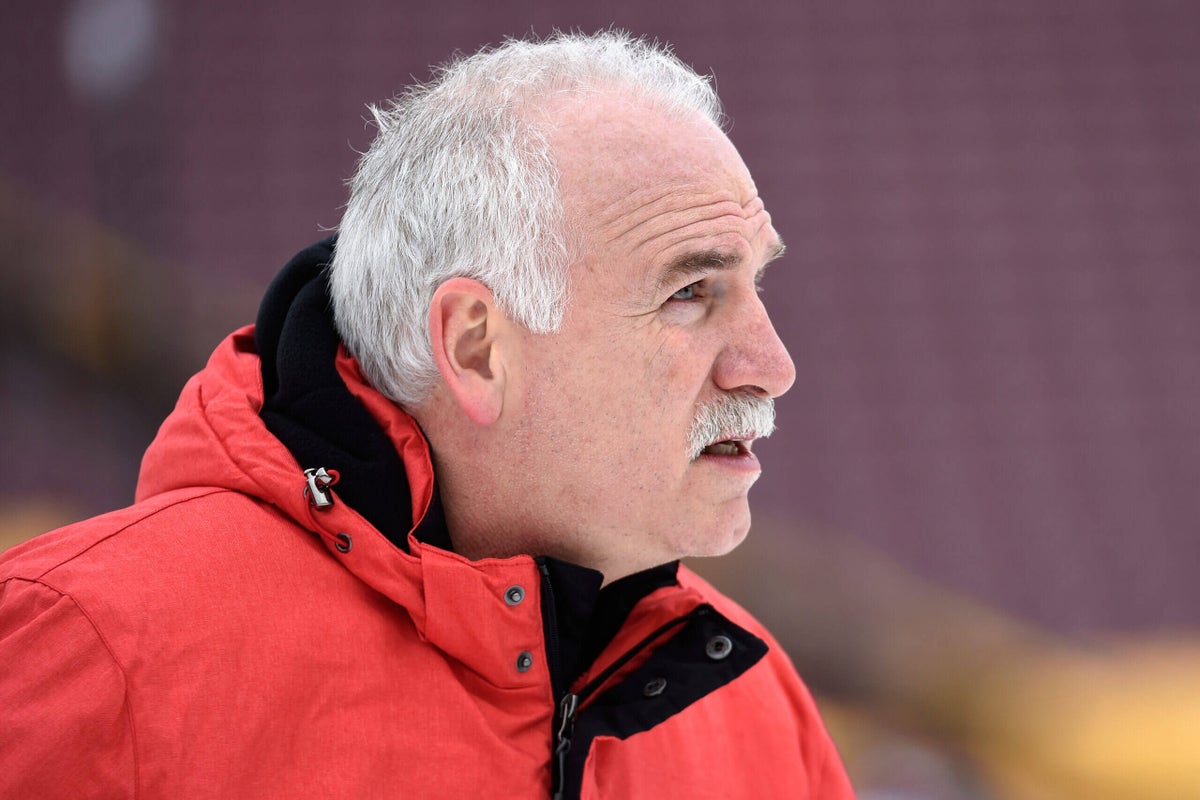
For a man who’s never been all that loquacious, who looks at a microphone the way he looks at a forward who’s disinterested in playing defense, Joel Quenneville was doing pretty well.
After more than two years of behind-the-scenes work to put himself back in the NHL’s good graces, the first public stop on Quenneville’s image-rehab/redemption tour was the Cam and Strick Podcast, a friendly but pointed interview this week with St. Louis Blues rinkside reporter Andy Strickland. And for the first time, Quenneville took some ownership of the Chicago Blackhawks’ systemic failure to protect Kyle Beach in 2010. He continued to insist he didn’t know the sexual nature of Beach’s allegations against video coach Brad Aldrich, repeatedly pleading ignorance, as he has from the moment Beach’s lawsuit surfaced in May 2021. But Quenneville should have asked more questions, he said. He should have pursued the matter further, he said. He shouldn’t have just assumed team president John McDonough and the brass would properly handle the matter, he said.
Then toward the end of the 45-minute interview, Quenneville blew a tire.
“I had a miss in 2010 and I own it,” he said. “At the same time, I believe there’s a place for me in the game.”
A miss. A miss. A miss is having too many men on the ice. A miss is making the wrong matchup decision in a playoff game. This was far more than a mere miss.
And so here is Quenneville, the second-winningest coach in NHL history. He admits he did wrong, but he also clearly still feels wronged. He’s put in long hours educating himself on workplace culture and power dynamics and he said he’s spoken with Beach, but he also still sometimes uses the careless, callous words of someone who hasn’t learned.
Quenneville wants a second chance. He wants to chase 1,000 wins and Scotty Bowman. And it’s left for NHL commissioner Gary Bettman — and the hockey world — to figure out how much he’s really changed, and to work out for themselves how much he really deserves reinstatement. What wins the internal debate? Emotion? Empathy? Or mere resignation?
The emotional response, the instinctive response that surges from deep down in my gut, is simply disgust.
That the NHL would consider allowing Quenneville to coach again, that an NHL team would want Quenneville to coach again — to lead the young men in its charge, to be the franchise’s voice and face and spine and character — after everything we know, everything we learned, and everything we still wonder, is stomach-churning.
Shall we recap?
Back in May 2010, during the Blackhawks’ Western Conference final sweep of the San Jose Sharks, Beach — a prospect and Black Ace — told Blackhawks skill coach Paul Vincent that Aldrich had sexually assaulted him. Vincent reported it to mental skills coach Jim Gary, who took it up the organizational chain. According to law firm Jenner & Block’s investigation into the incident, commissioned 11 years later by the Blackhawks, team management held a meeting shortly after Game 4 of the conference final at the United Center that included Gary, McDonough, general manager Stan Bowman, executives Al MacIsaac and Jay Blunk, and assistant GM Kevin Cheveldayoff.
Quenneville was then summoned to join the meeting. Gary told investigators Quenneville “appeared angry and was concerned about upsetting team chemistry.” Bowman told investigators Quenneville “shook his head and said that it was hard for the team to get where they were, and they could not deal with this issue now.”
This is the man who wants back in the league. A man who would not protect one of his players from a possible sexual predator on his staff because firing Aldrich — the guy who cuts clips for special-teams meetings — would have been too disruptive. A month later, Quenneville penned a glowing job evaluation for Aldrich, according to the report, and congratulated him on winning the Stanley Cup. Aldrich even got his day with the Cup.
Three years later, Aldrich was convicted of criminal sexual conduct with a minor in Michigan.
Nobody in that room in the Blackhawks’ offices after Game 4 did the right thing. Nobody. Nobody had the guts — the basic decency — to say “this is wrong.” Nobody went to the police, or to the press, or to human resources. Nobody. And so my gut reaction, that emotional response, is crystal clear: None of them should work in the NHL ever again.
Yet, Cheveldayoff is the GM of the Winnipeg Jets. Bowman had been linked to various GM openings last offseason and is pursuing his own reinstatement. And Quenneville hinted to Strickland there’s been interest from teams over the last couple of years.
His fate is entirely up to one man: Bettman.
“I still have to make a judgment as to when or whether it’s appropriate for them to be reinstated,” Bettman said in the fall. “It’s something I’m going to have to focus on more, and at some point, make a decision on.”
On Thursday, NHL deputy commissioner Bill Daly told The Athletic, “There has been no change in Joel’s status to this point in time.”
Perhaps the best thing, the thing that would send a real message, would be for Bettman to reinstate Quenneville and then for all 32 teams to take a pass, to never hire him. Not now, not ever. It’s a pipedream, of course. Winning trumps everything in hockey. It did in 2010. It will again in 2024 or 2025 or whenever.
Meanwhile, Beach, the No. 11 pick in the 2008 draft, was saddled with so-called “character issues” and never played an NHL game. He spent most of his pro career in Europe.
NHL justice at its worst.
Now, the empathetic response, once the initial fury dies down, is to give Quenneville some modicum of credit, and to allow for the possibility he might deserve a second chance.
Quietly, without public fanfare, Quenneville has been putting in the work over the past two-plus years. League sources told The Athletic that Quenneville has spoken at length with some of the more prominent forces for good in the hockey world — for hours, multiple times, unscheduled and unprompted, openly and earnestly — about what he did wrong, why it was wrong, and how he should and must handle a similar situation in the future. He’s said to have learned about the inherent power dynamics between a coach and a player that transcend size and strength. He’s said to have discussed ways he can foster a locker-room environment that’s more welcoming and less prone to the kind of homophobic bullying Beach said he was subjected to over his next three years with the Blackhawks organization.
Quenneville told Strickland he’s spent time with Sheldon Kennedy and his Respect Group, and inclusion activist Brock McGillis, among others.
So maybe Quenneville has changed. Maybe he’s evolved. Maybe he can be more than just an example of what not to do — a reminder of what failing to protect your players can mean to your career. Maybe he can be an example of how to be a part of the solution — a reminder that good intentions and good-faith effort can salvage your career.
Maybe we should give him a chance to prove all that. After all, isn’t this what we want as a sport and as a society? For people to accept responsibility for their actions, address their personal failings and come out better people on the other side? Don’t we want to incentivize genuine self-reflection and self-improvement? A lifetime ban doesn’t do that. A lifetime ban only engenders bitterness and entrenchment.
Maybe Quenneville has opened his mind and his heart. Maybe we should open ours, too.
Finally, the cynical response, after that moment of humanity passes like a drifting fog, is to wave it away like unwanted smoke.
We haven’t heard any of that accountability until just this week. Not publicly, at least. Quenneville said in the summer of 2021 that he was never aware of the allegations against Aldrich until Beach’s lawsuit surfaced earlier that year. He said it again even after the Jenner & Block report put him in that room, and he said it again this week on the podcast.
“First time I heard anything about sexual assault, sexual abuse, (was) on my way to the commissioner’s office (two years ago),” Quenneville told Strickland. “… I blame myself, that meeting, that I didn’t push the envelope to find out the level of seriousness. I wasn’t informed what had took place.”
He had little to tell the investigators. He hadn’t spoken publicly since he resigned as coach of the Florida Panthers two days after the report’s release in 2021, other than a prepared statement in a news release that expressed “deep regret and contrition.”
This is a 65-year-old man who’s been a part of the insular and often archaic hockey world for nearly his entire life, including more than 40 years in the professional ranks. It’s a sport with a deeply broken culture, where hazing and sexual assaults and homophobia are all too common, all too often ignored.
The cynic in me says men like Quenneville don’t change. That all of this is for show, performative penance, a means to an end, a way to give Bettman enough cover to approve his reinstatement. That Quenneville is one of the most successful coaches in league history, and on-ice success is the only thing that matters.
It was true in that United Center office on May 23, 2010, and it’s true today.
There are countless other coaches — experienced retreads and inexperienced up-and-comers, safe hires and daring choices — available. But someone will want Quenneville, even with all the baggage and bad PR that comes with him. Just like the Western Hockey League’s Lethbridge Hurricanes wanted Bill Peters, who resigned as coach of the Flames after former NHL player Akim Aliu alleged Peters directed racist comments toward him in an AHL dressing room.
That’s hockey. Nothing ever changes. Nothing ever will. Right?
Maybe. Maybe cynicism is the only sane way to approach anything anymore. Cynicism is familiar, comfortable even. And so, just like every other time the NHL lets us down, we sigh a deep sigh, we shake our heads, we shrug in resignation and disappointment and then we move on, too in love with the game to truly abandon the league that runs it.
Like it or not, agree with it or not, believe he deserves a second chance or not, Quenneville is probably on his way back. And deep down, we always knew he would be. Because that’s hockey.
(Photo of Joel Quenneville: Hannah Foslien / Getty Images)