


Detroit Red Wings: A legacy on ice
Tracing the journey of the Detroit Red Wings from their founding in 1926 to their status as one of the NHL’s most decorated teams, this video covers the team’s storied history, legendary players, iconic moments, and enduring impact on the city of Detroit and the world of hockey.
A jury ruled against former Red Wings Zamboni driver Al Sobotka in his age discrimination lawsuit.Sobotka was fired at age 69 for urinating in an ice drain, which he attributed to a prostate issue.Jurors who voted against Sobotka felt there was not enough evidence to prove he was fired solely due to his age.Two dissenting jurors believed Sobotka was a victim of age discrimination and that the company’s investigation was poorly handled.
In the end, fired Red Wings Zamboni driver Al Sobotka was unable to convince a mostly younger jury that he was wrongfully axed for urinating in an ice drain at work due to a prostate issue, and that the company really wanted him out because of his age.
But the 72-year-old former fan favorite did convince them of this:
“We did agree that something was a little fishy,” Juror No. 3 said after the verdict came down, in an exclusive interview with the Detroit Free Press. “However, we just didn’t hear enough that it was based off a decision that it was his age alone.”
Juror No. 3 is 22-year-old Kameron Buettner, of New Boston, a Red Wings fan and painter for a small home improvement company who was among five of the seven jurors who ruled against Sobotka following a four-day civil trial that ended Tuesday, Oct. 14 in Wayne County Circuit Court.
It took the jury less than an hour of deliberations to reach a verdict in a legal drama that has dragged on for more than three years.
The jury voted 5-2 in favor of Olympia Entertainment, part of Ilitch Holdings, Inc., that owns the Red Wings and Detroit Tigers. Olympia spent years trying to get the lawsuit dismissed, but the courts consistently ruled against the billion-dollar entertainment empire, concluding a jury should hear the case. In a civil trial, the jury does not have to be unanimous.
More: Ex-Red Wings Zamboni driver Al Sobotka begged Chris Ilitch for second chance after firing
Sobotka’s wife: ‘They screwed him a second time’
When it was all over, the verdict stunned and devastated Sobotka and outraged his wife.
“They screwed him a second time,” a visibly irritated Sandy Sobotka vented as she left the courtroom.
Sobotka, who wore a red tie and a pin on his suit that read “Mr. I” — for the late team owner Mike Ilitch — appeared lost and disillusioned, saying: “I’m shocked and disappointed. … I didn’t make that stuff up.”
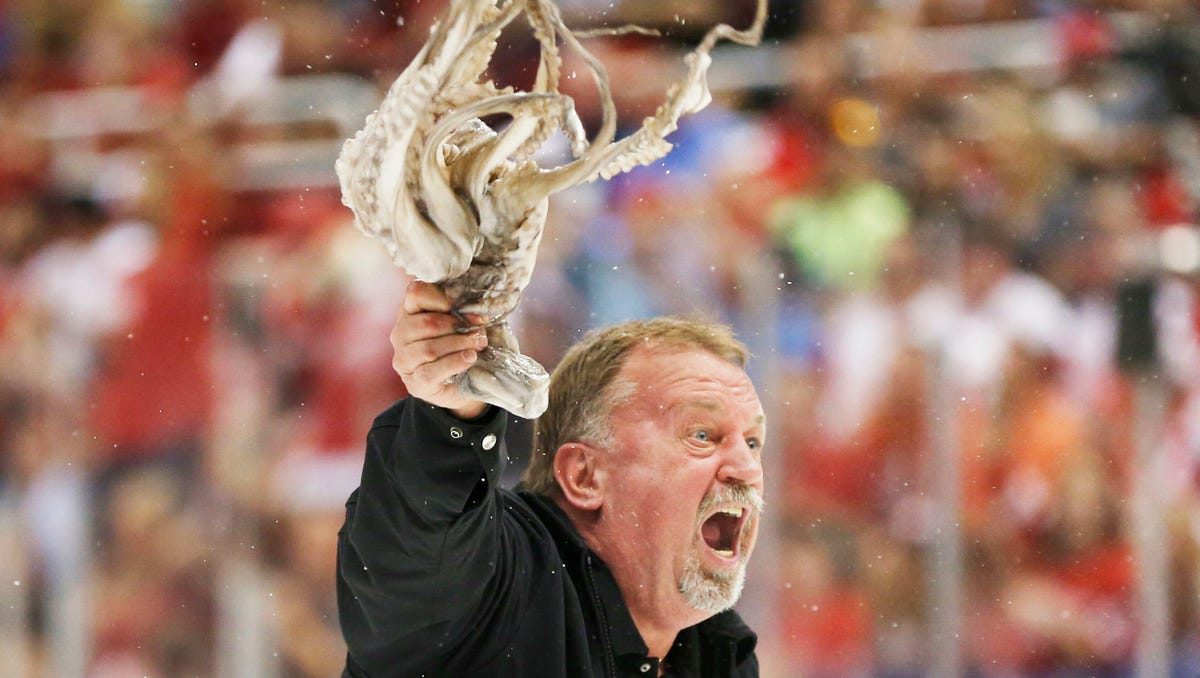
In an interview after the trial, three jurors explained how they came to their conclusions about the 2022 firing of Detroit’s beloved Zamboni driver who wowed fans for decades with his octopus twirling and hurling game rituals. The Free Press spoke to one juror who voted against Sobotka, and two who voted in his favor: A woman and a man who both said they believed Sobotka was discriminated against because of his age, denied a proper investigation, and was treated unfairly given his 50 years working with the Red Wings.
Juror: ‘We had sympathy for him’ — but peeing in the workplace is wrong
After closing arguments, the jury took a quick vote in the deliberation room. It was 5-2, favoring Olympia Entertainment. Jurors spent the next 50-some minutes giving their input, without arguing, but the vote never changed. The jury foreperson who oversaw deliberations was a 32-year-old Victoria Secret sales associate and cashier and community college student.
“Everyone had input,” said Buettner, the 22-year-old juror who explained why he couldn’t be swayed to change his vote.
As bad as he felt for Sobotka, Buettner said, he didn’t see enough proof that he was fired because of his age. He said there was one age comment that came out during trial — that a supervisor allegedly told Sobotka during a meeting that he was “getting old” just days before the peeing incident.
But that supervisor testified that he didn’t remember anything about that meeting, and that it was “not in his character” to say something like that.
Sobotka’s lawyer, Deborah Gordon, protested, telling jurors: “He never denied it.” Her contention is that the Red Wings wanted to get rid of Sobotka because of his age — he was fired at 68 — and used the peeing debacle as an excuse. She told jurors there was a cover-up by the higher-ups, and that they gave contradictory statements regarding who ordered the firing, and how the decision was made.
Buettner, though, wasn’t convinced the company acted unlawfully.
“It was a ‘He said, he said’ situation,” Buettner said, adding that “if only we had one more person” who backed up the age comment, his verdict may have been different. He also said that Sobotka’s claim that others also peed in the drain didn’t carry much weight because he couldn’t name those other individuals, except for the late Mike Ilitch.
During trial, Sobotka testified that Ilitch also once peed in a drain at Joe Louis Arena, hoping to show that men sometimes pee in places that aren’t a restroom, and that it’s a common occurrence among men, especially in sports.
Buettner said he didn’t doubt Sobotka, but noted that Ilitch was not alive to back up the story. And either way, he said, he views Sobotka’s behavior as unacceptable.
“There’s not a single person in here who would not feel bad for him. We had sympathy for him. But we had to base our decision on the facts of the case,” Buettner said, stressing: “What stood out most — he admitted to doing it. He admitted to urinating in the workforce. And obviously, that’s not acceptable anywhere you go.”
According to trial testimony, Sobotka did not urinate in an open public area, but in the Zamboni room during a morning shift, and where the public did not have access. The only person who witnessed the incident was an ice rink employee who said that, through the door, he saw “a stream” going into the ice drain, then reported Sobotka to human resources.
Sobotka, who had worked for the Red Wings for 50 seasons, was walked out that day, then formally fired two weeks later.
Juror: ‘There are some things that don’t deserve a warning’
Among Sobotka’s key arguments at trial was that his punishment was extreme, and that the higher-ups could have given him a warning or disciplined him instead, considering his decades of loyalty and hard work.
That argument seemed to at least partially resonate with the judge who oversaw the trial: In previously refusing to dismiss the case, Wayne County Circuit Court Judge Susan Hubbard concluded that a jury should hear Sobotka’s case “given the severity of the discipline.”
In hindsight, Sobotka’s lawyer, Gordon, said she believes age played a role in the verdict.
“We were absolutely shocked,” Gordon said of the verdict. “I believe that this jury did not have the life experience or the ability to completely grasp the significance of what happened.”
Perhaps most problematic for Gordon, she said, was that Olympia Entertainment never explained how Sobotka peeing in a drain harmed the company. Moreover, she noted, several executives and HR personnel conceded that there was no harm to the company or the public; and that one executive also admitted at trial that had he warned Sobotka, that would have rectified the situation, and that he believed Sobotka would never do it again.
The jury, though, wasn’t convinced that the firing was wrong.
“There are some things that don’t deserve a warning,” Buettner said, later adding:
“It’s nothing personal. All seven of us said we feel for Al. It’s not a testament of his character. It’s just he made a mistake. He admitted to it. It’s misconduct … the company said it’s a terminal offense. We agree.”
Dissenting juror: ‘It seems kind of sketchy on the corporate side’
Juror No. 5, an unemployed factory worker who declined to give her name, said she would have given Sobotka $3 million in damages — half of what his lawyer had requested.
The Detroit woman said she believed Sobotka was discriminated against because of his age, and that the company wasn’t forthcoming about how it handled the situation.
“It seems kind of sketchy on the corporate side,” the juror said of Olympia Entertainment’s handling of the incident.
Juror No. 2, 29-year-old Adam Tillery, who works as an analyst for the city of Detroit, said he also had reservations about the company’s handling of the case.
“The investigation was poorly done,” Tiller said. “They had no written statements, which seemed suspicious.”
Tillery noted that he has been involved in HR investigations as a witness in prior workplace discrimination disputes. Based on those experiences, he said, Olympia’s probe lacked proper protocols.
“There were no memos, no follow-up (with Sobotka),” said Tillery, stressing a case of this magnitude should have had “a paper trail” within the company. But there was none, Tillery said, adding “it was hard for me to rule out” that discrimination “wasn’t in play at all” in Sobotka’s firing.
“My gut feeling was yes, it played a role,” Tillery said.
Juror: ‘I got tired of hearing’ company say ‘he took his penis out’
Tillery said the lawyers for Olympia Entertainment also exhausted him with their portrayal of the urinating incident.
“They kept saying, ‘he took his penis out.’ I got tired of hearing it,” said Tillery.
Michael Mitchell, Olympia’s lead counsel, repeated the “penis” claim during his closing arguments, telling jurors: “He pulled his penis out to urinate. It’s that simple.”
According to trial testimony, no one ever saw Sobotka’s penis.
Mitchell, meanwhile, stressed to the jury that it had only one question to answer: Did age discrimination occur in the firing of Sobotka?”There is no evidence at all showing any kind of age discrimination,” Mitchell told the jury, maintaining this is a case about bad behavior, and a company having the right to get rid of employees who misbehave.”Use your common sense,” Mitchell told the jury. “Did we plan for Al to go into the Zamboni room and pee?”
After the verdict came down, Mitchell praised the jury for its decision, and seeing through what he described as “completely irrelevant” evidence.
“What it boiled down to was the jury saw that the conduct Mr. Sobotka engaged in was inappropriate in the workplace,” said Mitchell, who accused Sobotka’s legal team of “trying to inflame the jury” with irrelevant arguments.
“All of the excuses that he and his counsel made really didn’t carry any weight,” said Mitchell, stressing this case boiled down to one question: Was age discrimination involved in Sobotka’s firing?
“They appropriately found that it was not,” Mitchell said of the jury.
Juror: There’s still time for Olympia to do right by Sobotka
Tillery moved to Detroit from North Carolina in 2021. He doesn’t follow hockey, and said he had no idea who Sobotka was until he landed on the jury — even though a colleague had gifted him a purple plush octopus as a Secret Santa gift when he first arrived in Detroit.
It was Al the Octopus, the Red Wings mascot stuffed animal named after Sobotka.
“I never thought anything of it. Then the case is going on, and I thought, ‘Is this the Al?’“ said Tillery, noting he quickly put it together during opening statements.
Given what he eventually learned about Sobotka during the trial, Tillery said, he believes Olympia Entertainment owes him something, like a percentage of sales from Al the Octopus plushies or other memorabilia with his name on it.
“I think the company still has the opportunity to do right by Al, as a person,” Tillery said. “C’mon, it’s Al the Octopus, 50 years of service … that’s a long time to be with the company.”
Tillery and Juror No. 5 — the other dissenting juror — also scoffed at the $19,000 severance that Olympia Entertainment offered Sobotka after firing him — which was revealed during the trial — noting the company also wanted him to sign a nondisclosure agreement, promising not to say anything bad about the company or speak of the peeing incident again.
“For him to have 50 years with the company, the notoriety (of this case) and for 19 grand to be the starting point?” said Tillery, adding the figure should have been a lot higher. “I’m thinking the octopus is named after the guy. His merit and his character should have been considered, especially if they wanted him to sign an NDA.”
Sobotka declined the offer, and refused to sign the NDA.
As he previously told the Free Press, this was about his character, his decadeslong career with a team he loved, and an organization he dedicated nearly his entire life to.
“I was always loyal to them. … Anything I was ever asked to do, I did it — and more,” Sobotka said. “You try to say, ‘Let it go. Let it go.’ But it just keeps coming back.”
Contact Tresa Baldas: tbaldas@freepress.com