
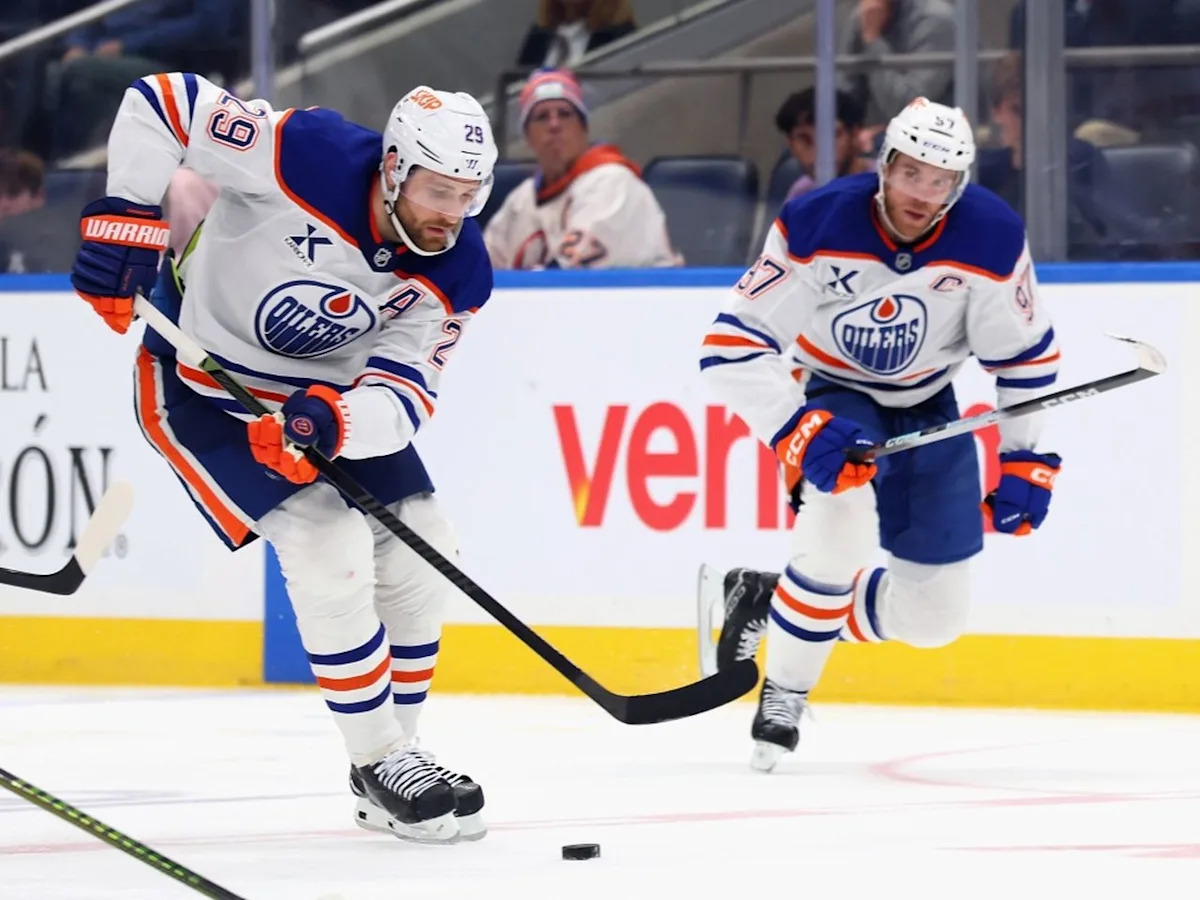
When you’re Connor McDavid and Leon Draisaitl, you tend to have a lot more say in how you are used in a game, as well as how often.
Five-on-five, whether it’s together or apart. Power play, that’s a no-brainer. Penalty kill.
Wait. Penalty kill?
Isn’t that reserved for the defensive-minded troops? Why would the offensive elite decide to get their hands dirty on a unit specializing in how to keep pucks out of nets?
Well, when you’re the Edmonton Oilers and you have had to watch your penalty kill go from tops in the league two playoffs ago, to bottom three in last year’s repeat run to the Stanley Cup final, you want to start looking for answers.
Sure, desperate times call for desperate measures. But this isn’t that. This is more like fine-tuning an already-impressive engine to ensure you’re getting top performance because you know you need every little advantage possible in order to avoid finishing in second place once again.
Except the penalty kill is bottlenecking your overall horsepower.
Just how bad has it gotten for the Oilers when shorthanded?
Two years ago, the Oilers finished 15th overall (79.5%) before absolutely locking it down in the playoffs, reaching the fourth and final round and going an incredible 66 for 70 (94.3$).
Last season, they once again ended up in the middle of the pack (78.2%), sitting 16th out of 32 teams after 82 games. But this time, they wouldn’t find the post-season gas pedal, idling all the way to a bottom-three finish (67.1%), 14th out of 16 teams, despite returning to the Cup final.
A little more oomph might not have ended up changing the outcome and the penalty kill alone wasn’t to blame for the Oilers falling 4-2 in the series to the two-time champion Florida Panthers, but they obviously see it as enough of an issue to begin throwing a couple of pretty important resources at it early on this year.
What has been the result early on?
While they are no Boston Bruins, who lead the way at a perfect 14-for-14 on the penalty kill this season, the Oilers are no slouches after allowing two power-play goals in the same number of opportunities.
That puts them at 85.6%, which ties them 12th overall four games into the season. Oh, and Draisaitl already has a shorthanded game-winner.
It’s already an improvement over where they’ve finished the past two regular seasons under head coach Kris Knoblauch. And they’re only a handful of games into their new-look penalty kill. Just wait until the kinks get ironed out.
But is it the best thing for the Oilers in their ultimate pursuit?
Here’s the thing: McDavid and Draisaitl played more minutes than the top defenceman on the team in their most recent game.
Sure, pointing your two best weapons at one of the problem areas on the team is an effective way to help start turning things around.
But when those weapons already are firing all night at targets on both 5-on-5 and the power play, it all begins to add up at some point.
McDavid’s average time on ice over his career is 21:44, while Draisaitl clocks in at 20:35.
This season, McDavid has jumped to 24:12 and Draisaitl to 23:38, thanks to their added shorthanded duties.
G-MAN’S TAKE: We know what you’re thinking. If anyone can handle it, it’s these two.
But here’s the thing.
How much is too much? Sure, they show no signs of wear and tear early on in the season, after just having taken two months off. But it was a short off-season. And one that followed another short off-season, at that.
What happens when the games begin piling up, along with the nagging bumps and bruises? When does the potential for injury become a concern?
And let’s just say, for the sake of argument, they last all 82 games at this pace and make it through the regular season injury free. What about playoffs?
What over the past two long but ultimately fruitless runs to the Cup final suggest it’s a good idea for the Oilers’ two best guys to push the pedal to the metal all the way from the start line of the season to the finish line?
TAKE 2: If last season’s playoff stretch taught us anything, it’s that the teams that rested their players made it farther than the ones that went full boar into the post-season in an effort to improve their seeding in the race for home-ice advantage.
That turned out to mean little, if anything, in the grand scheme of things. The Oilers held home-ice over Florida this time around and went 1-for-2 at home and 1-for-2 on the road.
Related
McDavid and Draisaitl each had one point to show for the final two games of that series and one point between them to show for the final two games of the previous Cup final.
TAKE 3: It’s obvious this team goes as far as McDavid and Draisaitl will carry them, (along with the required goaltending, of course). Is the best bet riding your two top workhorses out of the gates with a penalty-kill plough strapped around their necks?
Or do you take whatever steps necessary to keep these racehorses as fresh as possible for the final quarter-mile gallop?
It may only seem like a couple of minutes here and there, but it sure adds up in the end.
I’m just glad it’s not up to me to tell Edmonton’s superstar duo they’d be better off taking it easy and watching penalties get killed from the comfort of the players bench.
E-mail: gmoddejonge@postmedia.com
On Twitter: @GerryModdejonge