
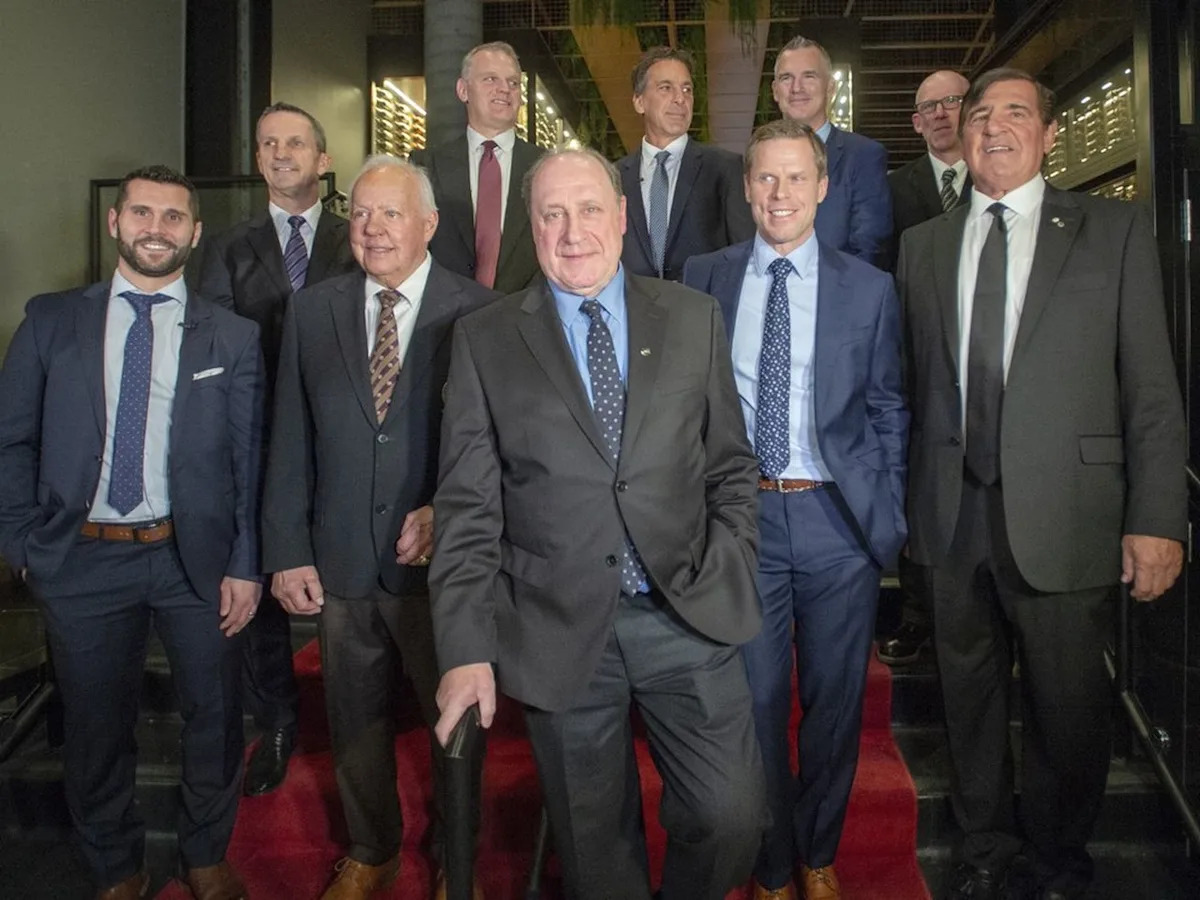
With the passing of Ken Dryden last month at age 78, Frank Mahovlich (87), Yvan Cournoyer (81), Serge Savard (79) and Peter Mahovlich (79) are the only remaining Habs players from Team Canada in the 1972 Summit Series. Are they highly involved as alumni with the current club? Cournoyer was the last great captain of the 1970s teams before Habs captains began to be traded. One would think his leadership around the team would be highly sought. As Danny Gallivan used to say: “Time becoming a critical factor …”
Grant Manson, Brampton, Ont.
Cournoyer and Savard were both at the Bell Centre for the Canadiens’ home-opening 5-4 overtime win over the Seattle Kraken on Tuesday. They still live in Montreal and are often seen in the team’s alumni lounge during the season. Frank Mahovlich lives near Toronto and Peter Mahovlich has lived in the United States for the last 40 years. Peter used to be seen often at the Bell Centre as a scout for the Florida Panthers, but retired a couple of years ago.
The Canadiens do have several former players working as ambassadors for the team. Réjean Houle, 75, recently stepped down as president of the team’s alumni association, replaced by 54-year-old Patrice Brisebois. Houle will remain as an ambassador, along with Cournoyer, Guy Carbonneau, Vincent Damphousse and Chris Nilan.
Since president of hockey operations Jeff Gorton and general manager Kent Hughes were hired almost four years ago, they have made the alumni feel welcome at the Bell Centre, which wasn’t the case under former GM Marc Bergevin.
“I get it, it’s these players’ time,” Nilan said on The Gazette’s Hockey Inside/Out Show this week. “Our time has passed. It’s their locker room, I get all that. I just know when I was brought up in this organization, having some of those (old-timers) around and visible, it was invaluable for us. Dickie Moore, Doug Harvey, Toe Blake, guys come in the room after the game. Like, hello! Jean Béliveau, even Guy (Lafleur) in retirement.
“It’s important,” Nilan added. “I think Bergy had a little bit of … I don’t know if he was insecure having those guys around. I don’t think any of these guys are in a position, ‘Oh, I’m going to go in and coach these kids and we’re going to tell them what to do.’ None of that. It’s just nice to see those guys around. They’re not going to be around forever. Looking at those guys on the bench (during the pre-game ceremony Tuesday night), that played with Ken Dryden, they’re in the twilight here. I’m getting there, too for Christ sake. … It’s nice to be part of.”
Regarding your article on Lane Hutson’s contract … wow! What a deal for all. Hutson makes a wonderful amount of money after just one full season and a Calder Trophy win, followed by an unbelievable under-the-ceiling cap hit of another future star for the Canadiens. Do you think other general managers and owners are saying to themselves: “What the f…? What are they doing in Montreal we don’t seem to be doing here?” Where else in the NHL is there this type of success in re-signing for long term, below market ceiling? Where are the players here seeking arbitration, demanding trades or squeezing every dollar they can out of ownership the way some have done in the NHL, most recently in Minnesota?
Rick Woods
No team in the NHL has ever won the Stanley Cup with a player having an annual salary-cap hit higher than US$10 million. That’s something Gorton and Hughes are obviously aware of with the highest-paid player on the Canadiens this season being Noah Dobson with a US$9.5-million cap hit.
Hughes was able to convince Cole Caufield and Juraj Slafkovsky to sign eight-year contracts for slightly less than captain Nick Suzki’s cap hit of US$7.875 million and then got Hutson to sign an eight-year deal with a cap hit below Dobson’s at US$8.85 million.
“I always love to see guys get paid and get what they’re worth,” Suzuki said after Hutson signed his contract last Monday. “We’ve kind of built a culture here where guys are not trying to break the bank. I think all Lane wants to do is win and I think he’s definitely set us up for that possibility moving on in the future.
“We’re in a different world in contracts now than when I signed four years ago,” Suzuki added. “The contracts are bigger, the cap’s higher. You have to go with the times. I think having Dobber and Laner where they are and all of us that signed eight-year deals that where we are is great for the team. … I really couldn’t care less who makes what and who’s the highest. It doesn’t really matter. I signed four years ago and I knew I was going to be locked in. I’m perfectly fine.”
Every GM in the league would love to have a team that thinks that way, but players are entitled to make as much money as they can during what can be short careers.
It certainly looks like Kirill Kaprizov broke the bank in Minnesota when he agreed to an eight-year, US$136-million contract extension that kicks in next season with an annual salary-cap hit of US$17 million — an NHL record. That’s a lot of money to pay one player, even if the NHL salary cap will go up from US$95.5 million this season to US$113.5 million by 2027-28.
Longtime player agent Allan Walsh stated recently that a big reason why former NHLPA executive director Bob Goodenow led a fight for NHL players against a hard salary cap was because he predicted teams, media and fans would label the best players “greedy” and “selfish” if they didn’t take a discount on contracts in order to help the team.
That seems to be the case now — and not just with the Canadiens.
Edmonton Oilers captain Connor McDavid recently agreed to a two-year, US$25-million contract extension that kicks in next season, giving him the same US$12.5-million salary-cap hit he has on his current eight-year, US$100-million contract.
What will Martin St. Louis do with Patrik Laine? He looks out of place with Josh Anderson and Jake Evans. Joe Veleno or Florian Xhekaj would help make a great fourth line.
Deborah Hart
The effort level has been there with Laine since the start of training camp but his speed — or lack of it — is an issue with the fast-paced game St. Louis wants his team to play, being very aggressive on the forecheck and in the neutral zone. Laine is only averaging 12:36 of ice time per game, the second-lowest among forwards, ahead of only Oliver Kapanen (12:25). Laine has a minus-3 differential, tied with Evans for the worst on the team, while Anderson is minus-2. The fourth line has yet to score a goal.
St. Louis said before Thursday’s 3-2 overtime win over the Nashville Predators that he didn’t want Veleno to sit much longer in the press box and it wouldn’t be a surprise if he plays his first game with the Canadiens as early as Saturday against the New York Rangers at the Bell Centre. It will be interesting to see if St. Louis would take out the veteran Laine or the rookie Kapanen. Veleno’s speed would definitely help on the fourth line with Evans and Anderson.
The Canadiens are 4-1-0, which will make it easier for St. Louis to be patient with Laine. As for Xhekaj, I expect we will see him with the Canadiens before the end of the season, whether it’s because of an injury or a trade.
If you have a question you’d like to ask for the weekly Habs Mailbag, you can email it to montrealcanadiens@postmedia.com
Related