
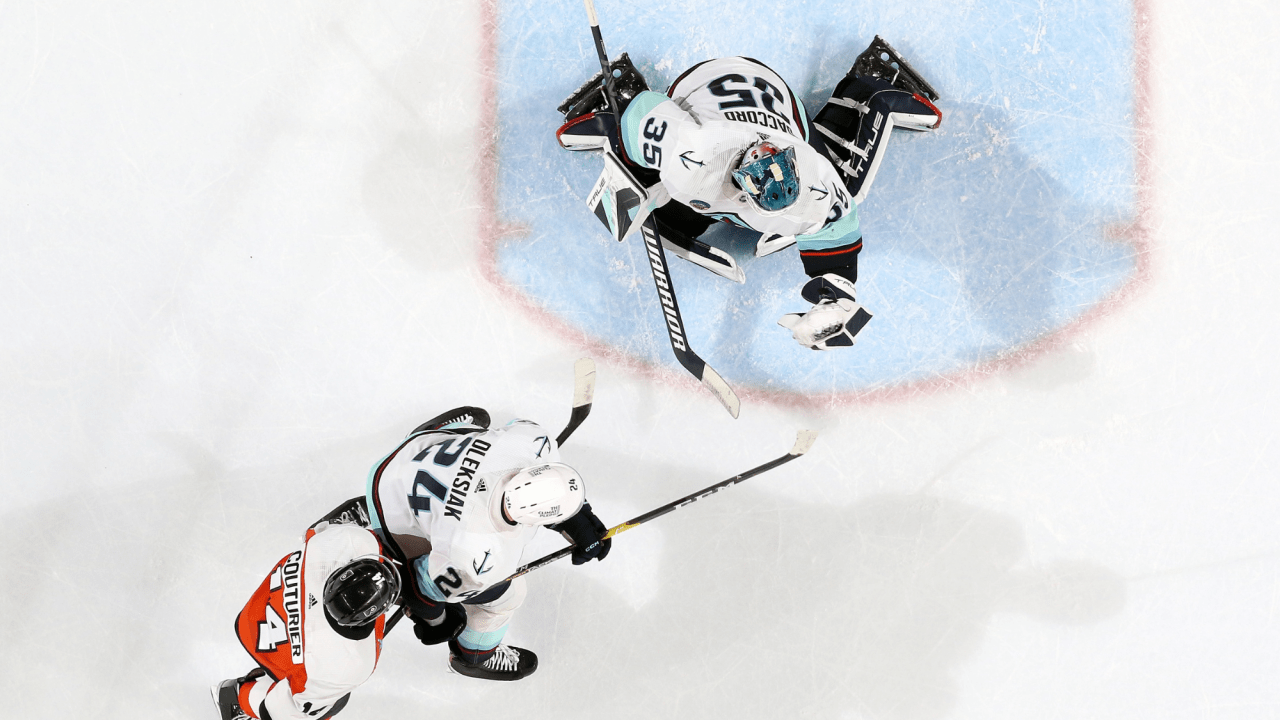
Given those risks, Oleksiak noted that teammates are often quite appreciative of the extra effort. The entire Kraken bench erupted when 19-year-old Kraken forward Berkly Catton, who now has four shot blocks in just five career games, got his first one in his NHL debut in Philadelphia last week.
“It can be a big morale boost, for sure,” Oleksiak said.
That aside, he added, shot blocking requires awareness of reading the space around you and knowing a shooter’s angles. He said the cardinal rule when attempting a block is taking the far side angle away and letting the goaltender handle anything to his short side.
“My first couple of years in Dallas I was trying to get in front of everything, and I think it kind of worked to our detriment,” Oleksiak said. “Sometimes it’s better to let the goalie see certain angles and not risk having a puck deflect off you. So, you’ve got to talk with the goalies about what their preferences are.”
Shot blocking has increased significantly in the NHL, becoming a more systematic part of defensive strategy – as witnessed by the Kraken’s widespread numbers throughout the lineup — rather than back in the day when one or two brave souls carried the load. Equipment padding has also gotten thicker, while facial visors, once frowned upon in the 1980s and 1990s, are now standard.
Kraken head coach Lane Lambert, who played as an NHL forward in the 1980s and 1990s, offered a tongue-in-cheek explanation for why shot-blocking is on the rise.
“Maybe because they now keep the stats on that,” he quipped.
On a more serious note, Lambert offered up: “If you’re in the right position defensively, there are often times when the puck’s going to hit you. This is, I guess, part of the (defensive) strategy. I mean, there are a lot of teams with a lot of players who block shots, and we’re included in that.”
Lambert isn’t wrong about shot blocking stats being a relatively new phenomenon that players can track and use to promote their abilities come contract negotiation time.
The NHL only began tracking blocked shots in 2005-06, when just six teams averaged more than 14 blocks per 60 minutes over the course of that campaign. Last season, only five teams averaged fewer than 14 blocks.
The Kraken in their 2022-23 playoff season averaged a 25th-best 13.62 such blocks, four fewer per 60-minute game than right now. But in the playoffs, they blocked 18.31 per 60 minutes – fifth best among 16 postseason teams — and nearly advanced to the Western Conference Final before losing to Dallas in a seven-game second round.
Kraken netminder Matt Murray broke into the NHL a decade ago and feels shot blocking has definitely “become a part of the schematics” in defensive approaches. Murray said teams try to counteract offensive advantages enhanced by technology on the video and analytics side. Offensive players, he said, are better at being more deceptive and finding areas of the ice where goals are more likely.