
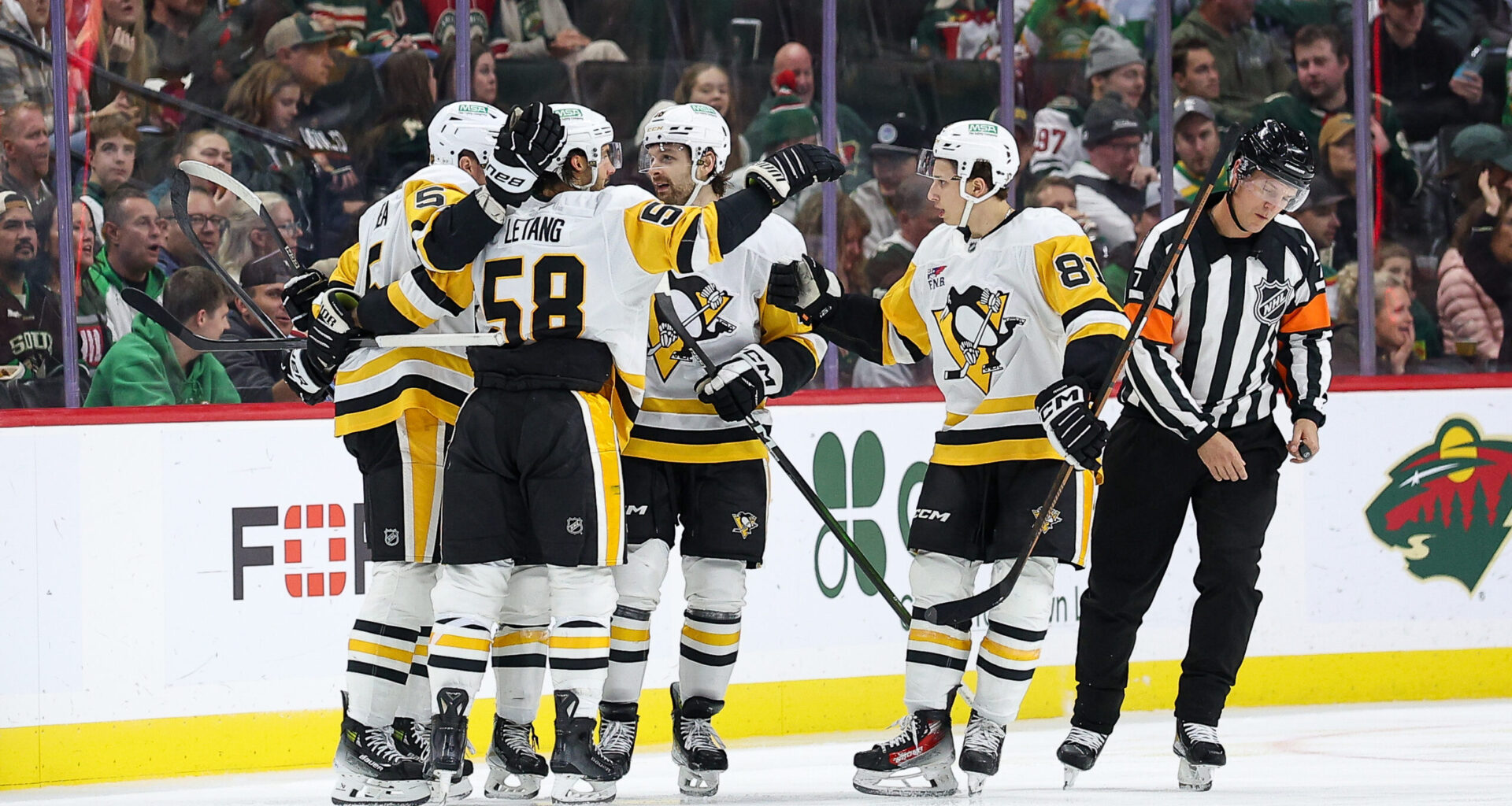
ST. PAUL, Minn. — Good goaltending in the first period, followed by a surge in the third period to protect a lead, delivered the Pittsburgh Penguins their eighth win of the season and an eight-game points streak.
The Penguins started poorly against the Minnesota Wild, being outshot 13-6 in the first period, but proceeded to take the puck and the game for most of the final 40 minutes in a 4-1 win at the Grand Casino Arena.
Ryan Shea had a goal and an assist. Tristan Jarry stopped 27 of 28 to elevate his record to 5-1-0 with a .923 save percentage.
“I don’t think we were playing fast enough (in the first), don’t think we’re putting enough pucks in the O-zone and getting on our forecheck,” said Bryan Rust. I thought we all knew we didn’t have a great first, and we were all kind of determined to have a better second and third.
No team has beaten the Pittsburgh Penguins in regulation or overtime since the Anaheim Ducks did it 16 days ago. Eight games and six wins later, the Penguins are dialing in and laying waste to a lot of dire predictions.
Surprise: They’re only getting better, too.
“I don’t think we’re trying to get too far ahead of ourselves. I think we’re having a lot of fun,” said Rust. “For the good and the bad, trying to learn from the bad, and learn from the good too. I think we’re just trying to have as much fun as possible.”
The Penguins outshot Minnesota 12-6 in the second period and heavily tilted the shot clock in the first 10 minutes of the third as they salted the game. Minnesota had a little push after the Penguins claimed a 3-1 lead on a Ben Kindel power play goal seven minutes into the final period, but the Penguins defended it, Jarry made a few more clutch saves …
“I think I’ve been feeling pretty good the last couple of games, just building off the last couple and having some good, strong practices, and I think just being able to rotate with (Arturs Silov ), it’s been really good,” Jarry said.
And the team that was more disappointing with a lead last season than getting a popcorn ball on Halloween firmly held another with energetic play down the stretch, and scored by solid goaltending.
“I thought that the last few games, there were some mistakes that I made,” said Jarry. “So, (it is about) cleaning those up and being able to learn from them. I think every time you get to step in the net, there’s another learning opportunity.”
Penguins Analysis
The scattered and somewhat muted play in the first period ended at the horn. The Penguins were given the short end of a pair of inexplicably bad calls, including an overturned goal on goaltender contact, which replays seemed to show was largely initiated by Minnesota defenseman Jake Middleton.
Coach Dan Muse had to take a timeout to see more replays. While he didn’t admit to it, there had to be a part of him that needed more views as he asked, “What am I missing?”
It was understandable that refs would initially wave off the goal, but not understandable that they needed only a brief look at the play to confirm their call.
Tactically, the Penguins were loose in the first period. When they are playing poorly, you can almost guarantee they’re spaced out, trying to stretch the ice as they’ve tried to do for the past decade.
Stretch passes were bounces to the other side. There was a lot of individual skating and being cornered, with nowhere to go.
It’s an old habit that goes back a few coaches.
When they’re dominating play, their puck support is done in tight groups and moving feet. Defenseman Erik Karlsson offered a little nugget to PHN Thursday morning:
“It might look like we’re playing faster, but that’s because we’re grouped together and the passes are quicker.”
Minnesota is headed toward hapless, and the Penguins displayed a real killer instinct. They were good in all three zones. There was a distinct absence of turnovers or coasting, and an abundance of racing back.
Tommy Novak was flying in front of his hometown crowd. He probably had three backcheck steals Thursday.
Penguins Report Card
Team: A
Bad first period, good second period, great third period. The Penguins continued to contain their mistakes and limit the resulting chances. Once they got on their toes, and once the forecheck began to generate momentum, energy flowed, and the Wild were anything but.
In fact, there really aren’t any bad grades to deliver. A few players could have been better, but that’s as far as we’ll go.
Tommy Novak: A
Lots of credit where it is due. Novak had his best game of the season. Amongst several highpoints, he set in motion the Penguins’ first goal with a hard backcheck and steal at center ice, then later in the sequence, continued the play with a wraparound attempt. His next shift in the second period, he broke clean of the coverage at center ice, pushed the defenseman back with speed, and used an inside-out move to the backhand to get to create space for a backhand shot.
Evgeni Malkin: B?
I don’t know how to square what I saw vs. what I read. After 40 minutes, the Malkin line was outchanced 8-1, and were outchanced 13-1 overall, but there were no big mistakes made by Malkin, Justin Brazeau, or Anthony Mantha.
They just weren’t connected.
Malkin is moving very well this season. There were even traces of his high-arched gallop with the puck Thursday. He did his job in the D-zone and pushed the play forward. When Malkin is playing like that, it’s not a trick, it’s a treat. The line was out of sync, but that doesn’t mean Malkin played poorly.
Filip Hallander: Good
Poor Filip Hallander. Sidney Crosby delivered a beautiful opportunity in the third period. Hallander even made a good shot, but Minnesota goalie Filip Gustavsson made a diving save to his right (so his glove the top hand). Gustavsson was horizontal and off the ice.
Hallander needs to play with the puck a little more, but he’s making good plays on the wall and participating in the play.
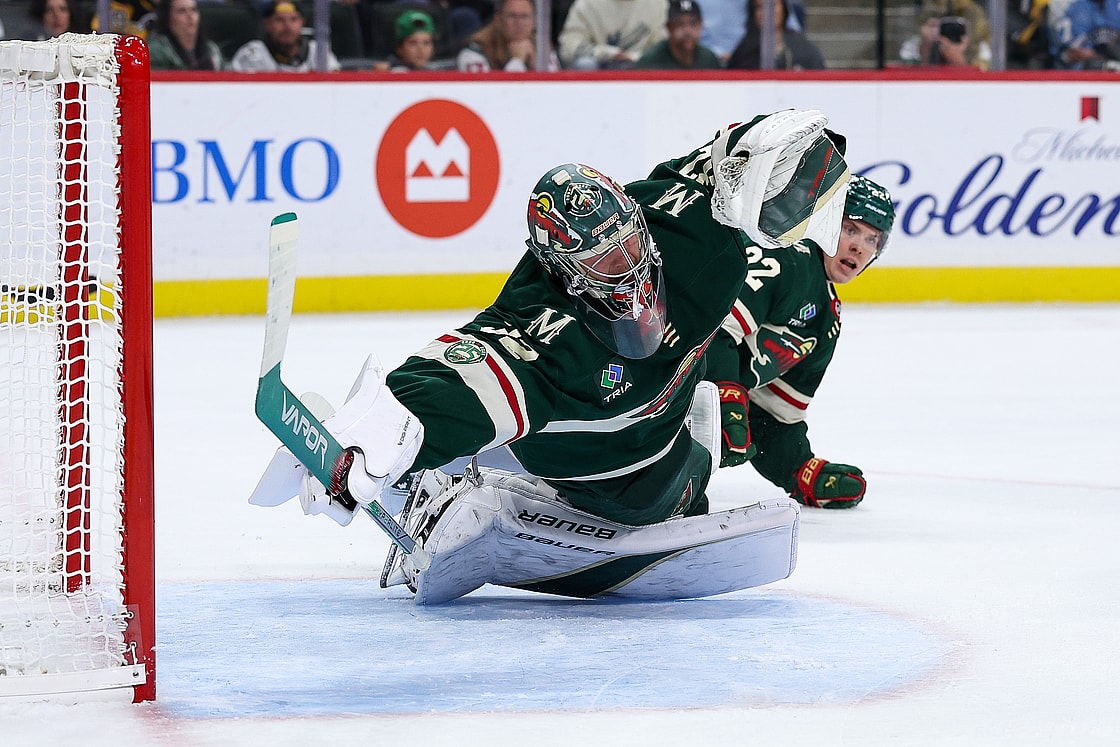 Matt Krohn-Imagn Images
Owen Pickering: Perfectly Solid
You may not have noticed. And that’s the reason why he gets a good grade from me. Pickering played a quintessential shutdown game. He had several stops along the wall and nullified a couple of scoring chances, including one in the second period about 15 feet from the net, with the reach that only a 6-foot-5 defenseman has.
As one example, in the first period, he kept the net clean by pinning Marcus Johansson to the wall twice in one shift.
I suspect the organization would like to see more, and he has the skills to provide it, but he settled down from his first game this season and submitted a very Marcus Pettersson-like performance. Zero mistakes, solid plays. That’s a win.
**One note on Pickering: He had 21 shifts, which is about the average for all of the Penguins’ defensemen, but he played just 13:23. His average shifts are only 38 seconds, while the rest of the Penguins’ defensemen’s shifts are about 15 seconds longer. D-partner Matt Dumba’s average shift length was 47 seconds.
Is the rookie being called over or getting off the ice too quickly to avoid mistakes?
Connor Dewar: A+
Dewar had three of the Penguins’ first five shots and five of their first 15, including a shorthanded breakaway chance and a one-timer from a little Sidney Crosby saucer pass when their shifts overlapped. Dewar had six shots on goal, and the puck followed him like a lost puppy Thursday.
Positive Signs
Villie Koivunen is stabilizing his game. He was rough in the first couple of games this season, and did not immediately reclaim his best game upon being recalled late last week. His game was quiet on Thursday, but without mistakes or individual losses. He has a lot more to give, but first, he had to stop the bleeding.
His best period was again the third period. For whatever reason, he’s not being patient with the puck and not letting the play develop in front of him–which are qualities that had been so impressive about him until the recent struggles at the NHL level. In the third period, he made a few plays with Kindel.
Fellow rookie Ben Kindel remains solid. The third line had a really good shift early in the third period (5:10-5:55) in which Kindel and Koivunen both sprang the rush and created a zone entry with dangerous intent.
Ice Bags
A few players needed bags of ice Thursday. The small visitor confines of the arena allowed the two Pittsburgh media reporters to see things we wouldn’t ordinarily see, like players with ice bags taped to their feet, ankles, and a few more heading for the trainers’ room.
The Penguins were credited with 15 blocked shots, but a few of them were bombs. Parker Wotherspoon blocked a shot late in the first period, and it so obviously hurt that he glided to the bench hunched over and sort of crawled over the wall. Of course, he was back on the ice 10 seconds later.
Even Evgeni Malkin blocked a hard shot.
Tags: Minnesota Wild Penguins Analysis Penguins game Penguins report card Pittsburgh Penguins
Categorized: Penguins Analysis