
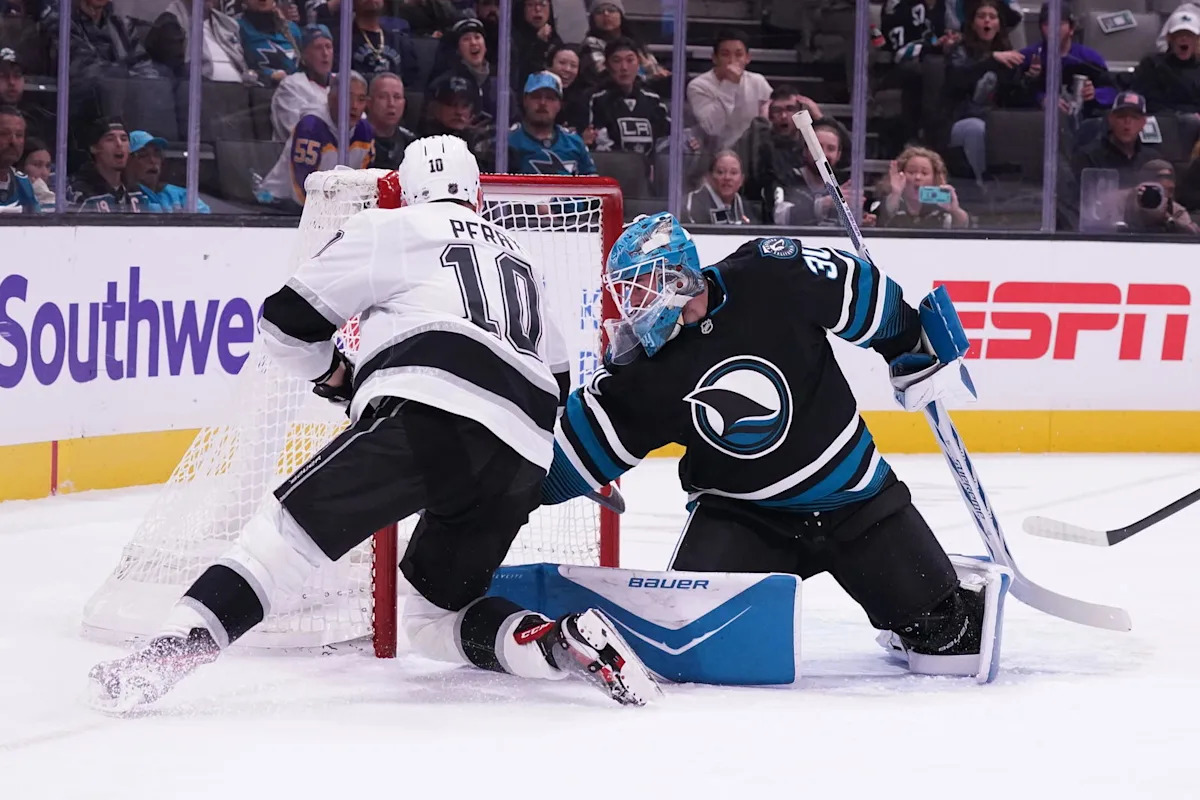
SAN DIEGO, CA — The series of the Los Angeles Kings’ Three Stats continues as the team still bounces around with their identity issues, their defensive concerns, and a longtime Duck that has looked royal. This week, we will address some of these stats in a more polarizing manner.
First Stat: -6
That’s not for a player, that’s for the whole team. When considering the -2 for the total combined scoring in all situations, one can still say “it’s only 12 games in”. When taking out specific conditions like six-on-five and four-on-four, this team is actually -6. Let’s just break down that math really quick.
Advertisement
At even strength, five on five, this team has scored 22 times. It has also been scored on 21 times. There’s your plus one. At five on four, the traditional power play, they have scored three and allowed a shorthanded goal —that’s a plus two. That’s meager to start the year after being very hot to finish the year before the team dried up after game two vs the Oilers.
Meager turns sour: Things sour when going to the penalty kill, because, of course it does for a team third in the league in most power-play goals allowed. They have been scored on 11 times, with two shorthanded goals, bringing the total to -9.
There are no inflationary measures with this team currently, since they have yet to beat an opponent by multiple goals more than once this year. Play in one-goal games consistently, and frankly, lose most of them, and your special teams metrics are going to sink you—that is, unless your power play is very good. By the way, it hasn’t been. Taking the second-most penalty minutes is quickly turning this team into one that chases most of its games, while relegating its depth players to the pine.
Advertisement
It’s important to know that a penalty kill differential is going to just grow and grow. Even a 95% penalty kill would still have to outscore that five percent. For example, the Kings allowed 36 goals on the PK last season, while scoring two shorthanded goals, for a -34. Their current rate is a staggering -61.5.
The same could be said of the power play, with a +30 from last season (35 scored, five shorties allowed). Through twelve games, a minute +2 has been produced by these LA Kings, while sporting a five-forward first unit. That projects to be roughly +14 over 82 games.
These rates, when combined with five-on-five (roughly +7 over 82-game pace), bring the Kings’ goals-for and against at the standard rates (5on5, 5on4, 4on5) to a -40.5 for the season over 82 games.
Advertisement
Now that’s a projection. That can change, and I’m relatively sure it will. But what I’m also certain of is that this team is still navigating the offseason changes and role turnover. The record of this ‘contending team’ reflects that.
Second Stat: Two Shifts
There is a lot to be made regarding Phillip Danault and his two-shift third period against the Sharks. At the end of the day, Jim Hiller called it a coach’s decision. It’s no secret that Danault has never been an offensive force for the Kings, or really, in his career. But the Kings were holding a lead in the third, and Danault is a key faceoff centerman and is relatively in the Selke discussion on an annual basis.
Advertisement
The defensive centerman has three points this year, all assists. Two primary and one secondary. His share of icetime, 27.3% is the lowest it has been during his tenure in LA. He is also on pace for his lowest point accrual in his Californian portion of his career. The former is intertwined with the ladder regarding dips in ice time, leading to what makes sense: less ice time means fewer opportunities to score.
It’s not necessarily a problem if the future of the franchise is collecting points at a higher rate than his former three seasons, in the form of Quinton Byfield (2-8-10 in 12gp), who has seen leaps in his share of ice time since his initial startup season in 2020 (25% to 32.1% share). That makes sense, to give the ice time to your future, but what if that future is covering for a player who is retiring at the end of the season?
Advertisement
Byfield is taking over for Kopitar, but what is the dialogue regarding Danault’s replacement? He’s not likely to whiff the 27 goals he scored in his initial season in LA, and has receded each season since (18, 17, then eight most recently). He’s in his 30s (32) and playing in a diminishing role. Is it time to start a dialogue without a clear-cut number two centerman lined up in the cupboard?
Third Stat: Five Goals
When the Kings signed Corey Perry in the offseason, the expectations were that he would contribute to their second unit on the power play and strengthen the bottom six. Add that into playoff experience with gumption, and there’s a heck of a pickup in the form of a 40-year-old winger. For the Kings, they are getting an onus of return from ‘The Worm’.
Advertisement
While injured for the first six games of the season, Perry has now played in six and has scored five goals. Though 75 goals for the year is probably not likely, acquiring a 20-goal player out of free agency, despite the age, would be a massive win for Ken Holland, especially if he converts on similar rates come postseason time.
Perry is seeing the highest share of offensive-zone deployments (20.4%) since his 2015 season in Anaheim (20.1%, 10 years ago). He’s also seeing the highest share of ice time of all possible icetime, with 23.1% since 2018 on the Ducks, when he had 24.6%.
He’s played up and down the lineup, mixing and matching with every available line. Right now? He’s the fourth-highest expected goals carrier on the team with 3.1. Though his 1.9 goals above expected lead the forwards on the team. It will deflate, but his expected goals per 60 are unsustainable at 2.15.
Advertisement
Unsustainable by almost every metric, but certainly a massive win for the organization thus far.