
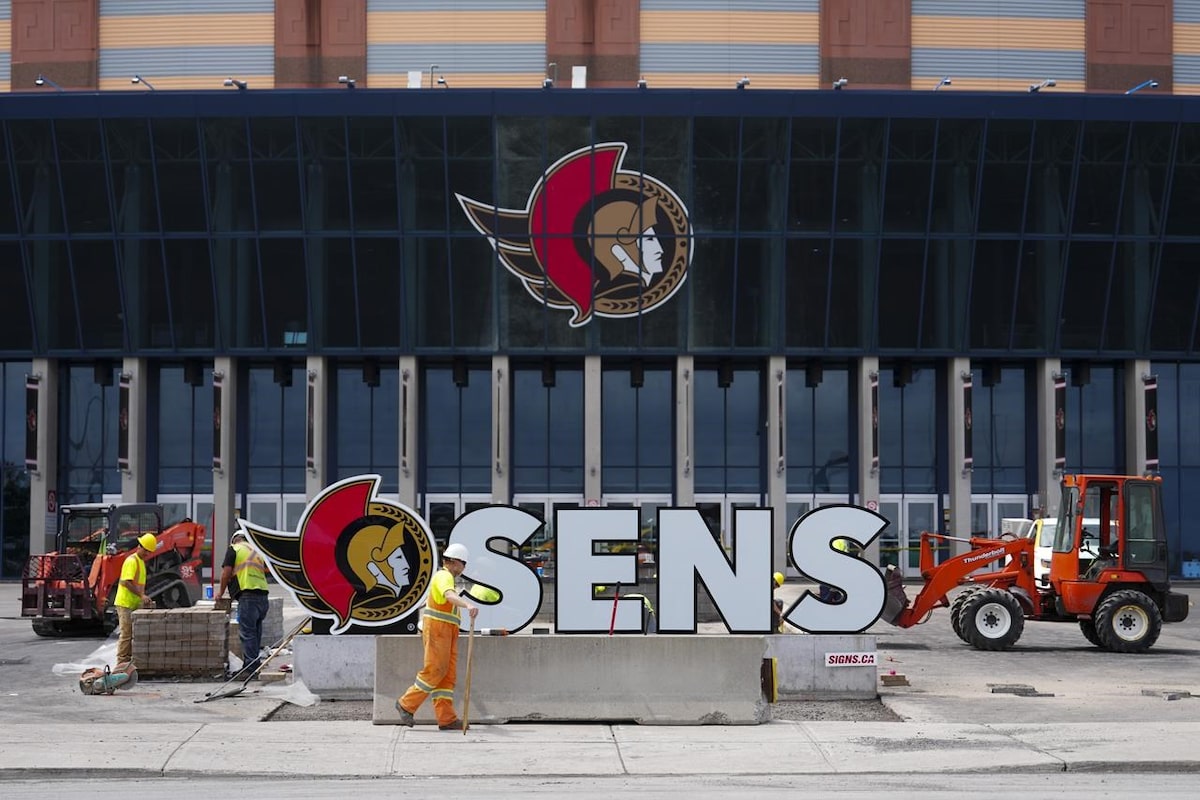
Landscapers work around Ottawa Senators team signage at the Canadian Tire Centre in Ottawa in June, 2023.The Canadian Press
Last month, Ottawa Senators owner Michael Andlauer sold the logistics business where he made his fortune for $2.2-billion, after more than tripling the company’s value in the past six years.
Pro sports is likely to be an even more lucrative investment for Mr. Andlauer, a self-made billionaire and beer-league hockey goalie.
Set aside what you’ve heard about frothy valuations on hockey, baseball, basketball and football teams. Owning a franchise such as the National Hockey League’s Senators is a proven approach to making serious money, according to a study run by the University of Michigan’s Ross School of Business and private equity firm Arctos Partners LP.
For all the talk of sports investing being driven by the greater fool theory – with one deep-pocketed fanboy justifying buying a team on expectations of eventually selling to an even wealthier frustrated jock – there are solid economics behind the lofty prices that teams command.
Over the past 20 years, owning a stake in a team from one of the four major North American leagues – the NFL, NBA, MLB and NHL – provided an impressive 12.3-per-cent annual return, according to the Ross-Arctos Sports Franchise Index. That’s significantly better than the performance of any public market benchmark, such as equities, fixed income or commodities.
Decades of double-digit returns, along with the leagues’ recent liberalization of rules to allow institutional investors into ownership groups, explain why asset managers are now lining up to put money into sports.
Pension plans and private equity funds put a priority on assets that turn in predictable results regardless of market conditions, or what the Street calls “uncorrelated returns.”
The institutional investor crowd also gets worked up about businesses with rising profit margins, which the NHL, NBA and NFL currently enjoy. Legacy media business, such as television networks, continue to pay up for the rights to games. At the same time, deep-pockets streaming platforms such as Amazon.com Inc., Apple Inc. and Netflix Inc. are starting to bid. So broadcast revenues in leagues with salary caps, giving teams the ability to control costs that come from paying players.
The NHL, NBA and NFL all recently announced new broadcast deals that guarantee billions in revenues for more than a decade. University of Michigan academics Emory Kaplan and Jon Grossman said in a report that “institutional investor interest is rising thanks to this long-term revenue and cost certainty.”
All of this is music to the ears of Rogers Communications Inc., which will eventually bring in partners at Maple Leaf Sports & Entertainment, parent to Toronto’s pro teams. And it’s ancient history to institutional investors such as the Ontario Teachers’ Pension Plan, which made serious money as MLSE’s former owner.
Team owners such as Mr. Andlauer, a 60-year-old who previously owned a stake in his hometown Montreal Canadiens, aren’t just investing because they are fans.
Over the past five years, Mr. Andlauer earned an 11.5-per-cent annual return on Andlauer Healthcare Group Inc., which he founded in 1991 and took public in 2019 at $15 a share. In late April, Atlanta-based United Parcel Service Inc. agreed to buy the transport company for $55 a share.
While this is heady performance, the Ross-Arctros Index did even better, rising 14.4 per cent annually over the past five years. Over the past 12 months, franchise values jumped by 17.3 per cent, driven by deals such as the US$6.1-billion sale of the NBA’s Boston Celtics.
In 2023, Mr. Andlauer led a consortium that set a new high-water mark for the value of NHL franchises when they bought the Senators for US$950-million. The ownership group also includes former Farm Boy co-chief executive officer Jeff York and Ottawa real estate developer Bill Malhotra.
If Mr. Andlauer cares about the economics of his investment, and billionaires typically care deeply about economics, a 17.3-per-cent-plus gain on the Senators means his group is already up about US$165-million.
The Senators stand to become even more valuable as a new $11-billion, 12-year broadcast contract kicks in next year with Rogers Communications Inc., and the team potentially moves to a downtown arena.
It took Mr. Andlauer 34 years to make his first billion by selling his logistics business. The surging economics of pro sports may make it far easier to make his second billion at the Senators, while potentially bringing home a Stanley Cup.