
Sometimes players and teams need a few games to shake off the rust and round back into form.
Take the Tampa Bay Lightning, who went 1-4-2 over the first two weeks of the season. It’s easy to get dramatic about how old and slow the defense looked against the rush, or the fact the star power wasn’t enough to outpace those problems. But over the last five games, Tampa Bay has shut down expected contenders like the Vegas Golden Knights and Dallas Stars and won 4-2 against the fast-paced Utah Mammoth.
While the Lightning look to be mostly back on track, not every player or team has been so lucky.
Early red flags, at the individual and team level, can develop into concerning trends. While it’s too soon to be mathematically eliminated from the playoff picture in the first week of November, those concerning trends can spiral into long-term problems that eventually crush a team’s postseason hopes.
So let’s spot some of those developing trends that playoff hopefuls need to stop from becoming season-long woes.
The Lightning’s power play
It’s not all sunny in Tampa Bay just yet. One key element of the Lightning’s attack is still lagging: the power play.
The Lightning generally have a dynamic power play; they ranked first in 2023-24 and were fifth last season. This year, they’re converting at a 14.6 percent rate and scoring just 5.24 goals per 60 (27th in the league). And it’s not just poor shooting luck holding them back, which has been the issue for a team like the Carolina Hurricanes, who are dead last in scoring (and shooting percentage) with the man advantage, but top 10 in scoring chance creation. The Lightning, on the other hand, are 24th with an xG rate of 8.58 per 60.
The key may be figuring out who fits best as the fifth member of that top unit. Oliver Bjorkstrand’s right-handed shot has been deployed as a one-timer threat from the left circle. Anthony Cirelli’s got some reps in the bumper, and now the team is rolling with Brandon Hagel in that position.
It’s challenging to compare how PP1 has performed head-to-head with each of these players, given each player’s limited ice time. Hagel and Cirelli have each played on PP1 for less than 10 minutes, which makes the results look very extreme compared to Bjorkstrand’s 27-plus minutes. But there has been some promise with one of the former two in the bumper and Nikita Kucherov and Jake Guentzel on the flanks, similar to last year, in Hagel’s time on the top unit.

The Stars’ five-on-five offense
With one of the deepest forward groups in the league, the Stars should be one of the best scoring threats. But that hasn’t been the case through the first 12 games of the season. Dallas sits 31st, ahead of only the Minnesota Wild, with 1.80 five-on-five goals per 60. While the team is expected to score more based on its shot quality, that still underwhelms with 2.25 xG per 60, which ranks 29th. That low-volume offense has been even more exposed over the last couple of weeks due to some early defensive lapses.
Injuries are likely the driving force behind those scoring woes, with Roope Hintz, Matt Duchene and Jamie Benn all sidelined. Without them, Mikko Rantanen, Wyatt Johnston and Jason Robertson (who are all producing at a high rate) don’t have enough support.
In the meantime, the power play is making up for those gaps. It gave the Stars the edge in their most recent wins (against Carolina, the Nashville Predators and the Washington Capitals) and helped them rally for a point against the Florida Panthers last Saturday.
But over-relying on the power play isn’t the most sustainable strategy — and the Stars learned that last spring, when they were eliminated after scoring just 1.65 five-on-five goals per 60 in the playoffs. Dallas has to hope that won’t become a theme again this year as the group gets closer to full strength.
The Maple Leafs’ special teams
The Toronto Maple Leafs don’t look like a contender at five-on-five through the first few weeks of action. Their special-teams play isn’t doing them any favors, either.
Over the last two years, Toronto has ranked in the top seven in both expected and actual goals on the advantage. This year, ahead of Monday’s matchup against Pittsburgh, the team’s scoring chance creation is down to 9.37 xG per 60 (18th in the league), and the scoring has been even more sparse (4.21 goals per 60, 29th in the league). And the team has already given up two short-handed goals in 12 games, after allowing seven in 82 last season.
A lot of that falls on the shoulders of the Leafs’ stars. Auston Matthews, William Nylander, John Tavares and Matthew Knies play about 70 percent of the team’s power-play time. But in their minutes together, Toronto is only up 3-1 in goals. That finally led to some personnel tweaks, with Easton Cowan getting the boost to PP1 in place of Knies on Monday night.
What’s concerning is that these special teams woes extend to both ends of the ice. The penalty kill, under new direction this year with Derek Lalonde taking over for Lane Lambert, is bleeding chances against — 11.3 xG against per 60, to be exact, which is sixth-worst in the league. Anthony Stolarz and the Leafs’ goaltenders are doing the most to cover for that, allowing only 5.4 goals against per 60, but that likely isn’t sustainable in the long term.
Svechnikov’s start
Andrei Svechnikov got some leeway over the last couple of seasons, despite dips in his play-driving and scoring, considering how daunting the recovery can be from a major knee injury. Last spring, he finally seemed to turn the corner back with his playoff performance. He was an offensive standout with eight goals in 15 games.
But that hasn’t carried into this season, with eight scoreless games to open the year. Svechnikov may be finding his rhythm lately, with two goals and three points in his last three games, but there are still some concerns below the surface.
That is what separates him from someone like Nikolaj Ehlers, who also got off to a slow start on the scoresheet. The Canes have been a stronger team on both ends in his minutes.
To Svechnikov’s credit, he hasn’t had the same offensive support as Ehlers. But he hasn’t taken on terribly tough minutes, either, or given the coaches reason to move him up in the lineup. Carolina is struggling defensively with the winger on the ice, and the offense isn’t strong enough to outpace that; the Canes are actually scoring much less with Svechnikov on relative to the rest of the team.
The Blues and Senators’ goaltending
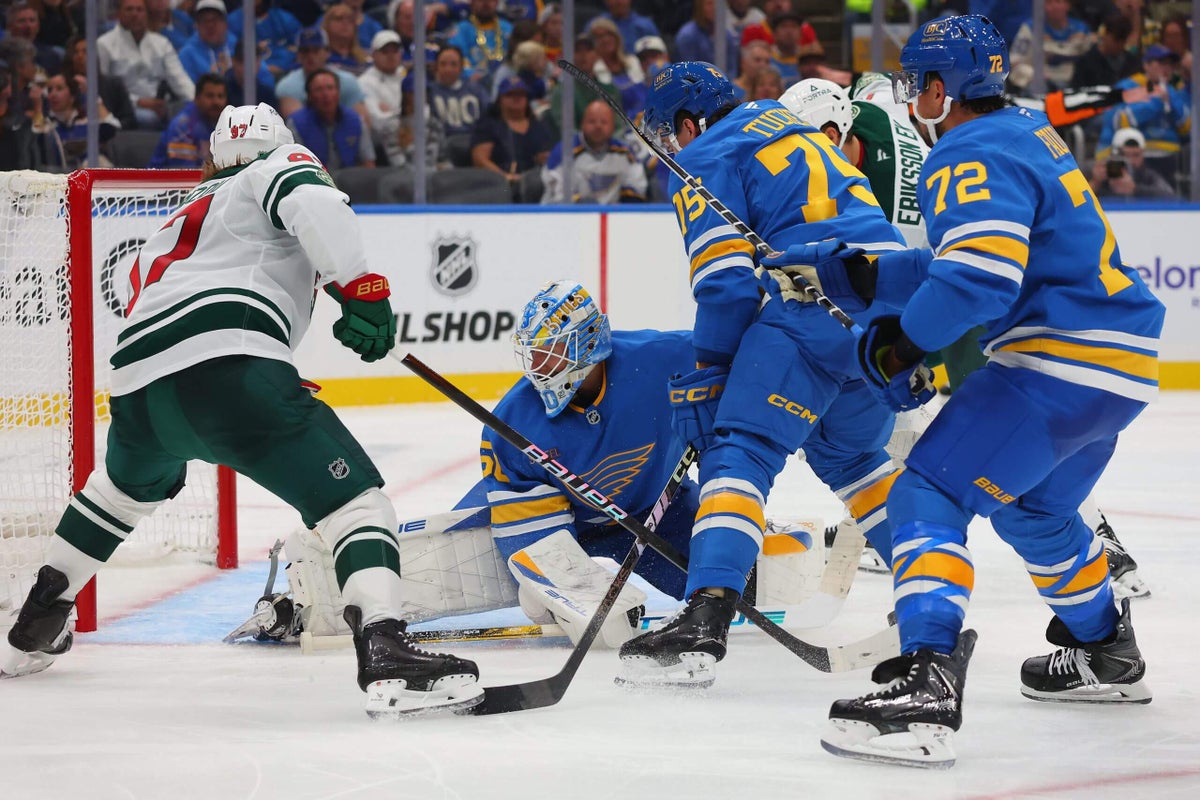
In all situations, the St. Louis Blues have allowed a league-high 14.3 goals above expected. The problem is that it isn’t just one goaltender struggling in St. Louis. Jordan Binnington and Joel Hofer have gotten off to disastrous starts, which has sunk the Blues to second-last in the Western Conference.
The team in front of the blue paint has been far from perfect in St. Louis. Despite generating a high rate of quality looks, the Blues have struggled to convert on their chances to give their goaltenders more goal support. The defense hasn’t been that dismal, though. The penalty kill is limiting dangerous chances, and the team’s five-on-five xG against is pretty middle-of-the-road.
The goaltending is The Problem in St. Louis, with Binnington and Hofer both allowing six-plus goals above expected and earning sub-0.890 save percentages.
The only team that comes close in terms of poor goaltending is the Ottawa Senators, who have allowed a combined 12.4 goals above expected in 13 games. Most of that has come with Linus Ullmark between the pipes; he has earned a GSAx of minus-9.4 through 11 games. While he hasn’t responded well enough to his workload to open the year, the Senators are also leaving him far too exposed to screens (and screening him while defending), exacerbating the issue.

The Minnesota Wild
Is a 5-2 win over the Vancouver Canucks enough to turn the Wild around? Minnesota has to hope it’s more than just a morale-booster, considering how much has gone wrong over the last few weeks.
One win really doesn’t move the needle for a team that has started 4-6-3 and sits 30th in the league — not when numerous weaknesses have contributed to a such a dismal start.
The Wild have been the worst-scoring team at five-on-five with 1.78 goals per 60 in their first 13 games. Some of that falls on rising stars like Matt Boldy. After starting strong with nine points in his first five games, he has only tallied another four points over his last eight outings. Kirill Kaprizov is producing, but his puck management has come under fire. Still, it’s reasonable to argue the risk versus reward is worth it for someone of his caliber, compared to a Zeev Buium whose usage has been limited.
As much as Minnesota’s power play has made up for five-on-five scoring gaps, it hasn’t been enough to make up for defensive lapses. The Wild, who are generally known for being a stout team, have slipped to the bottom third in shots against and expected goals. And the goaltending has only hovered around average relative to their workloads. The penalty kill has been even leakier, with the highest rate of expected and actual goals against.
Those uncharacteristically rough defensive metrics (and a lack of even-strength scoring) have contributed to a significant amount of time spent playing from behind. All of that has subsequently seen the Wild’s playoff odds sink from 58 percent in the preseason to 35 percent.
Data collected before Monday’s matchups, via Evolving-Hockey, HockeyViz, HockeyStatCards, All Three Zones and Natural Stat Trick. This story relies on shot-based metrics; here is a primer on these numbers.