

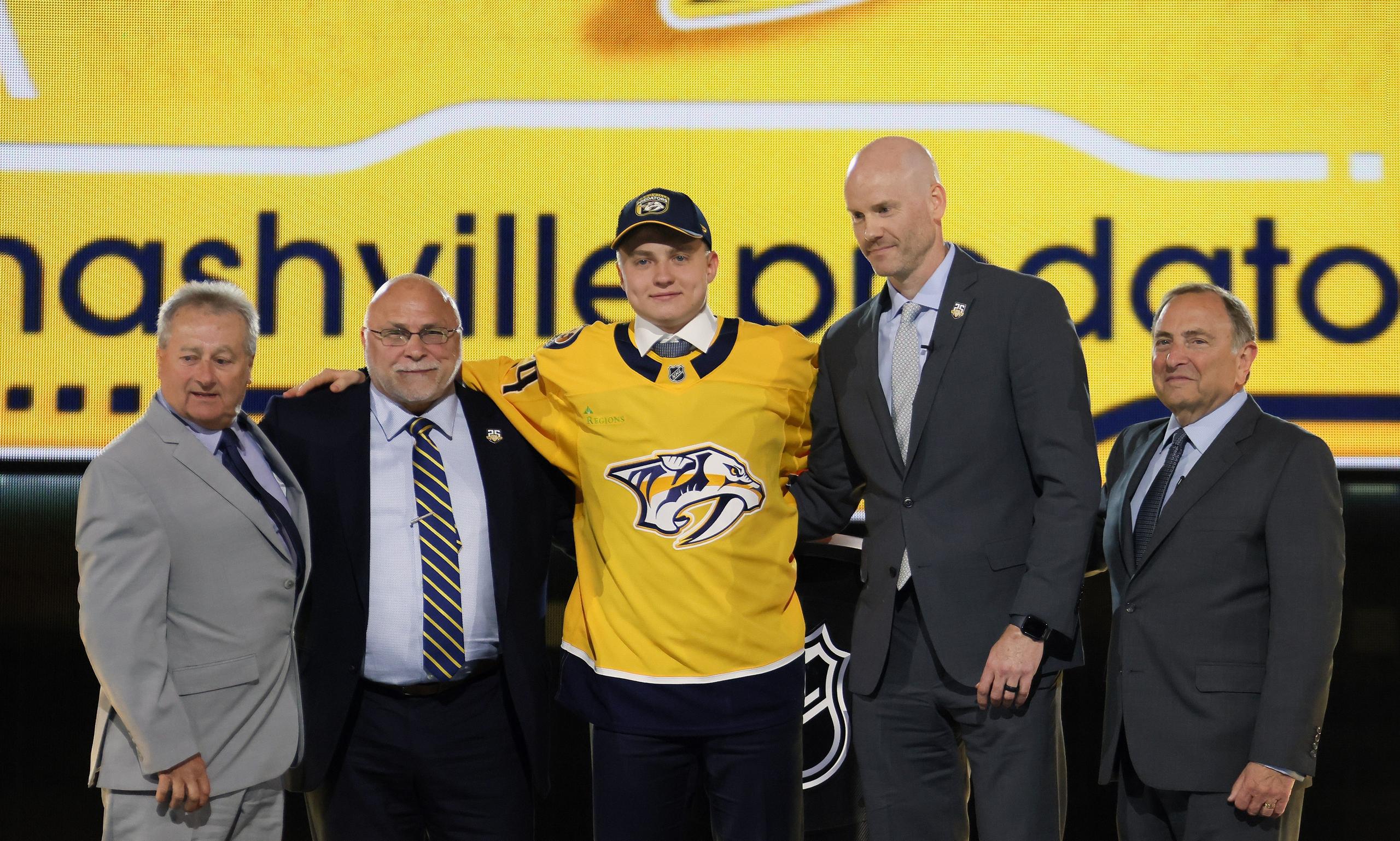
Yegor Surin’s second full KHL season is not just a continuation but an evolution, showing growth in both production and projection. Through 22 games in the 2025–26 campaign, the Nashville Predators’ 2024 first-round pick has already tallied 19 points (10 goals, 9 assists), along with a plus-17 rating and the kind of usage that typically signals a player on the verge of a much larger role. The consistency in his game is starting to match the potential scouts saw a year ago.
His contract situation, at least for now, is settled. Lokomotiv terminated and re-signed him in the summer of 2025 to a fresh two-way deal running through May 31, 2027, keeping him under team control through the end of the 2026–27 season. It was a move that demonstrated mutual confidence – Lokomotiv believes in his upside, and Surin seems intent on rewarding that faith. The step forward comes after a rookie KHL campaign where he produced 14 points in 41 regular-season games, plus seven points (five goals, two assists) over a deep 19-game playoff run.
Hartley’s Touch: Edge With Restraint
One major new element this year is Surin’s daily work with veteran coach Bob Hartley. The partnership has quietly reshaped parts of his game, particularly in the details that don’t always make the highlight reel – positioning, balance along the boards, and how to pace aggression. Surin doesn’t hesitate to describe the impact.
“He’s doing a great job, especially with younger players like me”, says Surin in a one-on-one interview with RG. “I’m learning a lot, particularly about board battles and defensive play. It’s really cool. I just need to keep improving.”
It’s clear that Hartley’s influence extends beyond the systems and into the mindset. Practices under him are famously structured and intense, but for a player like Surin, who thrives on energy and emotion, that structure has become a useful anchor.
The shift shows in how Surin channels his competitiveness. Once known for pestering opponents and getting under their skin at every turn, he’s learning to deploy that edge with more precision – something Hartley has emphasized since the preseason.
“No, not really,” he said when asked if Hartley had dialed it back. “We’ve only played about a third of the season, and I don’t want to waste extra energy on that yet. When the time comes, I’ll bring that part of my game back. I haven’t lost the skill – I still practice it with teammates.”
Back in North America, the Predators are watching closely. For an organization that values development as much as Nashville does, Surin’s progress in Russia represents both patience and potential payoff.
The Predators’ European scouts have tracked him consistently, and by all accounts, communication has remained steady and encouraging.
“I stay in touch with their scout and development coach. They text me things like ‘good job’ and send me clips of my shifts. I think they’re happy with me. I feel like they’re waiting for me.”
It’s a quiet but steady rhythm of feedback – just enough to keep him connected to the NHL program without disrupting his KHL focus.
He once again attended the Predators’ development camp this past summer and came away with a clearer sense of the standard he’ll need to meet to earn a spot in North America.
“I was at their development camp this summer, and it was even tougher than last year. The first time, nobody knew me, so it was easier. This time, everyone did, and it was much harder. The pace and skating level there are incredible. I realized there’s still a lot I need to work on.”
Ready for the Jump: Strength and Speed
When asked about the NHL’s current rookie class, Surin doesn’t hesitate to name names, but his tone remains grounded. He’s a student of the game, paying close attention to how peers of his age are adapting to North American ice and pace — not out of comparison, but curiosity.
“Among rookie defensemen, I really like Matthew Schaefer – he’s off to a great start. Ivan Demidov and Arseniy Gritsyuk are doing well too. But I think the first season doesn’t show everything – the second one is usually harder, and that’s when you really see what a player’s made of. Nikishin is also good, but he came over already fully prepared. That’s not the same as joining right after the draft.”
Ask Surin about Nashville’s season, and he smiles – the kind of polite, measured smile that says he’s been down this road before. He tracks the team’s results, catches condensed games online, and even swaps the occasional message with players in the system. But when it comes to opinions or predictions, he’s cautious.
“I follow their games, but honestly, I don’t want to comment too much – that’s up to the coaches.”
Instead, his focus is on what he can control: physical preparation. The transition from KHL to NHL ice has derailed plenty of talented players, and Surin seems well aware of the gap in strength and conditioning that often separates the two leagues.
“I need to build more muscle. Radulov keeps reminding me that players over there are much stronger and battles are tougher. He helps me a lot – gives advice, explains things calmly after games, and shares his experience. On the bench, he’s emotional, but afterward he always helps.”
He’s also keeping in touch with peers making that same jump.
“We’re also in touch with Daniil But, who’s now in the AHL. He said the preseason with Utah was very tough. We like to joke that in the NHL, the puck seems to fly faster – like it’s lighter than here.”