

It hasn’t been a particularly pretty start to the 2025–26 season for the Edmonton Oilers. Sitting at 6–5–4, Oil Country has had an inconsistent rollercoaster in the first 15 games. The Oilers are tied for third in the Pacific. The goaltending still doesn’t look great, the defence has taken time to get healthy, and the forwards haven’t generated much chemistry. Part of this is due to injuries, mainly the continued absence of Zach Hyman. However, the Oilers’ systems leave much to be desired. Why have the Oilers’ on-ice tactics changed? And how could returning to what has worked perhaps right some wrongs?
5v5 Killers? Not Quite.
Over the last three seasons, Edmonton has been one of the league’s premier teams at generating 5v5 offence. From 2022–23 to 2024–25, the Oilers rank 3rd in Chances For %, 3rd in Goals For, and 2nd in Expected Goals For % per NaturalStatTrick. This domination at 5v5 has allowed the Oilers to become one of the league’s true contenders, bucking their previous trend of being an okay 5v5 team with a lethal power play propping them up. So far this season, the Oilers have unfortunately regressed to special teams merchants. This year’s power play is 2nd in the league at 35.0%, while at 5v5, Edmonton is 16th in CF% (50.36%), 22nd in Goals For (26), and 15th in xGF (29.59%).
Part of this stems from injuries. Zach Hyman’s absence has had a major impact throughout the lineup, and you can expect to see some of these numbers improve once he returns at full strength. Hyman’s absence caused the Oilers to break out the line blender, throwing almost the entire lineup at the wall together to see what sticks. It’s hard to succeed when you’re unable to build chemistry, and hopefully, when Hyman returns to the top-six, it will hopefully right itself
However, it’s not like the whole team is facing an injury. One player’s absence shouldn’t crater the 5v5 results of an entire team, especially one as prolific over the last few seasons as the Oilers. So what’s the big issue? I would argue the problem is two-fold. Firstly, Edmonton has seemingly changed their shot volume to low-slot to the point, and their breakout and transition game has slowed.
Just Shoot It? Not Exactly.
On paper, just putting the puck on net sounds like a good idea. After all, you can’t score if you don’t shoot. However, a high volume of low percentage shots is worse than a low volume of high percentage shots. It matters where the shots are taken from, how dangerous an area they’re in, and how much of a chance the opposing goalie has to make a save.
Let’s take a look at the Oilers’ 5v5 offence heatmaps per HockeyViz from the last two seasons.
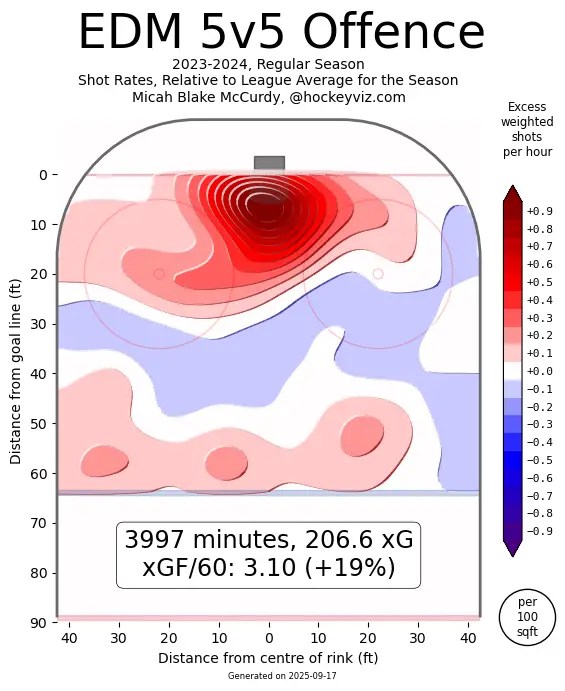
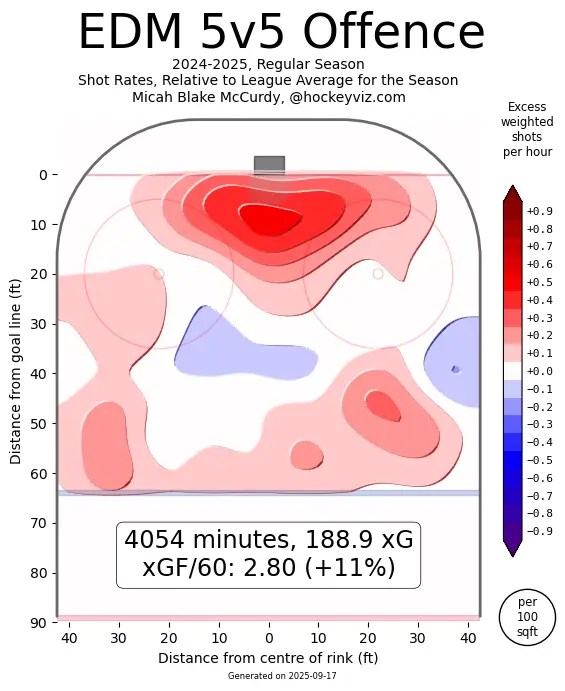
These heatmaps showcase the number of shots per hour via the colored bar on the right. The redder the area, the more shots recorded, and vice versa for the blue areas. You can see here that in the last two seasons at 5v5, the Oilers have made their bones primarily from shots around the net, near the circles, and a few choice areas around the offensive blueline. This balanced approach has allowed the team to succeed with either a reliance on close chances around the net or plays from the point that players can deflect or tip in front.
Now let’s see the Oilers’ 5v5 heatmap for 2025–26 so far.
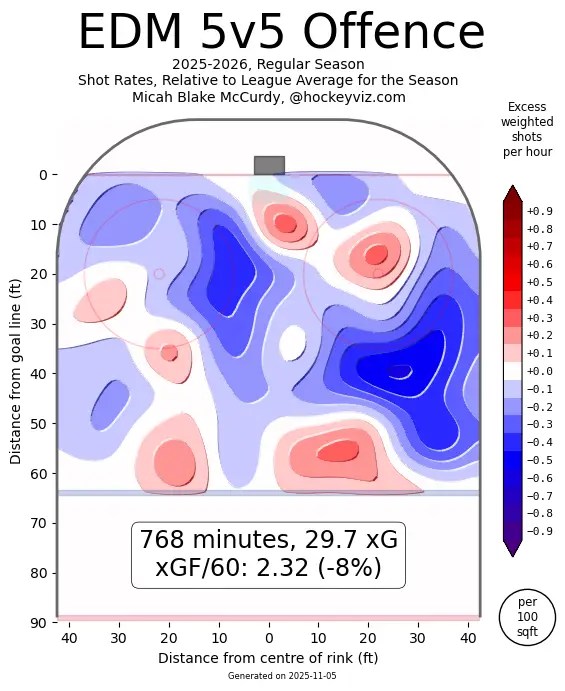
Yikes. Two things to notice immediately. The front of the net has been a deadzone for shots, except those directly in front of the crease. Secondly, the massive gaping blue abyss on the right side of the ice. Edmonton wasn’t firing it much there the last two seasons. But the area was at the very worst a light blue, not a black hole. The only areas the Oilers are getting shots on net from are just inside the blue line, right in front of the net, or just off the side in the circles.
So why has the Oilers’ offensive approach changed so drastically? That’s the million-dollar question. Head coach Kris Knoblauch has obviously done some tinkering to begin the year, and the early returns don’t look promising. Perhaps he tried to compensate for the loss of Hyman and the influx of new faces by keeping the offensive systems more conservative. Maybe he’s trying to keep the games as low-event as possible for another reason. It’s possible Knoblauch doesn’t trust his goalies, and even though the Oilers don’t tend to give up high danger chances, he might be concerned about giving them any hard chances to stop at all. If that is the case, he’s robbing Peter to pay Paul. The Oilers are built for speed and offence. If you’re afraid your goaltenders can’t hang, go talk to the GM about it.
Bet like a pro here with Bet99—Ontario’s go-to for elite odds and nonstop action.
 with Bet99—Ontario’s go-to for elite odds and nonstop action.
And outside Ontario, Canadians bet better
here with Bet99—bringing top-tier odds and action from coast to coast.
 with Bet99—bringing top-tier odds and action from coast to coast.
Something to be Desired in Transition
The Oilers’ transition game has taken a hit so far this season. As we just outlined, Edmonton is a team that plays its best hockey when they come in waves. They overwhelm their opponents offensively and stifling any offensive chances that go the other way. One key part of Edmonton’s attack is the transition game, where they’ve really thrived the last few seasons. Even that hasn’t looked right to begin the year. Everyone and their mother knows about the McDavid drop pass to enter the zone. But the Oilers work best when the defencemen move the puck quickly, not allowing their opponents to set up defensively.
Instead of quick passes through the neutral zone, Edmonton’s breakout relies heavily on long stretch passes that are easily intercepted. They also rely on low-percentage dump-and-chase plays that give up possession. This may have to do with the departure of Paul Coffey. In his time as assistant coach, was able to mould Edmonton into one of the league’s premier transition teams, even more so than when he arrived. This issue you’d hope is more one of growing pains. With players like Evan Bouchard, Jake Walman, Mattias Ekholm, and Darnell Nurse, they could have an elite transition game. To do that, they need to get back to what works. Moving the puck with tempo up to the forwards and joining the attack, not trying to thread a 50-foot stretch pass through three opposing players.
Room for Optimism
It’s been an up-and-down start to Edmonton. These system troubles have also tended to fluctuate game by game. Some nights, they look like the Oilers of old, pushing the pace of play and controlling the game. Other nights, their forecheck and breakouts look uninspired and sloppy. It’s a long season, but the fact is, the Oilers are fortunate to have their current place in the standings. If they’re looking to truly right the ship, their systems under the hood need to revert to the last few seasons. If they’re able to do that, Edmonton will find much more success as the year goes on.
Photo by Curtis Comeau/Icon Sportswire
Like this:
Like Loading…