
Though their early season record is much better than fans have become accustomed to, the Edmonton Oilers have left something to be desired. With a high standard and truly only one hurdle left to climb, the Oilers have avoided their usual horrid starts. Most expect that their play and record will turn around in the near future, but opinions on how that might happen are more varied.
For many, the focus is on offence. The Oilers have only been scoring at a rate around the middle of the league. Given that they have a strong power play efficiency, this raises a concern, although the team’s overall shooting percentage should improve. For others, it is the costly mental mistakes that are the biggest issue, perhaps best exemplified by Evan Bouchard’s occasional baffling sequences. Many point to the ongoing issue in net, where the Oilers’ philosophy of a cheap tandem has grown tiresome.
While fixing these issues would help, the biggest problem might be the team’s performance on the penalty kill. Though they sit around the middle of the league in efficiency, the problems are evident when put into context. Let’s take a deeper look at what might be the biggest area of concern for the Oilers.
Looking beyond penalty killing efficiency
As mentioned, the raw data is a bit generous. Sitting around the middle of the league in penalty killing efficiency, some might overlook the issue altogether. Instead, some deeper context will raise concern. Let’s use some goaltending statistics from Moneypuck through November 6 to get some context.
For all the bellyaching about Stuart Skinner’s ability, and undeniably the occasional gaffe of his own, he has authored a solid start to the season. For goalies with at least five games this season, Skinner ranks 18th in goals saved above expected per 60 minutes. Backup Calvin Pickard ranks 41st, or third last, among eligible goalies. Despite an overall save percentage around league average, Skinner has faced a higher-than-average workload when shot quality is considered.
Skinner’s play on the penalty kill requires some deeper attention as well. Again, the raw save percentage is nothing special, but considering the quality of the workload, Skinner has performed quite well. In fact, Skinner ranks eighth among goalies with at least five starts with roughly 2.2 goals saved above expected per 60 at four-on-five. In short, Skinner’s strong performance on the penalty kill has made the Oilers’ unit look better. He is dragging them up to average.
Chances against
A look at this heat map from Hockeyviz shows just how much of an issue the penalty kill has been. Not only are the Oilers conceding a high volume of chances, but nearly the entire slot has been a shooting range for opposing power plays.
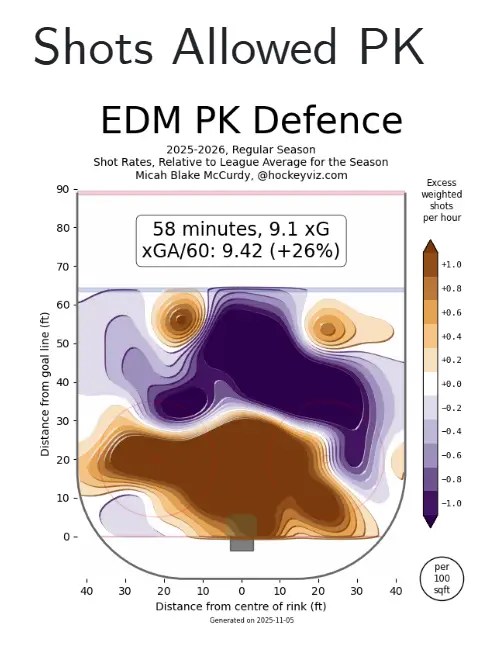
Coming into their own as a high-powered offensive juggernaut, the Oilers’ penalty kill has often been secondary to their success. Still, the best moments the team has authored have come when the penalty kill is strongest, including a legendary run during the 2023–24 playoffs.
Gaffes will always happen, but the team should be able to lock in as the season progresses. The offence might turn around, if not by positive regression in the overall shooting percentage, then by the return of Zach Hyman and growth from younger or less experienced options in Isaac Howard, Matthew Savoie, and David Tomasek. Acquiring a goalie has been difficult, and will continue to be so given the team’s cap constraints. Instead, figuring out the penalty kill will be vital to forging a championship identity.
Usage of Oilers personnel
Coach Kris Knoblauch has relied on skilled players to handle most of the penalty-killing duties. Connor McDavid, Leon Draisaitl, and Ryan Nugent-Hopkins lead the way for penalty-killing forwards. Clearly, they are supremely talented players, and having them be a part of the penalty kill is not inherently wrong. Instead, it has an effect on the lineup across other game states as well.
To start, the Oilers’ offensive forwards are using a lot of their energy on the penalty kill. Reducing their minutes here might increase the energy they can provide at even strength. The effect trickles down to the rest of the lineup as well, leaving many bottom-six forwards with less of a role.
This might make sense under the circumstances, the Oilers trying to integrate some young scoring wingers into the lineup. Knoblauch has opted for skilled fourth lines, though clearly this has not helped the team generate offence. To some extent, this might be playing the long game, allowing the likes of Savoie and Howard to get acclimated.
Reinforcements for the Oilers
With Mattias Janmark, a longtime staple of the Oilers’ penalty kill, nearing a return, there might be some change on the way. Savoie has seen some regular usage on the penalty kill and should continue to improve. Adam Henrique has held a regular role, though perhaps more is in order. Perhaps Noah Philp should earn a bigger role here as well.
One of the biggest x-factors might be Alec Regula. Often injured, Regula has had the best defensive metric on the team this season. If he can stay healthy, Regula might be able to gain further traction as well.
His right shot and his size make him stand out, no doubt, but Regula has shown enough skating, passing, and offensive ability to look like a legitimate option for the Oilers. Perhaps more trust can see him earn a big role on the penalty kill.
While neither Janmark nor Regula are fantasy hockey superstars, their effect on the team’s scoring woes might be limited; adding both to the penalty kill might be a viable path to improving the team as a whole. These two players alone will not solve the Oilers’ issues here, but they can certainly be a big part of the solution.
Bet like a pro here with Bet99—Ontario’s go-to for elite odds and nonstop action.
 with Bet99—Ontario’s go-to for elite odds and nonstop action.
And outside Ontario, Canadians bet better
here with Bet99—bringing top-tier odds and action from coast to coast.
 with Bet99—bringing top-tier odds and action from coast to coast.
The penalty kill can be improved
In all likelihood, the Oilers’ penalty kill system will need some tightening. Last season, the penalty kill had its issues, failing spectacularly at times even into the playoffs. Relying on cohesion, the Oilers’ penalty kill requires precision and attention to detail. The threat of having McDavid and Draisaitl on the unit is real, but perhaps having more usage from specialists will allow for greater synergy.
It is expected that the Oilers will continue to improve as the season progresses, including penalty killing. At the very least, they have not dug themselves a huge hole through the fall portion of the regular season schedule, as they have in previous years. Needless to say, it will be interesting to monitor how the penalty killing unit evolves as the season progresses.
Follow The Oil Rig on social media!
Like this:
Like Loading…