
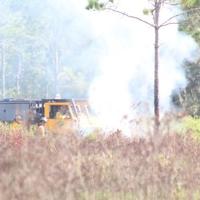
Florida Forest Service burn trucks, heavy equipment for clearing land, and a half-dozen Kubota vehicles with water tanks stood by as prescribed burn professionals lit a field on fire in Highlands Hammock State Park last weekend.
Prescribed burns are controlled fires intentionally set in natural areas under specific weather and environmental conditions. They are used as a land management tool to achieve various objectives.
The afternoon live prescribed burn demonstration was the fitting end to Lake Wales Fire Fest, a day of exhibits and informational sessions with environmental groups, fire departments, land management pros, and scientists who study the effects of fire on the plants and animals of Lake Wales Ridge.
Archbold Biological Station, Buck Island Ranch, Glades Electrical Cooperative, Friends of Highland Hammock State Park, Highlands County Audubon, Lykes Brothers ranch and others manned booths and educated members of the public as to the benefits, and dangers, of fire.
Nathaly Ingle, who just started her job at Florida Fish and Wildlife Conservation Commission (FWC) in Lake Placid, showed off a new Ford F-550 outfitted with a three-connection water truck that fights wildfires. She and her colleague, John Foligno, the lead area biologist with the Lake Wales Ridge Wildlife Environmental Area, have different roles. Foligno does many of the controlled burns in the Ridge for FWC. Ingle, FWC land owner biologist, collaborates with landowners to improve land for Florida panthers.
“By burning land, it brings in more prey for them,” Ingle said. “It gives them places to hide; also, overgrowth makes it harder for Florida panthers and prey to traverse the land.”
Foligno and Ingle’s office is on the Royce Tract of the Ridge, next to Lake Istokpoga.
“We’ve seen panthers out by Old State Road 8, and up towards Royce Tract, where our office is,” Foligno said. “That’s where we’ve seen some.”
“We’re just educating people about the bear, what our agency does, and Lake Wales Ridge State Forest.” Olivia Wetsch and Richard Sweat of the Florida Forestry Service were on hand to educate people how the agency preserves wildlife areas as well as recreational areas for the public.
“We tell people about land management, how the Lake Wales Ridge has a lot of rare species, from scrub jays to bears to rare plants, which is what I study,” Wetsch said.
Sweat is a good, old-fashioned forest ranger.
“I do what we always do. I work with the public to protect the land but to show them ways to enjoy it,” Sweat said.
Roberta Lake, of Highlands County Audubon and a member of the Lake Istokpoga Management Committee, urged visitors to learn about the Ridge to River project, which will lead to a voter referendum to allow the county to use property tax money to purchase local land for preservation. Venus resident Ken Keck educated visitors with a map of preserved lands.
Grace Campbell and Danny Callahan of Lykes Bros. Inc., which owns the 300,000-acre Lykes Ranch, also uses prescribed burns.
“Our goal today is to let them know we do controlled burning for ecological reasons but also for grazing,” Campbell said. “And we do it safely.”
According to Callahan, certified “burners” like himself measure conditions carefully before lighting what are known as “drip torches.” The burners walk along a perimeter, or from another start point, and light the fires with a drip torch.
“The largest burn we’ve done recently was the 3,000-acre burn last year on six-mile Slough,” Callahan said. “We have our own staff – including equipment operators – seven certified burners. You have to keep an eye on the humidity, temperature, wind direction, wind speed – it all comes into play,” he said. “When the Forest Service says, ‘Stop burning,’ we do.”
Other hazards include thick smoke from prescribed burns mixing with fog, or thick smoke crossing U.S. 27, U.S. 98, State Road 70 and other highways. Such smoke can be hazardous to drivers, Callahan said.
Greg Knothe pushed a carriage containing his toddler, Willow, who was showing signs of sleepiness.
“I’ve been enjoying talking to the environmental groups and the Forestry Service people,” Knothe said. “I am learning more about prescribed burns and the benefits to natural resources, but I need to get this little girl to sleep.”
Greg and Willow, who came all the way from Lakeland, brought mom, too. Candice, his wife, is with Polk County Natural Resources and was busy talking to members of the public.
Meanwhile, Brian Finder, natural areas coordinator with Polk County and his colleague, Eric Eversole, the county environmental lands stewardship coordinator, educated the public on the benefits of their work. Finder pointed to a large piece of Polk County land that is home to Bachman sparrows, which are protected. Their breeding habitat is open pine forests. The domed nest is usually built on the ground near a clump of grass or a bush. Females lay three to five eggs.
“Bachman sparrows benefit greatly from our prescribed burns in the SUMICA Tract, a large conservation area near Lake Wales and Lake Walk-in-Water,” Finder said. “The habitat has to be burned regularly for that species.”
Eversole held up Tank, a gopher tortoise that survived a car strike. He gets around just fine, thank you, but you can see a disfigurement where his shell resealed itself.
“Tank is one of our educational gopher tortoises. We have a permit with FWC for him because he wasn’t deemed healthy enough to be released into the wild. He’s built like a tank but he’s had a run in with a car.”
According to Eversole, Tank is there to remind drivers to keep an eye out for wildlife crossing the road.
By the way, you know those holes tortoises dig in the sandy soil of the Lake Wales Ridge? “Those burrows are important to the environment,” Eversole said. “They provide habitat for more than 300 species.”
Wes Brandon and his wife Amber and son Tommy J. said they had a great time learning about prescribed burns.