

When a team with the pedigree of the St. Louis Blues is floundering near the bottom of the Central Division, the trade chatter inevitably follows. With a record hovering well below .500, the rumor mill is churning, and general manager (GM) Doug Armstrong has reportedly hung the “open for business” sign on the team’s front door.
But if you think this signals a panic-driven fire sale, you haven’t been paying attention to how Armstrong operates.
Related – Zegras Leads Flyers to Victory Over Blues in High-Scoring Affair
The current situation in St. Louis is not a simple case of a struggling team looking to dump assets. It’s a far more complex maneuver, a two-front strategy aimed at achieving two distinct goals: First, to send a shockwave through his own dressing room to salvage the current season. And second, to meticulously prepare the franchise for a new era of leadership.
The Protégé and the Long Game
Before we analyze a single trade rumor, the most important piece of context is this: this season is expected to be Armstrong’s final year as the team’s GM. The succession plan is already in place, with Alex Steen, his protégé, set to take the reins.
This pending transition of power is the lens through which every decision, every rumor, and every high-ball asking price must be viewed.
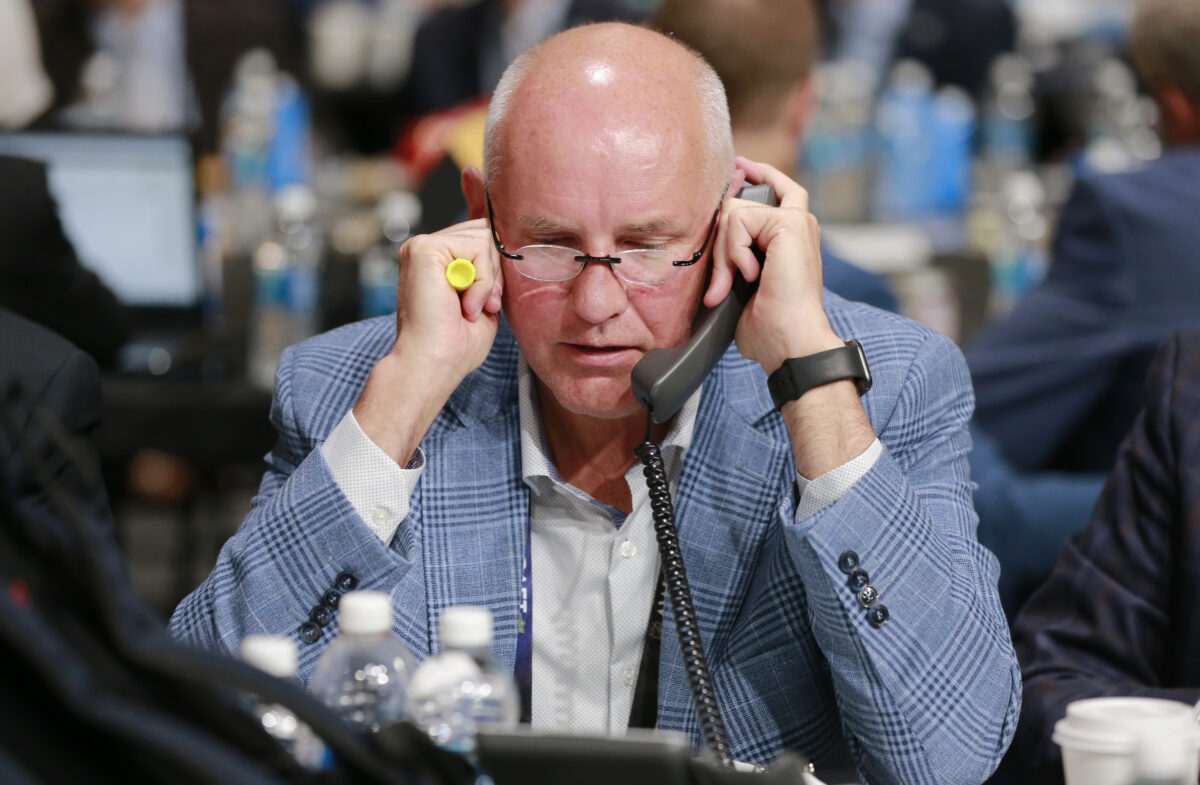 Doug Armstrong, General Manager of the St. Louis Blues (Photo by Jeff Vinnick/NHLI via Getty Images)
Armstrong’s primary objective is not a quick fix to get into the second wild-card spot. His goal is to hand off a team to Steen that is structured, competitive, and confident. He has always valued long-term stability, and as insider Elliotte Friedman noted, one “just can’t believe for a second that Armstrong would do anything that leaves Steen in a worse position.”
This isn’t a GM trying to save his own job with a desperate move. This is a GM cementing his legacy by ensuring the long-term health of the franchise for his hand-picked successor. He has worked to put Steen in a position to be successful, and he will not deviate from that path by trading away key assets for pennies on the dollar, no matter how badly the team is playing in November.
We’ve Seen This Movie Before
This “open for business” declaration is a classic move from the Armstrong playbook. He is a master of using the media and the league-wide grapevine as a motivational tool.
We saw this in 2019, when a struggling Blues team received a mock “Christmas Sale” memo from their own GM. That team, famously, rallied from the league basement to win the Stanley Cup. We saw it again last season, when Armstrong, amidst heavy speculation, gave his players a chance to dictate the trade deadline approach. They responded, the deadline was quiet, and the team snagged a playoff berth.
Related – NHL Rumors: Oilers Lose Forward, Blues Business, and Kampf’s Mess
This current message is likely directed more at the players inside the Blues’ locker room than at the other 31 GMs. It’s a clear challenge: Turn this ship around, or I will. The performance of the players, not the inbound calls, will dictate the actual trade strategy.
The Usual Suspects: Who’s on the Block?
While the GM’s message may be an internal gambit, the calls are still coming in, and the speculation is focused on a few core veterans.
 Jordan Kyrou, St. Louis Blues (Amy Irvin / The Hockey Writers)
Jordan Kyrou: The 27-year-old right winger is drawing “the most buzz” in trade circles. Kyrou was recently made a healthy scratch ahead of a game against the Buffalo Sabres, a move clearly designed to send a message to him and the entire bench. After a significant dip in his play, the benching was the ultimate “show, don’t tell” maneuver from the front office.
Kyrou was the subject of conjecture last June, just before his no-trade clause kicked in on July 1. As Friedman noted, there may be growing frustration from the player’s side, observing that, “Every time things get tough, it seems to be him that gets benched.” Multiple teams have inquired, and the Seattle Kraken, who reportedly explored a trade last year, remain a team to watch.
Brayden Schenn: Perhaps more surprising, the captain’s name has “been out there” again. Schenn remains a highly-regarded leader and productive playmaker, signed for two more years at a very reasonable $6.5 million AAV.
Schenn was a popular target at last season’s deadline but wanted to stay. The critical difference now? His previous full no-trade clause has become a modified no-trade, requiring him to submit a 15-team no-trade list. This gives Armstrong significantly more flexibility. In fact, insider Frank Seravalli believes Schenn is the more likely player of the two to be moved, citing the persistent interest in the captain and the thin market for quality centers.
 Justin Faulk, St. Louis Blues (Amy Irvin / The Hockey Writers)
Pavel Buchnevich and Justin Faulk: These two veterans round out the list of players reportedly being “explored” as Armstrong looks to “shake things up.” Seravalli has suggested that if the Blues do pull the trigger on a trade, their priority should be to bolster the blue line, which could put a player like Faulk in play or signal a different kind of “hockey trade” entirely.
The ‘Penthouse Value’ Problem
So, with all this smoke, why is there no fire? The answer lies in the second part of Armstrong’s strategy: protecting Steen’s future.
Armstrong has signaled he’s open for business, but he is absolutely not holding a clearance sale. He will not “dump the assets.” The asking prices for players like Schenn or Kyrou are, by all accounts, astronomical.
Insider Darren Dreger summed it up perfectly, noting that Armstrong wants “penthouse value” for his core pieces. The “bad news,” as Dreger put it, is that the market simply isn’t in Armstrong’s favor right now. We are only 15-20 games into the season. Teams are not yet desperate, cap space is tight across the league, and few are willing to pay a premium in November.
Armstrong knows this. He is unlikely to get that significant return he’s demanding this early in the year. And that, paradoxically, may be the entire point.
Armstrong has set the reserve price so high that the most probable outcome is that he doesn’t sell at all. He’s challenging his team to prove the assets are more valuable in St. Louis than they are on the trade block. For a GM playing the long game, that’s a brilliant position to be in.
AI tools were used to support the creation or distribution of this content, however, it has been carefully edited and fact-checked by a member of The Hockey Writers editorial team. For more information on our use of AI, please visit our Editorial Standards page.
