
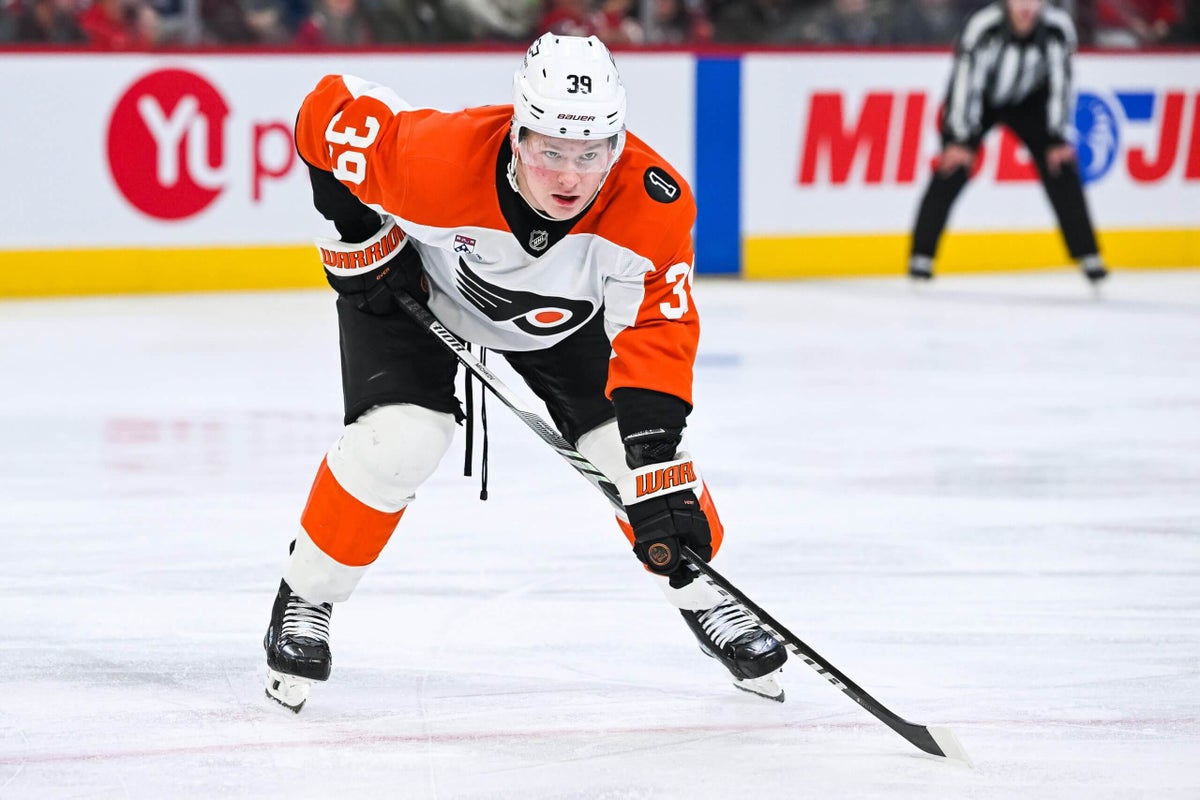
Everything seemed to be trending towards a long-awaited emergence. Matvei Michkov scored goals in three straight games for the first time in his nascent career earlier this month: his one-timer against Nashville on Nov. 6 ended a nine-game goal drought, followed by a stellar single-man effort against Ottawa two nights later. Then, on Nov. 12 versus Edmonton, Michkov recorded his first power play goal of the season, zipping in a perfectly placed wrist shot from the top of the circle.
Further, in that 2-1 overtime loss by the Philadelphia Flyers to the Oilers last Wednesday, Michkov recorded 16:05 of ice time. It was just the third time this season he eclipsed 16 minutes, suggesting he was finally earning greater responsibility under coach Rick Tocchet.
Not so fast. Michkov dropped back down to 14:07 in the Flyers’ thrilling 6-5 shootout win in St. Louis on Friday and skated 14:35 on Saturday in a lopsided 5-1 defeat to the Dallas Stars.
Michkov’s ice time has been under a microscope since opening night. We touched on it early and got further clarity in late October after speaking with team sources. As it stands through 18 games, Michkov’s 14:50 average time-on-ice per game is 14th on the Flyers and just ninth among forwards (it’s a distant ninth, too, as Bobby Brink, eighth among forwards, is averaging 16:33 per game).
It’s worth examining further, considering how important the 20-year-old Michkov is to the Flyers’ short- and long-term success.
The conversation still must begin with Michkov’s conditioning level, something that has been mentioned frequently regarding the forward and which he himself alluded to recently when Michkov acknowledged that he didn’t train as optimally as he could have in the offseason.
It’s impossible to know just how unfit Michkov was when he arrived to camp, which makes it difficult to determine how long it should take for him to get into game shape. Still, I posed a question on Sunday via text message to a few former players-turned-analysts: How long does it take an out-of-shape player to typically catch up when the season begins?
Mike Johnson, who called two Flyers games this month against the Canadiens and Senators, said: “Generally, you should be fine by the end of training camp. But the reality is, there’s not a lot of time to practice and may be even less during the season, so it’s hard to play your way into shape by playing games.
“Also, depends on your body type. (Michkov) looks like a guy who carries more weight, so it might be harder for him to thin down. So it’s a chicken and the egg: he can’t play big minutes, but he’s not going to get in shape playing smaller minutes.”
Former Flyers forward Jody Shelley, now a TNT analyst, offered a more pessimistic view. He pointed out that even players who arrive to camp in prime condition on Day 1 take a little while to get fully up to speed, which means a guy like Michkov could be perpetually behind the eight ball for some time.
“I’d say two-to-three months. … Conditioning, speed, battle shape. It takes a month even for guys in shape to have their body, mind and recovery ready for the grind,” Shelley said. “So if you’re out of shape, you’re catching up, and you are behind. … Battle shape is a different level.”
It’s that “battle shape” that is vitally important to a guy like Michkov, too. As NHL Network and New York Islanders analyst Thomas Hickey points out, Michkov “isn’t a fast guy to begin with,” so the conditioning factor shows up in those battles, and whether he’s getting open.
Michkov’s lack of separation is something that Tocchet has mentioned previously, and matches the eye test, as Michkov, who has four goals this season, just doesn’t seem to find himself in dangerous scoring areas with the puck as often as he was late last season, especially.
“Is he content being covered? Or, is he trying to get open?” Hickey said. “Those will be good indicators on whether he’s getting his fitness back.”
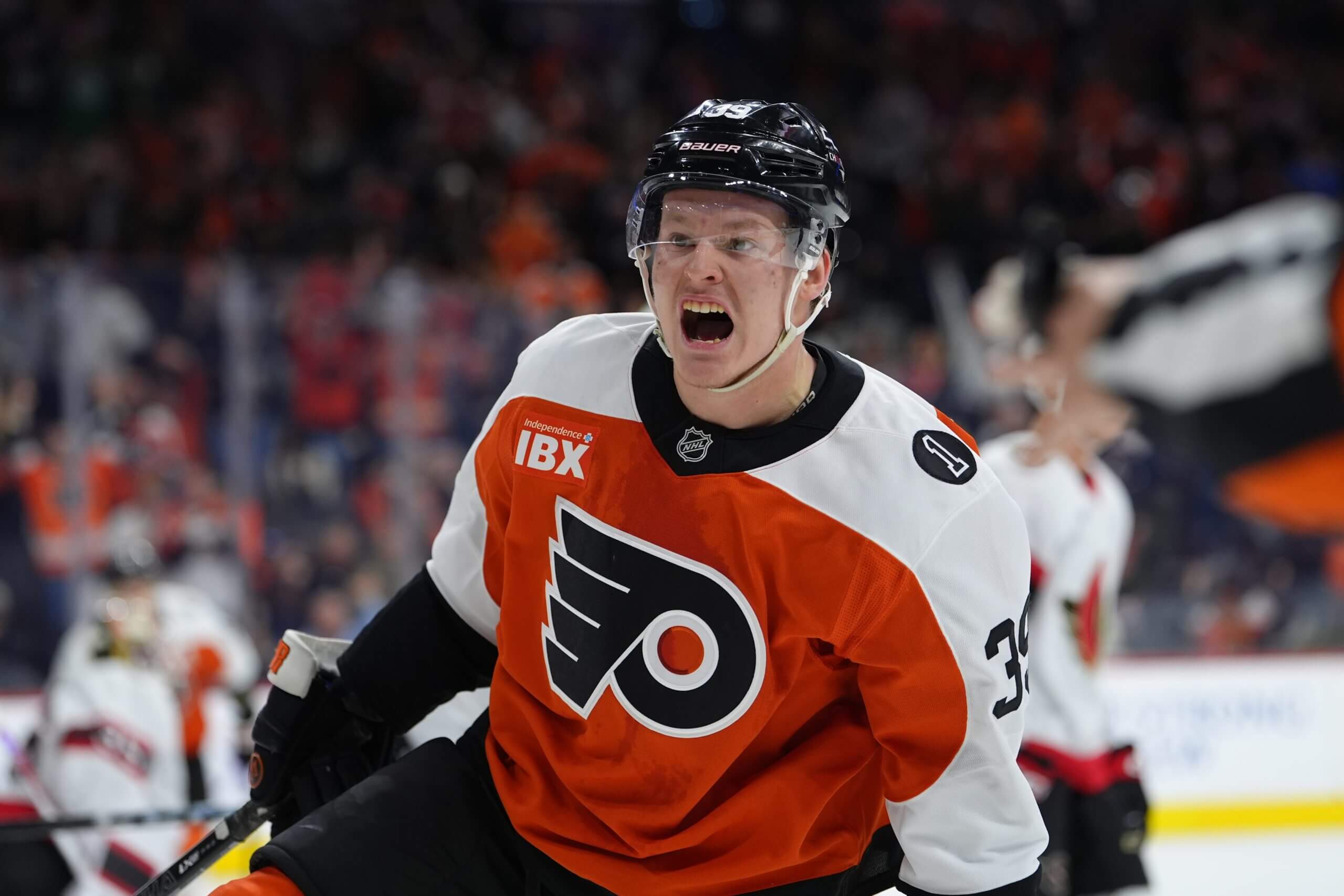
Matvei Michkov has four goals this season but hasn’t been in dangerous scoring areas with the puck as often as late last season. Kyle Ross / Imagn Images
But there’s more to it than a player simply rebuilding cardio and strength.
“The bigger question (is), how long does it take you to earn your coach’s trust back?” Hickey said. “Or, trust in general?”
That, too, seems to be an ongoing process for Michkov, who, at times, makes plays that are too high-risk for Tocchet’s liking.
The Blues game on Friday reflected that. It was notable that with about three minutes left in the third period when it was 5-5, it was Rodrigo Abols taking a shift in Michkov’s place with Sean Couturier and Travis Konecny. Michkov did get a shift in with about a minute to go, but then in three-on-three overtime, when the Flyers didn’t have the puck at all for about the first three minutes, Michkov remained on the bench.
The Flyers being in so many tight games has surely exacerbated the ice time issue. Only the Oilers have played more games past regulation than the Flyers (8), while the Flyers’ 11 one-goal games is tied for sixth-most in the NHL. For a team that has just four regulation wins so far, banking as many points as possible is vital now, particularly with the Metropolitan Division standings so tight.
That makes it a complicated situation if you’re Tocchet. He surely knows that at some point Michkov is going to have play a bigger role in the offense, particularly as the Flyers have shown to be a team that is still figuring out that aspect of the game and the way he wants them to play.
But he also owes it to the rest of the team to play the guys who are producing, such as riding the Trevor Zegras-Christian Dvorak-Owen Tippett line in St. Louis and giving Zegras top unit power play time ahead of Michkov (Zegras has been on the ice for nine of the Flyers’ 10 power play goals this season).
The Flyers are still working out what Tocchet wants them to do in the offensive zone at five-on-five. The most insightful comment we’ve gotten on that front was earlier this month in Montreal, when Travis Sanheim said they were still adjusting to a “brand new system” offensively, that “takes a lot of energy.”
If guys like Sanheim and other veterans are still trying to figure it out — and judging from their 29th-ranked offense, they certainly are — it’s probably even more complicated for Michkov, who is still just in his second season and perhaps still catching up physically.
To be clear, it’s going to be up to Tocchet to ultimately figure this out. If this is still an issue after Christmas, then maybe a closer look at how the coaching staff is handling Michkov will be necessary. But considering we’re not even at the quarter-point of the regular season, and there are other mitigating factors at play, more patience seems to be plainly necessary.