
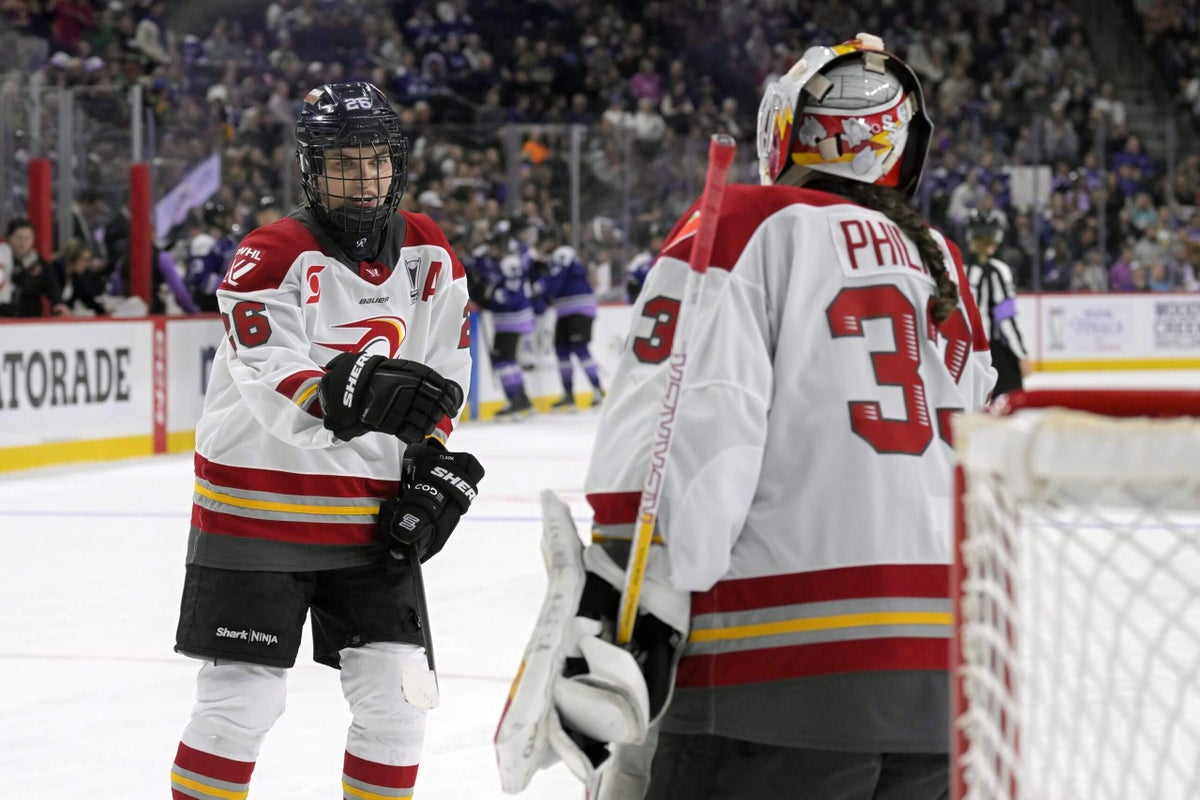
Maybe no team is feeling the pain of PWHL expansion and a league-wide summer of change more than the Ottawa Charge.
Like all of the original six franchises, the Charge lost four players during the expansion draft process: star goalie Emerance Maschmeyer, top-four defenders Ashton Bell and Aneta Tejralová and 2024 No. 2 pick Danielle Serdachny. When free agency opened, top winger Tereza Vanišová signed with the Vancouver Goldeneyes, and center Shiann Darkangelo left for the Montreal Victoire, opening massive holes in a forward group that initially looked fine post-expansion. To make the blue-line damage worse, Zoe Boyd and Jincy Roese also walked.
General manager Mike Hirshfeld has tried to minimize the damage, signing stars Gwyneth Philips and Emily Clark to early extensions. He took a few swings in free agency, and will look to two newcomers to North America to be potential X-Factors for the Charge.
If Ottawa gets the best versions of Philips, Clark, and captain Brianne Jenner, among other veterans, some success is possible. Regression and frustration in Ottawa might be a more realistic expectation, however.
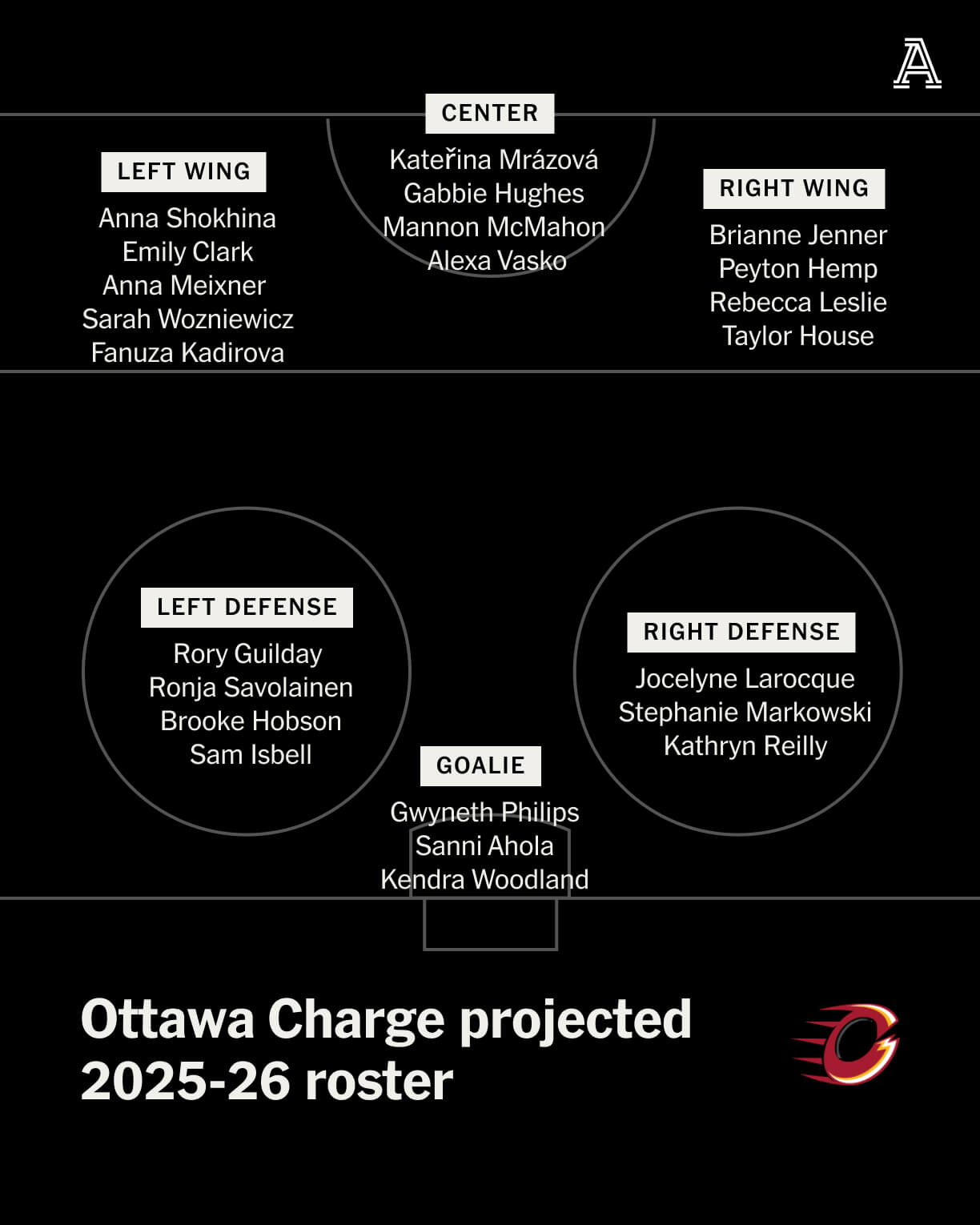
The roster
Strengths
Where would the Ottawa Charge be without Philips?
They probably wouldn’t have made it to the Walter Cup Finals after starting goalie Maschmeyer went on long-term injured reserve in March. They would also look much worse this season after so many big departures in the offseason.
“We’ve got the best goalie in the world, I think also people need to remember that,” Hirshfeld said in the offseason. “We’re going to be in every game, just because we have the best goalie in the world.”
Last year, Philips stepped into the starter’s crease and won four of the final games of the regular season to help Ottawa get into the playoffs. The semifinals against Montreal were a battle of the goaltenders, where Philips came out on top against Ann-Renee Desbiens. In the Finals, Philips stole the show and won playoff MVP despite being on the losing side.
Throughout the Charge’s playoff run, Philips did not lose a single game in regulation — dropping four in overtime — and led the postseason with a .952 save percentage and 1.23 goals against average. She made 257 of 270 saves throughout the playoff run, over 100 more than the next closest goalie.
Philips is the exact type of elite talent Ottawa has struggled to attract in free agency over the last two years, which makes her signing a two-year extension this offseason a significant commitment.
She raises the team’s floor considerably and is its biggest strength. You don’t have to squint to find other gems in the Ottawa lineup, too. Clark has always been a reliable, do-it-all player, but her star turn in the playoffs solidified her as a true face of the franchise in Ottawa.
A two-time Olympian, Clark was often Ottawa’s best skater and hardest worker. She led the team in playoff scoring, tallied two big game-winners (including the goal to send Ottawa to the Finals), had to kill penalties and faced opposing team’s top lines.
Clark also signed a two-year extension this offseason, which, according to The Associated Press, makes her the highest-paid player in the PWHL this season. She already led Ottawa forwards in ice time last season, and unless there’s significant internal growth in the forward group, Clark will likely be asked to do even more in 2025-26.
Weaknesses
Last season, Ottawa was largely built on a collection of several good-to-great players, rather than building around a handful of local stars and a supporting cast of talent like other top teams in the league.
That method worked pretty well as the Charge marched to the Finals, so you could try to be optimistic about Ottawa sticking with that by-committee approach. The problem is, the team lost a lot of those good and great players.
Ottawa struggled to score last season, finishing tied for last in the PWHL with 71 goals, or just 2.4 per game. The losses of Vanišová, who led the Charge with 22 points and was second behind Marie-Philip Poulin in goals (15) league-wide, and Darkangelo (8) are significant.
Between all of Ottawa’s departures, there are 34 goals no longer accounted for, or nearly half of the team’s total offense from last season.
Ottawa played in 24 one-goal games last season between the regular season and playoffs, winning 12. With Philips in net, games might stay close, but it’s unclear whether Ottawa will be able to outscore opponents.
The Charge will need more from Jenner, who only scored seven goals last season, and have to hope that Gabbie Hughes can bounce back after a drop in production from her rookie year. Kateřina Mrázová returning to form and staying healthy will help, too.
However, unless there are leaps from returnees like Anna Mexiner or Rebecca Leslie, who both scored one goal last season, we’ll likely be talking about the same offensive issues all season.
The blue line was similarly depleted, with only three regulars (Jocelyne Larocque, Ronja Savolainen and Stephanie Markowski) returning.
Larocque played exceptionally well in the postseason, but part of what made her return to top-pair form in Ottawa is that the Charge didn’t need to rely on her quite as much as the Toronto Sceptres did. At 37 years old, without her partner in Bell, and the Charge’s questionable depth, Larocque is at risk of being overplayed and regressing a bit this season.
At 5-foot-10, Ronja Savolainen has great size and could be due for a big sophomore season after Ottawa protected her in expansion. First-round pick Rory Guilday should also be a capable top-four defender. She has good size at 5-foot-11 and defends at an elite level with a long reach and physical presence to clear the crease in front of Philips.
Markowski played the fewest minutes of any regular Ottawa defender and could now be moved up the depth chart. The top four might look OK if she, or even Brooke Hobson, who spent the last two years with the New York Sirens, can take a positive step. Yet it really feels like Ottawa’s top-three defenders, who all shoot left, for whatever that’s worth, might be a tad overextended this season.
The big question
Can Anna Shokhina and Fanuza Kadirova be X-Factors for Ottawa?
Ottawa has struggled to retain and attract top talent in each of the last two seasons. Last offseason, it was top scorer Daryl Watts leaving to play for the Toronto Sceptres. This year, it was top-of-the-lineup players like Vanišová, Darkangelo, Roese and Boyd all walking out the door.
Hirshfeld had to get creative and took a big swing at the draft, selecting a pair of Russian forwards.
A star in Russia, Shokhina was a wild card heading into draft night. She has led the top Russian league in scoring and won MVP in scoring six times, winning MVP once. She’s a highly skilled winger who looked to be a worthwhile late-round bet, but Hirshfeld, who called Shokhina the fourth most talented player in the draft, jumped at the chance to take her in the second round.
It’s still an open question how her game might translate to the PWHL, given Shokhina hasn’t played best-on-best at the international level since Russia’s last international competition at the 2022 Olympics. There’s also the varied quality between the ZhHL and PWHL. Still, Hirshfeld was steadfast that Shokhina is “going to be a superstar in this league.”
She looks like a skilled attacking winger who plays quickly, skates well, has great hands and can really shoot. If she works out, that’s a huge win for Ottawa.
Kadirova, 27, is even more of a wild card. When she signed, Hirshfeld said in a press release that she is a talented and skilled goal scorer, but also that the PWHL is going to be a learning curve for her.
“She’s going to need to deal with the physicality in this league,” he said. “But we think the upside is high.”