
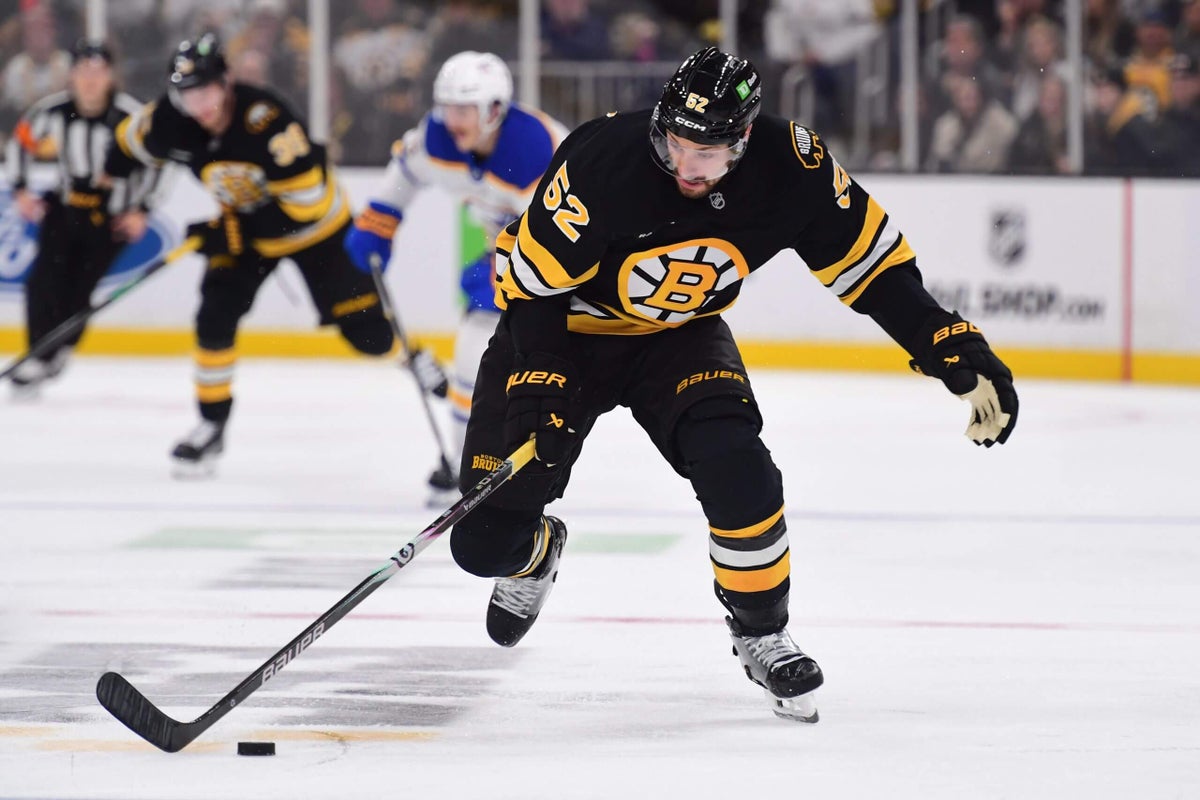
Sean Kuraly is 32 years old. He has made 586 appearances in NHL regular-season games and another 57 in the playoffs. His game relies on speed.
In hockey, those first two variables — age and miles on a body — usually compromise the third.
But the fourth-line center and penalty killer has not slowed down since he concluded his first tour with the Boston Bruins in 2021. It’s been the opposite.
“My jump metrics have probably improved. My speed numbers have probably improved,” Kuraly said. “Not to say that’s some amazing feat. Maybe they weren’t that good to start with, right? But the basic philosophy has been about accessing the power this body has, not continuing to add horsepower.”
Kuraly’s new boss, in fact, has a specific critique. On occasion, Kuraly skates too fast and takes himself out of position.
“There’s just a couple times I wished he would have slowed down a little bit,” coach Marco Sturm said, “and just think a little more.”
On Oct. 25, during the third period of the Bruins’ 3-2 win over the Colorado Avalanche, Kuraly hit a top speed of 22.57 mph. On Nov. 3, 2021, Kuraly, 28 at the time, maxed out at 22.48 mph.
“His skating,” general manager Don Sweeney said, “really hasn’t dropped.”
Kuraly’s path to getting faster began on an operating table. Just not in the expected way.
Kuraly’s max speed by season
SeasonMax speed
2021-22
22.48 mph
2022-23
22.71 mph
2023-24
22.75 mph
2024-25
23.06 mph
2025-26
22.57 mph
Source: NHL EdgeSurgery averted
After the 2020-21 season, Kuraly visited the Hospital for Special Surgery in New York. His hip was in bad shape. Doctors gave him two choices: major labrum surgery or extensive rehabilitation.
Kuraly wanted no part of the former. He needed guidance about the latter.
Paul Whissel is the founder of Root Cause Physio. He used to be the Bruins’ director of sports performance and rehab.
When Kuraly called about his situation, Whissel, who specializes in physical therapy, agreed to examine the center. Whissel believed Kuraly could manage his situation. It would start with his training.
The way Whissel sees it, too much time in the gym can initiate unintended consequences. Whissel targeted two priorities for Kuraly: less is more, and focus on alignment.
“A lot of it is one-sided or we put depth constraints on it,” Whissel said of Kuraly’s movements. “Just to make sure he’s loading what the intended area to be loaded is. Not just doing things fast and quick. There’s just a high focus on movement quality.”
This was new for Kuraly. As a four-year player at Miami University, Kuraly went at it hard in the gym in search of speed, power, strength and explosiveness.
Under Whissel’s guidance, Kuraly adjusted his training to get his hip right. He did not undergo surgery.
In 2021-22, during his first season with the Columbus Blue Jackets, Kuraly scored 14 goals and 30 points in 77 games, averaging 15:52 of ice time per appearance. All were career bests.
Kuraly was sold. It wasn’t just that he was healthy. His performance was peaking.
Kuraly has stayed with Whissel since. Kuraly trains during the offseason in Columbus with a group that includes former Blue Jackets teammate Kent Johnson, who is nine years younger. Whissel, who is based in Portland, Maine, oversees the sessions remotely.
“He’s a big, strong guy,” Whissel said of the 6-foot-2, 208-pound Kuraly. “A lot of times with that, the goal is always to add more, to load more. For Sean, a lot of it was more about trying to get his body in a better position to access what was already there.”
Kuraly does not do any heavy deadlifts. He estimates he has lost some of his upper-body mass.
“I don’t do anything,” he said, “to keep my arms strong.”
His purpose is to keep every cylinder hammering in his engine. Otherwise, he’s out of the league.
“Be healthy and be fast,” Kuraly said. “They’re the things I’ve kept at No. 1 and No. 2 priorities. That’s what I spend all my time on off the ice.”
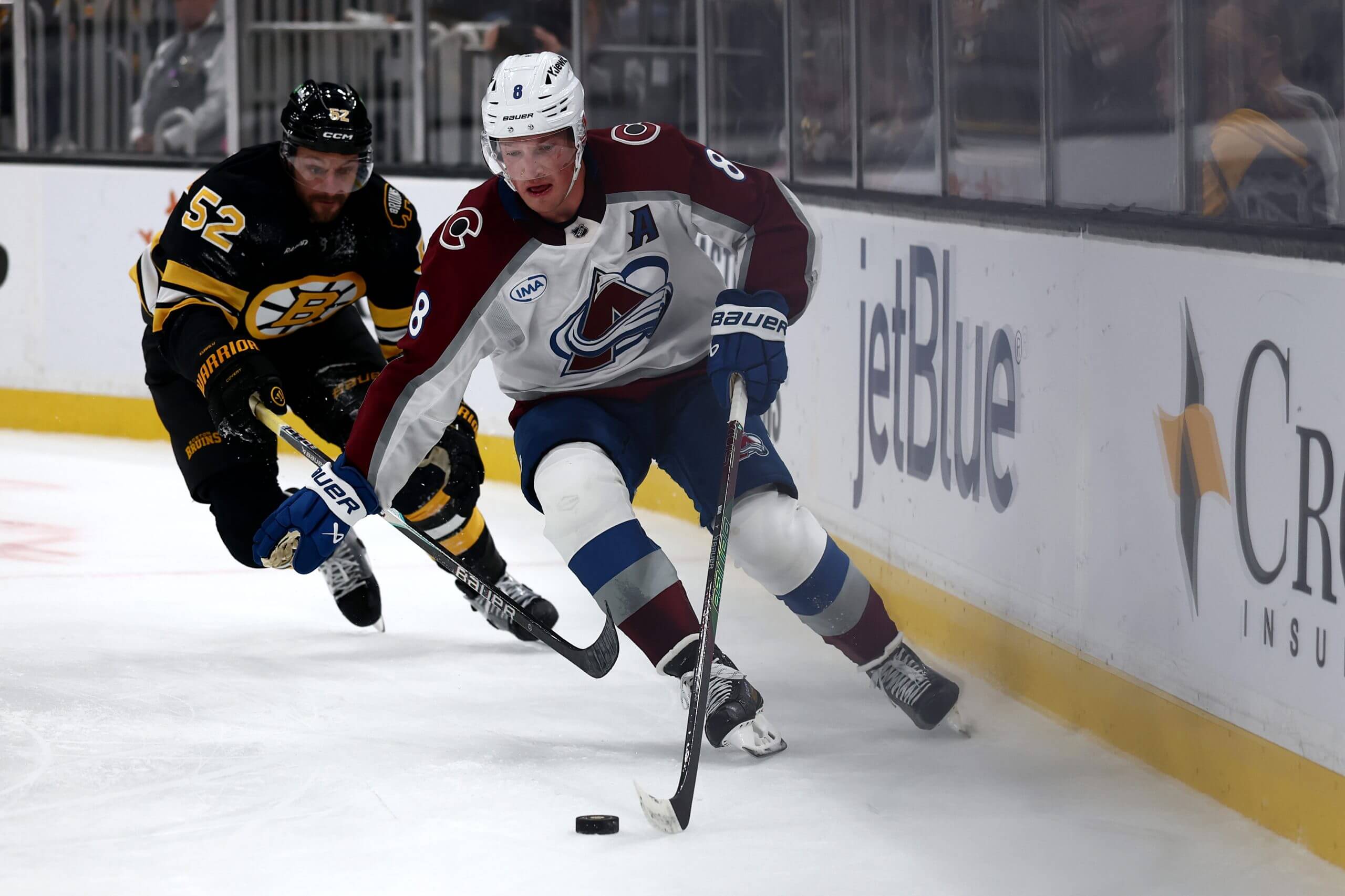
Sean Kuraly (52) chases one of the NHL’s fastest players, Colorado Avalanche defenseman Cale Makar. (Maddie Meyer / Getty Images)
Staying young
The wall hits hard for players of Kuraly’s profile. It is simply nature at work.
“That, is going to be the No. 1 thing that, as you go on, you see why guys are falling out of lineups,” Kuraly said of players’ declining speed. “So I’ve had a good eye on that for my whole career. It’s been a major focus.”
Less speed is just one thing. Injuries are another.
“Loss of relative motion,” Whissel said of a common shortcoming that comes with age. “The hips is a huge one. When you have less time and room to express force down because you have less motion at your hips, you’re trying to accomplish that through your back or other areas. There’s a high secondary cost, and the output is going to be less.”
Kuraly regularly kept his foot on the gas during his first leg with the Bruins. He’s more selective with the accelerator this time.
“I’m finding ways to get better and achieve results with a smarter way to get it done,” Kuraly said. “In terms of changing speeds or being able to be in a right spot, I’m not skating 100 miles an hour a whole shift. When the puck does come to me, I’ve got the energy to go 100, not 90.”
During the offseason, Kuraly lifts three times a week. On Mondays and Wednesdays, he focuses on 10-yard sprints. He typically runs four to six sprints — sometimes from a standstill, other times with a 10-yard fly-in — with three or four minutes of rest in between. Kuraly is aiming for maximum speed on each rep. His sprints are timed. Whissel insists on proper breathing.
Kuraly tries to master proper foot contact with each stride. This accesses peak power. It also translates to the ice.
“It’s not that we don’t jump or measure jumps,” Whissel said. “But I tend to think the horizontal has greater carryover than the vertical. It’s just a very safe way. His spine is less loaded during those than if he had weight on him and doing some type of loaded jump. For him, especially getting older, it’s important.”
Last year, Kuraly averaged a career-low 11:46 of ice time per game, including 0:54 on the penalty kill. He is up to 13:56 this season, with 3:15 of it on the PK.
In Sturm’s system, the center needs to be patient in the defensive zone instead of chasing pucks at maximum velocity. Kuraly is still learning when to pick his spots. But when he has to go, his body gives him what he needs.
“It’s a really big part of what keeps guys in the league at an older age,” Whissel said. “With how fast the game has gotten, it stands out more and more when you start to slow down and the wheels stop. I think you could have gotten away with that 10, 15 years ago. I think it was easier for guys to potentially last longer. But with how quick the game’s gotten, he realizes that, especially with the type of game he plays. He forechecks hard. He’s really looking to be a presence out there. His hockey smarts are part of it. But his speed is a huge, huge asset for him.”