
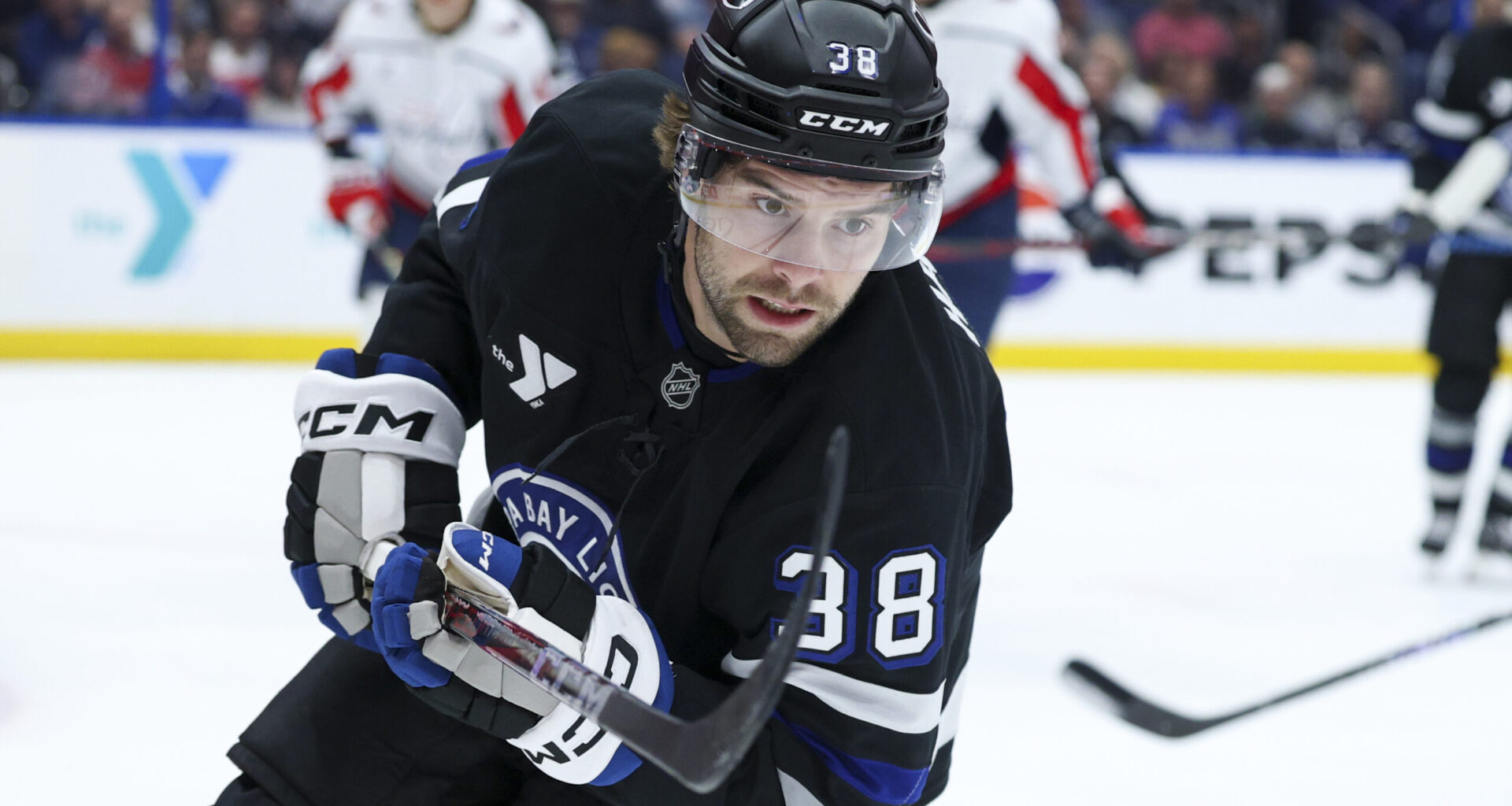
The Tamp Bay Lightning played 14 games in November and won 11 of them. That’s it, that’s the review. We really don’t need to get any deeper than that.
But, we do. Well, we have to in order to show up in Google results.
The Lightning started the month 15th out of 16 teams in the Eastern Conference. They had rallied to a 5-4-2 record in October, but still had a mountain to climb in the standings as only the Buffalo Sabres were behind them. After ripping off their 11 victories, including an on-going seven-game winning streak, they found themselves at the top of the conference, tied with the Carolina Hurricanes (the Sabres remained at the bottom).
So, how did they start at the bottom to end up at the top? It was because they generated more scoring chances, right? Nope.
More high-danger chances? A little.
Okay, so defensively, they allowed fewer scoring chances, right? Nope.
Alright, they allowed more scoring chances, but they weren’t high-danger ones, right? Yeah, that’s going to be another no.
Then how did they win 78.5% of their games? Let’s look at the numbers.
5v5 stats and league-wide rankingsOctober (5-4-2)November (11-3-0)GF/602.48 (18th)3.24 (5th)xGF/603.10 (4th)2.87 (5th)GA/602.48 (15th)2.25 (11th)XGA/602.29 (7th)2.65 (19th)SCF/6028.17 (8th)27.0 (12th)SCA/6022.40 (2nd)25.56 (11th)HDCF/6011.32 (16th)11.70 (10th)HDCA/608.84 (2nd)10.71 (13th)Save Percentage.907 (15th).915 (9th)Shooting Percentage9.33% (19th)13.14% (2nd)Stats courtesy of Natural Stat Trick and NHL.com
We guess it all comes down to those last two stats. Which, as a site that enjoys the “fancy” stats from time to time is a little disappointing. We were hoping there was something in the possession numbers that explained their success, and it comes down to some old school stats like save percentage and shooting percentage.
Heck, the Lightning didn’t even generate more shots on net, in fact, they had fewer.
OctoberNovemberShot attempts59.2955.18Unblocked shot attempts43.8539.69Shots on goal26.4224.66Percentage of total attempts on net44.5%44.69%
Sometimes the puck just starts going into the net. There was a slight uptick in converting their high-danger chances (1.62 HDGF/60 vs. 1.41 HDGF/60) and a big improvement from their mid-danger chances (1.17 MDGF/60 vs. 0.59 MDGF/60). Even if they weren’t generating more of those types of chances they were doing a better job of finishing them.
Individually, their top players (at least the healthy ones) carried them as Nikita Kucherov finished the month tied for third in points with 22 (7 goals, 15 assists) while Brandon Hagel was tied for sixth with 19 points (12 goals, 7 assists). Those 12 goals trailed only Jason Robertson’s 13. Meanwhile Jake Guentzel continued his team MVP quest by adding another 17 points (10 goals, 7 assists).
Hagel’s return to his scoring ways has been a huge boost to the offense. He never stopped generating chances, and now that the puck is going in for him, it has helped pick up the slack with Brayden Point struggling to find the back of the net.
We may have jinxed the team a little last month when we used the phrase “healthier roster”. Throughout the 14 games, 27 players suited up for at least one game with 24 of them recording at least one point. Boris Katchouk (3 games), Jakob Pelletier (1 game), and Max Crozier (4 games) were the unlucky trio. The injuries the Lightning suffered did allow a few players to step up their roles with the team, and a couple flourished.
Darren Raddysh had one of the best months of his career, posting 2 goals and 11 assists in his 12 games. Four of those points came on the power play as he took over Victor Hedman’s spot on the point. Overall the team was slightly better with the extra skater as they finished at 18.4%. While not at their normal lofty standards, it was at least middle of the pack for the league.
Charle-Edouard D’Astous chipped in 6 points (1 goal, 5 assists) and blocked 17 shots while playing 19:06 in a second-pairing role. Zemgus Girgensons had three goals in the month and led the team with 41 hits. More importantly, he teamed up with Yanni Gourde and Pontus Holmberg (during the seven games he was healthy) to give Coach Jon Cooper a cohesive third line that could defend and still generate chances. The trio had a nifty 60.97% edge in expected goals during the 77 minutes they were together.
The Lightning bumped up their scoring, but the real hero of the month was Andrei Vasilevskiy. His 5v5 numbers were fantastic – .932 SV%, 1.94 GAA, and an 8.47 GSAx. Those are Vezina-level numbers (well, they would be if Jesper Wallstedt wasn’t going off in Minnesota). He may be getting older, but he can still stop pucks with the best of them.
With the restructuring of the Lightning defense in front of him due to the injuries sustained by Victor Hedman, Ryan McDonagh, and Eric Cernak, he faced a few more chances in November than he did in October. While the Lightning allowed more high-danger chances against, Vasilevskiy stepped up his game, posting a .908 SV% on those opportunities compared to the .778 SV% he had in October.
On those rare occasions Vasilevskiy took the night off, Jonas Johansson did what all coaches want their back-up to do – he gave the Lightning a chance to win. His numbers weren’t mind-blowing – .865 SV%, 2.96 GAA, -2.84 GSAx, but he went 3-1 in his four starts.
The Lightning were able to put their season back on track with one of the best months in franchise history. While winning 75% of their games moving forward isn’t feasible, they put themselves in a position where they can control their own destiny moving forward.
Their current seven-game winning streak opened up a small gap at the top of the standings as they have a four-point lead over second-place Boston (with two games in hand). They are also six points clear of falling out of a playoff spot. The East is still compressed as last-place Buffalo is only five points behind Pittsburgh, who holds the second Wild Card spot. With a schedule that skews heavily to Eastern Conference games, the Lightning can continue to widen the gap if they can continue to pile up the points.