
Montreal Canadiens head coach Martin St-Louis was asked about the relatively low ice time given to rookie Ivan Demidov, who is currently second in rookie scoring, with 19 points in 24 games.
His answer was slightly confusing, but if there’s one thing I’ve learned since he took over as head coach, it’s that we should react to his decisions, not necessarily to his answers during press conferences.
Habs coach Marty St. Louis today on giving more ice time to Ivan Demidov:
“He’s just gotta continue doing what he’s been doing. I know I can give him more (mins) and I’m trying to. Sometimes it’s a matter of context, sometimes I look at the game sheet and think: ‘Jeez he only… pic.twitter.com/Pj1BY4SY57
— /r/Habs (@HabsOnReddit) December 2, 2025
Ivan Demidov’s Ice Time
Demidov has averaged 10:51 of 5v5 ice time per game, which is the second-lowest mark among all regularly used players this season. Only Oliver Kapanen, his centre, averages less ice time (10:40), though the difference is negligible.
On the surface, it’s quite clear that he’s using Demidov sparingly, at least at 5v5.
It should be noted that this isn’t abnormal when it comes to how St-Louis integrates rookies into his lineup. Juraj Slafkovsky, drafted first overall in 2022, was given an average of 10:47 ice time at 5v5 during his rookie season.
However, Slafkovsky was only given 1:17 average ice time on the powerplay that season, whereas Demidov is already averaging 2:20 on the powerplay per night, a significant uptick in man-advantage usage.
In that vein, we can already state that Demidov is ahead of the Slafkovsky development curve when it comes to his overall ice time.
But the main point of contention when it comes to his ice time is clearly his TOI at 5v5, which leads us to the next step of the evaluation.
Why isn’t Demidov being used when the game is on the line?
Once again, we can turn to Slafkovsky for a partial answer, as he was regularly stapled to the bench during his rookie season whenever the game entered the last 10 minutes of the third period.
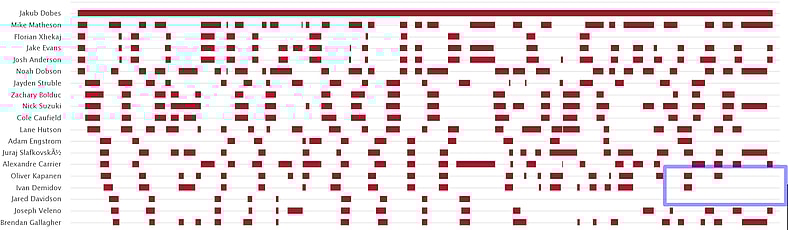
The same phenomenon is taking place with Demidov, as evidenced by Wednesday’s game versus the Utah Mammoth. He was given just one shift after the 50-minute mark, while his centre, Kapanen, was given two.
But is it just a matter of not trusting Demidov and Kapanen’s defensive prowess?
The numbers suggest it’s a legitimate factor. While playing together this season, Demidov and Kapanen have managed to control a little over 40 percent of the shots, and 45 percent of the expected goals. It’s not particularly surprising. After all, they are rookies.
To make matters more complicated, Kapanen is the only centre in the lineup this season that has a sub-50 percent faceoff efficiency, which has led to St-Louis relying on Nick Suzuki, Jake Evans, and Joe Veleno whenever a faceoff win is needed, and thus, fewer opportunities for Demidov in the third period.
Montreal Canadiens Brass Tacks
Statistically speaking, St-Louis is making the right call by avoiding Kapanen when the game is on the line, but it’s also fair to say he’s the person who decides upon the lines, therefore, it’s his decision that has limited Demidov’s usage at 5v5.
I’d also argue that Veleno, despite winning 50.9 percent of his faceoffs this year, doesn’t win enough draws to compensate for his lack of defensive value. Coaches tend to get tunnel vision when it comes to faceoff percentages, and while it’s true that Kapanen only wins 48.9 percent of his draws, it’s a negligible difference in the long run. We’re talking about one or two extra faceoff wins for every 100 draws.
Demidov, like Slafkovsky before him, should start to receive more ice time as the season unfolds, but based on St-Louis’ decisions, he’s not being used with a trustworthy centre, which mitigates his ice time at 5v5.
Seeing as there’s no internal solution to the lack of centre depth, there’s a risk that Demidov’s ice time is unlikely to increase at 5v5 in the near future.
All Montreal Canadiens statistics via Natural Stat Trick.

Marc has been covering the Habs for over a decade. He previously worked for Journal Metro, The Athletic, The … More about Marc Dumont