
Dan Ninham
Special to ICT
Bimaakoweba’igedaa! Let’s play hockey!
That was the message — in Ojibwemowin — at a groundbreaking hockey game between the Colorado Avalanche and the Minnesota Wild on Nov. 28, marking the first time a National Hockey League game had been broadcast entirely in the Ojibwe language.
The historic broadcast was a part of the Wild’s celebration of Native American Heritage Day and reflects a growing partnership between the Minnesota Wild and the Mille Lacs Band of Ojibwe, which recently secured naming rights to the team’s arena, now known as the Grand Casino Arena.
The Ojibwemowin broadcast was a collaborative effort between FanDuel Sports Network, the Mille Lacs Band, the Grand Casino and the Midwest Indigenous Immersion Network, a nonprofit dedicated to revitalizing the Ojibwe language.
“This milestone reflects our ongoing commitment to celebrating the Indigenous communities who have long been part of Minnesota’s cultural fabric,” Matt Majka, chief executive officer of the Minnesota Wild, said in a statement.
“We’re proud to help expand access to the game we all love and to support the preservation and vitality of the Ojibwe language for generations to come.”
The game was called by respected language speakers Gordon “Maajiigoneyaash” Jourdain, Ph.D., Lac La Croix First Nation; Chato “Ombishkebines” Gonzalez, Mille Lacs Band of Ojibwe; and James “Ginoonde” Buckholtz, Lac du Flambeau Band of Ojibwe.
When the Wild scored a goal, the broadcasters yelled and jumped for joy speaking Ojibwemowin. The Minnesota Wild posted live snippets of the game on social media.
The Wild edged out the Avalanche 3–2 in overtime, including an ensuing shootout.
‘The opportunity in front of us’
The partnership began forming soon after the tribe won the rights to rename the arena.
“The Mille Lacs Band reached out and asked me if I would be willing to do an invocation and set a dish, an offering for our relationship in blessing our future, you know, potential good doings for the community and for the economy,” said Baabiitaw Boyd, co-founder of the Midwest Indigenous Immersion Network.
“When I went to do that talk, the owner Craig Leipold was welcoming us after we did the initial talking for food and tobacco. He stated that he was so happy to be a partner and he was looking forward to all of the opportunity in front of us, at which point I raised my hand and interrupted the man … and I said, monolingual Ojibwe commentary for every live game,” Boyd said.
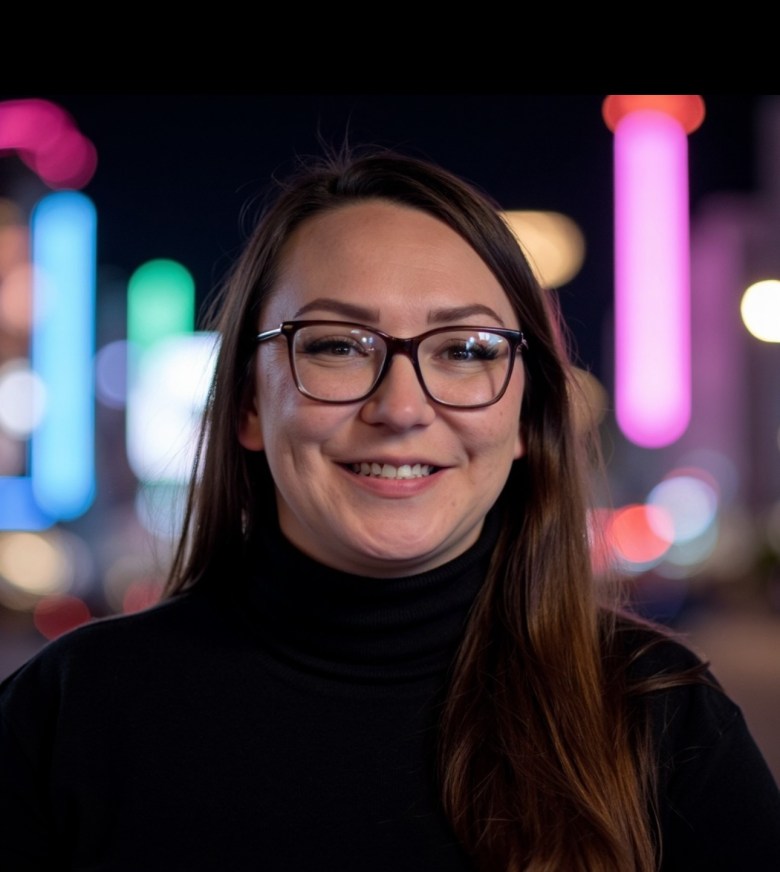 Baabiitaw Boyd is co-founder of the Midwest Indigenous Immersion Network.
Credit: Photo courtesy of Baabiitaw Boyd
Boyd continued to talk about extending the conversation of collaborating with the NHL franchise with Indigenous initiatives. She said Leopold exclaimed when addressing her idea, “Yes, that’s what I’m talking about. I’m talking about opportunities like that. Those are great ideas.”
About a month later, she said, representatives from the Wild and from Mille Lacs Corporate Ventures reached out.
“And so it began,” she said. “I helped coordinate the commentators and bringing on the people that would do good to hockey and do good by the language with their skill set … We knew that the folks that we chose for this particular commentary were deeply knowledgeable.”
Paul Loomis, executive producer of video content for the Minnesota Wild, helped train the broadcasters for their historic roles that included shadowing broadcasters working live NHL games.
“Once the decision was made that we could indeed execute this alternate broadcast, I asked Baabiitaw Boyd if the three commentators could attend the two games prior to observe,” Loomis told ICT. “So, they came to the game on Sunday, Nov. 16, versus the Vegas Golden Knights, and again on Wednesday, Nov. 19, versus the Carolina Hurricanes.”
“The Golden Knights game was broadcast on our broadcast partner, FanDuel Sports Network, the Carolina game was broadcast on TNT sports as a national broadcast,” Loomis said. “I reached out to both networks requesting that our three Ojibwe commentators be in their respective broadcast booths for the live pregame and intermission on-camera segments, so they see how live television is executed from the perspective of the on-air commentators.”
Both networks agreed, Loomis said.
“They were able to observe the execution of our regional partner and national broadcast from their TV booths — something virtually nobody is able to experience,” Loomis said.
“While they were at the game, I also brought them into the TV trucks, located in the basement of the arena, to help them understand to whom the commentator is speaking from the booth, and how the broadcast is put together and distributed out of the arena to all the homes in the region,” he said.
They also set them up in the same TV booth they used during the game “to get a feel of the angle and distance from the ice to call the game,” Loomis said. “At the Carolina game, we gave them headsets to get used to listening to each other in the earmuffs .. We exposed them to all that we could in a short period of time to get a good idea of the flow of the game, and the process of the broadcast production.”
Talking hockey
Ojibwe commentator Gonzalez told ICT that he and his fellow broadcasters prepared for their big show. Part of that was identifying Ojibwemowin words used for hockey.
“Maajiigoneyaash and I started just talking about hockey,” Gonzalez said. “I started writing all the words down that I could as we went along,and asked for clarification on what I did not know. Then we were allowed in the booth at the live Wild game to get a feel for the game and talking to each other through headsets standing next to each other.”
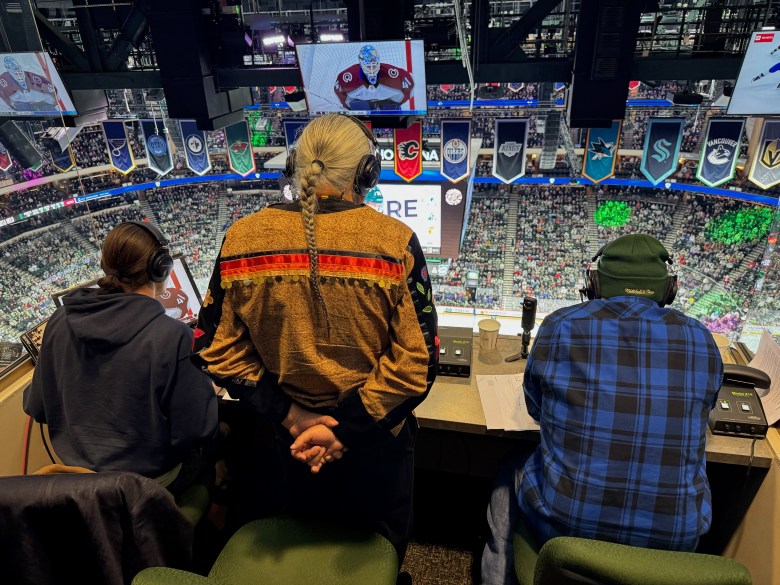 Broadcasting a National Hockey League game live in the Ojibwemowin language for the first time ever are, from left, James “Ginoonde” Buckholtz, Lac du Flambeau Band of Ojibwe; Gordon “Maajiigoneyaash” Jourdain, Ph.D., Lac La Croix First Nation; and Chato “Ombishkebines” Gonzalez, Mille Lacs Band of Ojibwe. They broadcast the game Nov. 28, 2025, between the Minnesota Wild and the Colorado Avalanche at the Wild’s Grand Casino Arena in Minneapolis. Credit: Dan Ninham/Special to ICT
It was a learning experience, he said.
“Harder than I thought,” he said. “I then started writing more words and Maajii and I cleaned up our list and added more words as we went along. I then found a Hockey 101 glossary. So I pulled out from what we already created. Filled in voids.”
They relied on their own experiences to select the correct Ojibwemowin words.
“Being hockey is a sport played by Maajii and myself, we were familiar with how to talk about the game,” said Gonzalez. “There are everyday Ojibwe words used, such as mitig for hockey stick. But it’s really just a stick in general. But we included it because that’s what Maajii used growing up. We also added words like bimaakoweba’iganaatig as a literal definition for when there does need to be a technical turn. Also using old words and repurposing them, such as bima’iganaak, that is a word Maajii offered for scoreboard. It comes from the scorekeeping stick used in the moccasin game.”
A few glitches and kinks needed to be worked out while the Wild/Avalance game broadcast was live. The broadcast had technical difficulties, and the Ojibwemowin was absent on the airwaves for the first two periods. It finally came in the third period and continued through overtime and shootout.
“Our special Ojibwe-language Wild game broadcast was affected by unexpected technical issues,” a FanDuel spokesman said after the game. “Our team acted quickly to identify the problem, and the feed was fully restored. We regret the viewing experience was impacted and apologize for any inconvenience this may have caused.”
Growing interest in Indigenous language
Indigenous language radio and television broadcasts of sporting events occur throughout Indian Country in Canada and the United States, including a recent Cree-language broadcast in Canada and longstanding sports broadcasts in Navajo.
“All the years I’ve broadcasted sports my main goal was to bring to action through radio,” said Cuy Frank, a Navajo citizen and manager of KCZY radio of Navajo Technical University. Frank has been broadcasting basketball and football in the Navajo language for more than 20 years.
“Just the other day, a listener said she was trying to explain to another how I was calling a foul. They said it is difficult but if you’re listening and understand the language it makes perfect sense,” added Frank.
Frank said he has learned to adapt.
“The Navajo language has some limitations but the fun part is its ability to transform the game into a colorful and new world that makes each play and action visually illustrated through the language,” Frank said. “I take from the stories or rules like from the Navajo shoe game or races, but at a pace with basketball. Or it can be as simple as translating a rule and giving it a shorter name in the event it has to be called and the next important action comes.”
Finding the right words and descriptions in another language has been key, he said.
“My main goal is to keep the pace and my calls consistent and continuous at least for basketball due to its fast pace at Division 1 college,” he said. “For football it’s a lot more fun when I have an analyst who is fluent and this allows us to be creative in our description of the game. Play-by-play is my forte but having someone to discuss the previous play or to explain a flea-flicker is good.”
He continued, “Overall, the joy is keeping the listener involved and painting a picture of each moment and action for them through our very descriptive Navajo language.”
A standard has been established in Canadian television networks spearheaded by the Aboriginal Peoples Television Network, or APTN. Although the Wild/Avalanche game was a first for an Ojibwemowin broadcast, the Plains Cree and Inuktitut languages have been broadcast on NHL networks for more than a few years.
In 2023, a five-game broadcast series, “Hockey Night in Cree,” featured all seven Canadian National Hockey League teams in a program aired on the Aboriginal Peoples Television Network, or APTN.
Studio host Earl Wood, Saddle Lake Cree Nation, talked about the need to continue to hear Indigenous languages on the airwaves and beyond.
“It’s in our DNA,” he said. “We all have that collective genetic memory, so the language is embedded in all of us. All we have to do is water it and wake it up a little bit and help it grow.”
The broadcasts are expected to return in Cree – with a new broadcast in Inuktitut – in the upcoming season, according to the APTN website.
“Experience the thrill of NHL hockey in Indigenous languages with APTN,” the website states. “This season, ‘Hockey Night in Canada’ in Cree returns alongside the debut of ‘Hockey Night in Canada in Inuktitut.’ APTN is bringing the language, culture, and excitement of hockey to new heights. Tune in to APTN and APTN Languages and celebrate the rich heritage of Cree and Inuktitut while cheering for your favourite teams.”
The APTN website hosts bios, a Plains Cree dictionary of hockey vocabulary, and a video example of a game with the Indigenous language.
The Minnesota Wild events builds on those groundbreaking moments.
“This and future events will set a new standard of expectations toward normalizing our language, Ojibwemowin, in all spaces we share,” Dustin “Gimiwan” Burnette, president of Midwest Indigenous Immersion Network, said in a statement.
“This could lead to partnerships as big and bold as any of our regional sports teams want them to be,” Burnett told ICT. “We’d love to be more involved with the sports we all love. The cost to allow for broadcasting in this capacity is relatively low compared to the value it brings to our archival and revitalization efforts.”
He added, “There are still a few thousand first-language speakers of Ojibwemowin in Ontario and Manitoba. I could see several Wild fans from our Northern relatives wanting to be a part of this.”
Loomis summed up the post-game celebration by addressing the future of the Ojibwemowin broadcasts.
“I think it’s safe to say that we will do this again in the future,” he said. “Timing depends on all parties— our friends and Ojibwe representatives, Wild, and FanDuel.”
“FanDuel is our broadcast partner, so it would have to be done with them. But what we can learn from this first try is exciting and will only help the next time we do this. I, personally, can’t wait to do it again.”
Related