
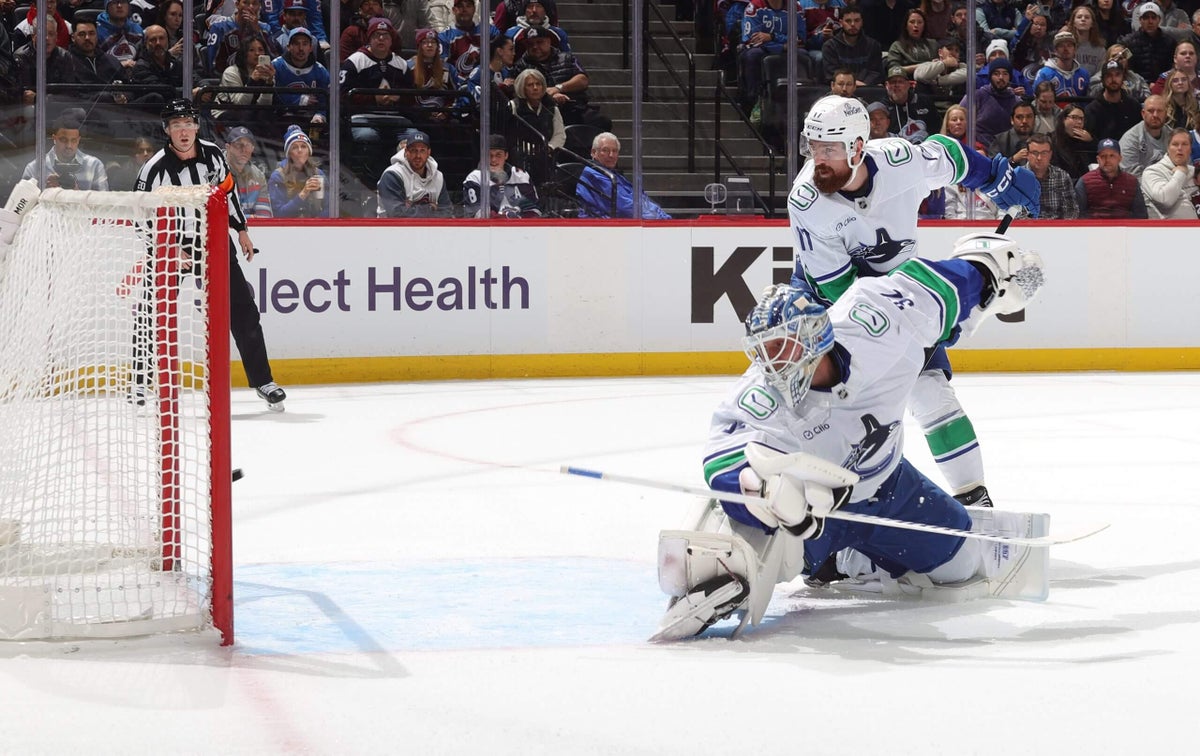
After 27 games, the Vancouver Canucks have completed one-third of the 2025-26 NHL season. It’s been a nightmare beginning to a high-stakes campaign.
The Canucks are in 30th place in the NHL standings with a dismal 10-14-3 record. They’ve picked up just three regulation wins in their last 21 games. They haven’t won back-to-back games since their first mid-October road trip, back when Filip Chytil was still healthy.
Vancouver’s front office has indicated it’s ready to begin selling, a telling sign of the organization’s bleak state.
There are still two-thirds of the season left to be played, so the Canucks aren’t technically out of the playoff race yet. Last year, the Canadiens got off to an identical 10-14-3 start and still made the postseason. Let’s be realistic, though; it would take a miracle for this Canucks team to replicate that kind of against-all-odds rise back up the standings.
Many fans have already started firing up draft lottery simulators, hopeful that the franchise can draft as high as possible next summer. It raises an obvious question: Could the Canucks be bad enough to finish near the bottom of the league standings and secure a top-five draft pick? This is a crucial question to forecast because an awful start doesn’t always guarantee a top-five or even top-10 pick.
In 2022-23, for example, the Canucks had the worst 16-game start since the Mark Messier era, and were similarly in 30th place in the NHL standings. We did a similar piece at the time, predicting that Vancouver was a pretender in the Connor Bedard sweepstakes, and sure enough, the club went through a midseason coaching change and ended up picking 11th that summer.
A top-five pick would be a tantalizing reward for Canucks fans this season. While Gavin McKenna is the likely prize with the No. 1 pick, there are five or six players at the top of the 2026 NHL Draft with star potential.
It goes without saying, of course, that coaches and players will never intentionally “tank.” NHL players are hypercompetitive athletes who hate to lose. There are always stakes at the individual level to motivate players, whether it’s future ice time, role or future contracts. This Canucks team, for all its flaws, has competed hard.
Strong effort doesn’t guarantee any results in the NHL, though. And the Canucks have a better chance of finishing bottom five in the league standings than they did during their last slow start in 2022-23. Here’s why.
A lack of truly bad teams this year
How low the Canucks will finish in the standings isn’t solely determined by their performance and record. A lot will also hinge on how bad the teams around them are.
In recent years, it’s been exceptionally difficult to sink all the way to a bottom-three finish. Teams have needed 60 points or fewer in three of the last four years just to finish 30th, let alone 32nd.
However, this year, the barrier to entry for a bottom-three or bottom-five finish could be significantly easier. Only three teams besides the Canucks have a points percentage below .500 so far. That’s a significant drop-off compared to this time last year, when 11 teams had a sub-.500 points percentage. Many clubs that were expected to be contenders for a bottom-five finish before the season began are off to better-than-expected starts.
Surprise NHL starts
Team
Record
13-7-5
14-8-3
14-10-3
15-13-0
13-11-3
11-7-6
11-9-6
I expect some of these teams to come back down to Earth over the remainder of the season. Macklin Celebrini and Connor Bedard are the real deal, but the Sharks and Blackhawks have also been carried by exceptional goaltending that may not last. Seattle has been outshot and outchanced by wide margins at five-on-five, but is benefiting from a mini PDO bender. These clubs could slow down and slide in the standings, but the early-season points that they’ve already deposited mean the threshold for a bottom-five finish could be more doable than in other recent seasons.
Colleague Dom Luszczyszyn’s model projects only two teams to finish below 73 points: the Nashville Predators and Calgary Flames. The Predators and Flames are poor teams, but they aren’t anywhere near historically awful, unlike some bottom-feeders in recent years.
However, they’re both still more likely to finish 32nd or 31st than the Canucks. The Predators were one of the worst teams in the NHL last year; their centre situation is just as dire as Vancouver’s, and they don’t have a Quinn Hughes-level game-breaker. There’s also a decent chance they could sell off some of their veteran talent like Ryan O’Reilly, Steven Stamkos, Jonathan Marchessault, and perhaps even Juuse Saros, closer to the trade deadline.
The Flames, meanwhile, are even more starved of high-end offensive talent than the Canucks. They’re the lowest-scoring team in the NHL by a substantial margin, and Nazem Kadri is the only player on the team on pace for more than 45 points. Calgary also has the most difficult strength of schedule of any NHL team for the remainder of the season, according to Tankathon.
Besides Nashville and Calgary, though, it feels like the race to the bottom is wide open.
Why Canucks’ defensive woes could sink them
No matter how many injuries or offensive woes they faced last year, the Canucks’ floor remained relatively high thanks to their defensive structure under Rick Tocchet. Vancouver ranked top 10 in the NHL last season at suppressing both shots and expected goals against per 60 at five-on-five. That kept the team competitive and close in games last season, even when the lineup was missing key contributors (remember when Noah Juulsen was playing top-four minutes for a stretch when Filip Hronek was hurt?)
This year, the Canucks are surrendering goals against per game at the worst rate in the NHL. And they’ve fully deserved this fate, as their defensive metrics for limiting shots and high-danger chances are among the worst in the league.
Heading into the season, many expected that the Canucks would be an upper-echelon team at preventing goals against, based on the quality of their blue line and the strength of their goaltending tandem on paper. However, I think we have to downgrade our expectations for the Canucks’ competitiveness this season, given the dramatic deterioration of their defensive environment since Tocchet’s departure.
The Canucks have controlled 43.9 per cent of expected goals at five-on-five this season, according to Evolving-Hockey. There are 15 instances since the 2021-22 season in which an NHL team has owned a five-on-five expected goal share below 46 percent through the first week of December (approximately the one-third mark of the season). Thirteen of those 15 teams finished bottom 10 at the end of the season. Nine of those 15 teams (60 percent) finished bottom five.
xG share below 46% thru 1st week of Dec
Team
Season
xGF%
Final Points
Bottom 5 Finish?
Bottom 10 Finish?
2024-25
43.7%
52
Yes
Yes
2024-25
43.4%
80
No
Yes
2024-25
45.6%
91
No
No
2023-24
40.2%
47
Yes
Yes
2023-24
41.4%
52
Yes
Yes
2023-24
45.5%
76
Yes
Yes
2022-23
39.4%
58
Yes
Yes
2022-23
41.3%
59
Yes
Yes
2022-23
44.8%
59
Yes
Yes
2022-23
40.2%
70
No
Yes
2022-23
42.8%
75
No
Yes
2021-22
43%
57
Yes
Yes
2021-22
43.4%
61
Yes
Yes
2021-22
45.2%
73
No
Yes
2021-22
45.4%
81
No
No
Note: I excluded teams that made a midseason coaching change, such as the 2022-23 Canucks, because those clubs often saw a new coach bump in the second half. Adam Foote is a first-year head coach, so we can safely assume Vancouver won’t make a coaching change.
It’s important to clarify that most of the teams that finished below 60 points in the standings had an expected goal share closer to the 40ish percent range at this stage of the season, rather than the 43-44 percent range the Canucks are in right now. In other words, it’d be unfair to compare this year’s Canucks to the historically awful Sharks and Blackhawks teams from recent years, which were a whole different level of miserable.
But again, because the NHL lacks true bottom feeders this year, you probably don’t need to drop below 70 points to finish bottom-five in the standings anyway. Put bluntly, the Canucks’ underlying profile resembles that of a team that should remain in the basement.
What about the injuries?
The Canucks have been hammered by injuries through the first quarter of the season. However, I’m not convinced that the return of players like Teddy Blueger, Derek Forbort and Nils Höglander will fix their two-way problems.
Good teams don’t see their defensive structure completely collapse when a few key players are missing. Look at how well the Carolina Hurricanes have performed despite their injured blue line, for example. Jaccob Slavin, the best shutdown defenceman in the NHL, has played two games all season. They also had other key top-four defenders, such as K’Andre Miller, Jalen Chatfield and Shayne Gostisbehere, miss time with injuries earlier in the season. Despite that, the Canes lead the Eastern Conference in points.
The Tampa Bay Lightning went 11-4-0 in November, despite Victor Hedman, Brayden Point, Ryan McDonagh, Erik Cernak and Anthony Cirelli missing time with injury in that span.
In other words, I believe the Canucks’ two-way problems go far deeper than the players they’re currently missing. In my mind, Thatcher Demko and Chytil are the only injured players whose returns could move the needle for this team.
Demko is one of the rare goaltenders in the league talented enough to excel in a defensive environment as leaky as Vancouver’s. If he were to return and play at a high level for the remainder of the season, the Canucks would be significantly more competitive.
However, the tricky part with Demko is that there’s no guarantee he’ll stay healthy when he returns. Since the latter stages of the 2023-24 regular season, Demko has been injured five separate times in his last 37 appearances.
Chytil is in a similar situation as Demko; he could return to the lineup at some point, which would be a massive boost to the club’s centre situation, but there’s zero guarantee that he’ll be durable enough to avoid another injury.
How a potential early sell-off could impact the Canucks
Currently, Luszczyszyn’s model projects the Canucks to finish with around 83 points. This would leave them a few points ahead of a bottom-five finish, with a projection in the 24th/25th place range. Personally, I’m slightly lower on the Canucks than the model’s projection. But even if we take the model’s output as a baseline, a key variable we should consider in the wake of Vancouver’s willingness to sell is how much weaker the roster could become, and how that could impact the team’s final results.
I asked Dom to run simulations for a couple of hypothetical scenarios. Firstly, what if the Canucks were to trade away their pending unrestricted free-agents (Kiefer Sherwood, Evander Kane, Blueger and Forbort)? Secondly, what would happen if they sold all the UFAs and an established veteran with significant contract term remaining, like Conor Garland?
In the first scenario (just the pending UFAs), the Canucks would drop to a 76-point projection. Their odds of landing a top-five pick would jump from 21 percent to 46 percent. In the second scenario (trading away the pending UFAs and Garland), the Canucks would slide to 71 projected points. Finishing in the bottom five would be overwhelmingly likely, and their chances of drafting inside the top three would spike to nearly 40 percent.
What if VAN made trades? (Dom’s model)
Trade ScenariosPoint ProjectionTop-3 oddsTop-5 oddsTop-10 odds
No trades
83
12%
21%
49%
Pending UFAs traded
76
26%
45%
77%
Pending UFAs + Garland traded
71.6
39%
64%
90%
Intuitively, this makes sense. Losing Sherwood (the team’s leading goal scorer), Garland (one of their only play-driving forwards) and Kane would be a devastating blow to an already-thin forward group. Selling Blueger and Forbort, meanwhile, would severely diminish the odds of Vancouver’s 30th-place penalty kill bouncing back. None of this even considers the possibility of the club dealing Hughes ahead of the deadline if he decides he doesn’t want to stay in Vancouver beyond his current contract.
I don’t believe the Canucks are prioritizing landing a top-five pick, but if that were the case, then it would behoove them to start selling veterans, as it would have a meaningful impact on the club’s rest-of-season outlook.
Conclusion
I view the Predators and Flames as the lead contenders to finish 32nd and 31st, respectively, which would secure them the best possible odds of winning the McKenna sweepstakes. However, there aren’t as many truly awful teams compared to recent years. That increases the Canucks’ odds of finishing in the bottom five in the league standings, but it’s far from a guaranteed outcome. These are some of the most important unknown variables to monitor:
If Demko and/or Chytil return this season, stay healthy and perform at a high level, it will raise the Canucks’ floor.
Will the Canucks sell early, and will they move core players beyond just their pending UFAs? Vancouver’s odds of a top-three or top-five pick increase significantly if it sells aggressively.
Boston, Seattle, San Jose and Chicago, who were expected to be bottom-five contenders before the season started, are off to better-than-expected results. However, all of those teams’ five-on-five underlying numbers are poor, suggesting possible regression. They’ll stay competitive if they keep getting elite goaltending, but if not, could any of those clubs fall off a cliff in the second half and sink to a bottom-five finish?
Could the Canucks’ five-on-five play improve in the second half once they’re more familiar with Foote’s system?
Overall, I’d be surprised if the Canucks can avoid a bottom-10 finish (at the very least) this season. A bottom-five finish is less certain, but it’s undoubtedly within the realistic range of outcomes for Vancouver.