
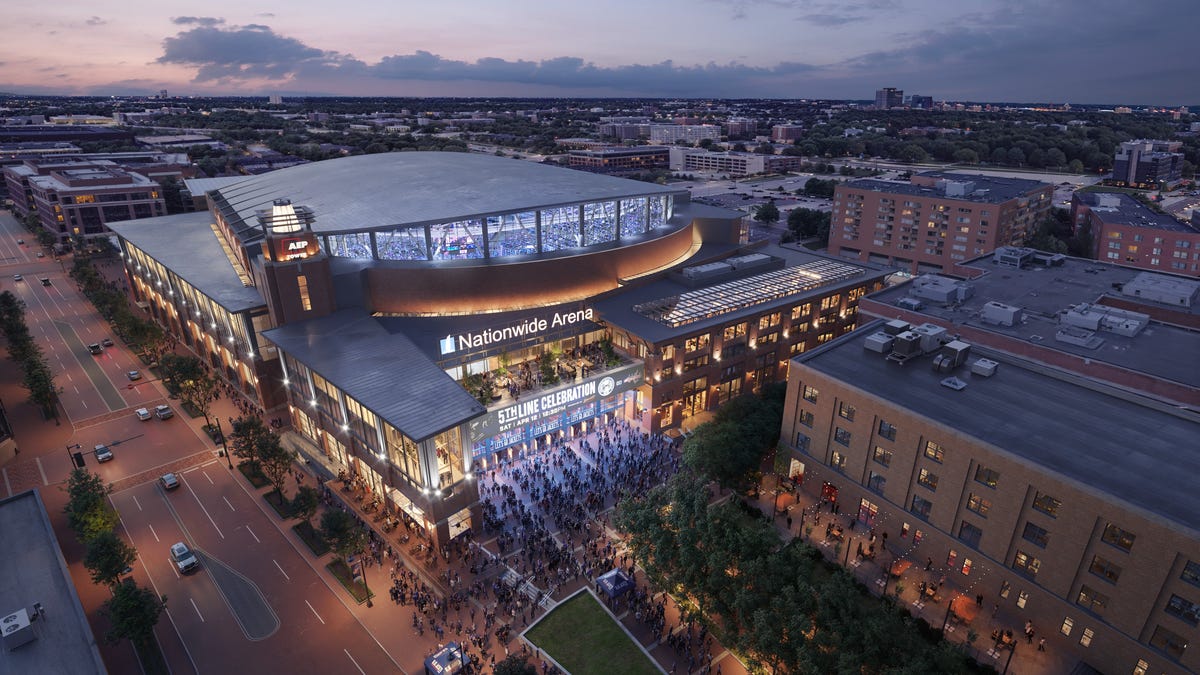


Nationwide Arena turns 25
Ken Paul, executive director of the Franklin County Convention Facilities Authority, says the Nationwide Arena needs a new entrance as the building turns 25 years old.
The government authority that owns Nationwide Arena has agreed to a $400-million plan to renovate and modernize the home of the Columbus Blue Jackets and the area’s premier concert venue.
The Franklin County Convention Facility Authority, which also owns the Greater Columbus Convention Center, the Hilton Columbus Downtown Hotel and several parking garages, proposed the plan earlier this year when it released artist renderings of the remodeled suites, a rooftop terrace and expanded entrance and Jackets team store.
The plan’s confirmation comes as Nationwide Arena celebrates its 25th anniversary this year and officials have expressed a desire to enhance customer experience and remain competitive to venues in other markets.
“I think this is an incredibly important community asset, and we have an opportunity to advance this …. and ensure the future of the facility for the next 30 years,” Ken Paul, the facility authority’s executive director, told The Dispatch.
“Nationwide Arena has been a great place to watch a game or enjoy an event for 25 years, and thetime has come to reinvest in our community’s arena,” Paul said in an earlier news release. “Modernizing the building is essential to stay competitive, meet the expectations of today’s fans, andensure our arena continues to serve Columbus well into the future.”
Paying for an expanded arena has been an issue in recent years. The authority announced in 2024 that the arena, which opened Sept. 9, 2000, at a cost of $175 million, needed about $60 million in repairs alone, some of which are underway.
The renovation funding includes new private investment combined with money from the state of Ohio, Franklin County, and the city of Columbus, each of which has verbally agreed to the funding plans, said Paul. “Ultimately, City Council will decide whether to put it on their agenda and then to vote. I think I have fair assurance that it’s going to get due consideration.”
The authority will apply for up to $100 million allocated for Columbus from the state fund dedicated to sports-facility improvements. It also plans to issue more than $100 million in public bonds for the project. The authority also is requesting $25 million in bond funding each from Columbus and Franklin County. The remaining balance of the project cost, not to exceed $400 million, will be privately funded.
“Nationwide Arena was built entirely with private funds, and since 2012, it has been owned andmaintained with public support. This proposal continues the public–private partnership that hassustained the arena as a vital community asset for 25 years. Through continued shared investment,we can ensure the Arena remains competitive for years to come,” Paul said in a news release.
In addition to the arena plans, the authority hopes to issue bonds to purchase an adjacent four-story building at 375 N. Front St. The building, owned by an entity of Nationwide Realty Investors, was recently valued at $9.3 million, according to county records. Rent payments from that office building will help cover some of the plan’s debt service.
The authority also will issue bonds to settle an outstanding balance on the loan used by the authority to purchase Nationwide Arena, and to reinvest interest savings into the improvements project. The authority purchased the arena for $42.5 million from Nationwide Mutual Insurance Company and Dispatch Publishing Group in 2012, according to Dispatch reporting.
The authority is planning to back most of the new bonds with an increased share of state casino tax revenue and an increase in the city admission tax charged at events at Nationwide Arena. The admission tax Columbus charges would increase from 5% to 7%, with the 2% increase for arena events only. The casino tax from the state to the county would increase from 32% to 50% over the next four years.
Paul said that raising those existing taxes would allow the authority to “reinvest in the building with no new taxes and with minimal impact on funding for other community priorities – ensuring that those who benefit most from the improvements help pay for them … especially at a time when resources are constrained and the needs across Columbus are many.”
In a nod to inflation, officials have said that repairing and renovating the arena now will help avoid more costly work in the future. Paul said Nationwide Arena hosts a million guests annually and generates about $200 million in spending annually. The tax revenue it generates supports public safety and human services throughout the region.
The Arena District’s 20,000 employees and various restaurants, and entertainment venues, including Huntington Park, will generate roughly $1.5 billion in state and local taxes over the approximately 30-year life of the new bonds, Paul said.
Currently, 80% of Nationwide Arena’s 5% admissions tax goes back into arena operations. The other 20% is for the Greater Columbus Arts Council. Under the new plan, 2% of the proposed 7% admissions tax would solely fund arena needs.
These are the very first steps to advance the plan,” said Paul. “It is a clear demonstration of local public support of reinvesting in the facility. I’d like to think we are in a strong position for state funding. We want to make the best case to demonstrate local support.”
Asked about Dispatch reporting in 2021, which indicated depleted accounts for upgrades due to Covid-19, Paul said that has reversed with strong attendance at Blue Jackets games and with local casino gambling stable.
“Casino revenue has performed consistently over the years and has recovered post-Covid,” he said.
Columbus City Council and Franklin County Board of Commissioners are expected to vote this month to adjust their casino tax allocations, and city council is expected to approve an increase of its admissions tax at the arena. Neither entity will be asked for direct capital investment in the project this year.
The issuance of public bonds by the authority is subject to future approval by both the city and county, with amounts contingent on state funding support and private investment, Paul said. “It’s very complicated,” he said. “But we’re hopeful.”Growth and development reporter Dean Narciso can be reached at dnarciso@dispatch.com.