
We asked the VIPs to submit mailbag questions late last week and received nearly 150 responses over the weekend.
It was clear from the tone and substance of the questions that Vancouver Canucks fans are deeply disappointed with the performance of their favourite team, and moreover, with the franchise’s overall direction.
Usually, we try to answer a smattering of the questions submitted, but this time, given how many questions were focused on either Quinn Hughes’ future, Canucks ownership and the performance of the team’s hockey operations leadership, we decided to pick just a few representative questions on these topics and answer them with significant depth.
You can find Part 1 of our mailbag here. Today, we’ll go through our assessment of Canucks management as they approach their fourth anniversary at the helm of this franchise’s hockey operations department.
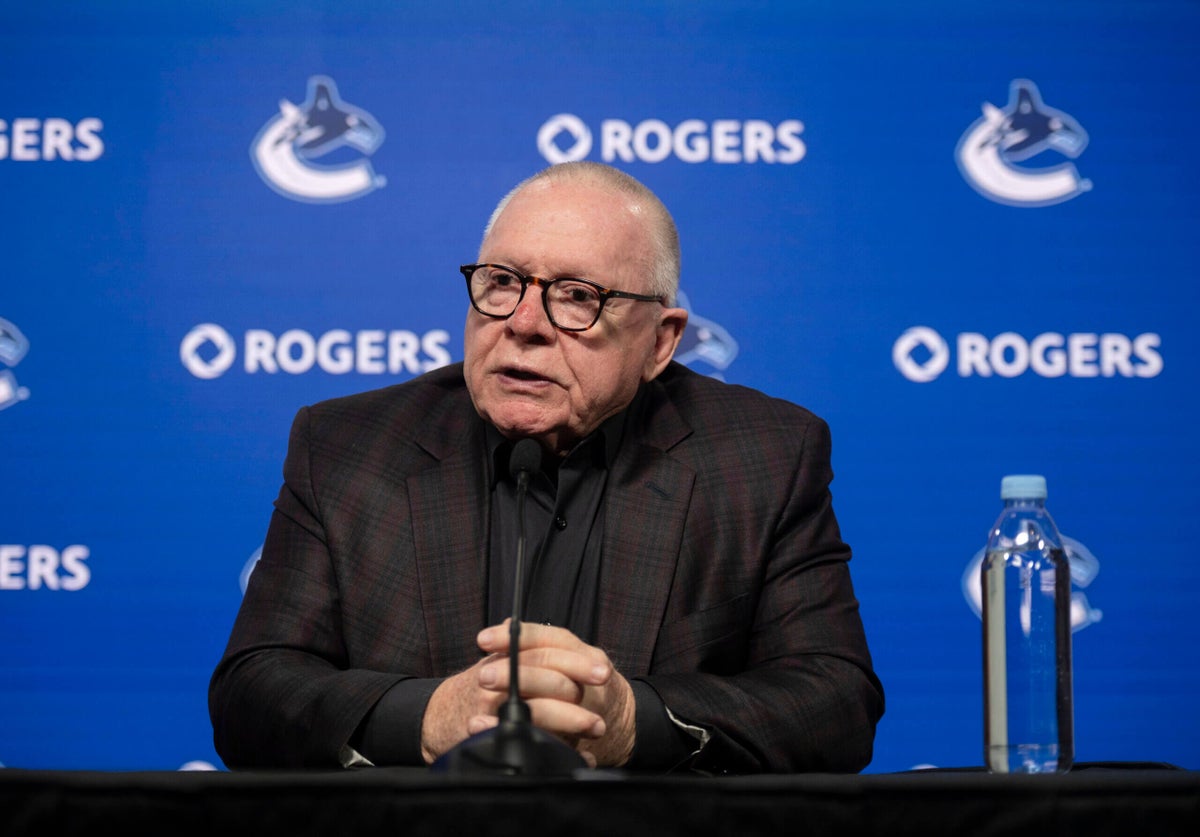
Will you do a four-year objective assessment of Jim Rutherford and the job he has done? Dec. 9 will be the fourth anniversary of his hiring. I think the team (current state and future prospects) is worse now than it was four years ago. — Gordon D.
When Jim Rutherford took over on Dec. 9, 2021, the Canucks were in disarray.
The previous summer, Vancouver had executed the doomed trade for Oliver Ekman-Larsson, and sagged out of the gate to a 10-15-2 start. With Canucks fans positively mutinous that fall — chants of “Sell the team!” had become commonplace at Rogers Arena in November 2021 — ownership fired both head coach Travis Green and general manager Jim Benning.
The team Rutherford took over was hopelessly top-heavy, capped out (with a bleak long-term salary cap outlook) and completely barren in terms of quality prospects.
Rutherford inherited some star talent up front — J.T. Miller, Elias Pettersson and Bo Horvat down the middle, Brock Boeser and Conor Garland on the wings — but the rest of the roster was downright grim.
Aside from Quinn Hughes, Vancouver had Ekman-Larsson and Tyler Myers on defence and little else. Luke Schenn, Tucker Poolman and Travis Hamonic were taking turns playing top-pair minutes. Kyle Burroughs and Brad Hunt played a significant heap of games and were heavily used.
Vancouver was also lacking depth up front. Tanner Pearson was its third-best winger. The likes of Tyler Motte, Juho Lammikko and Matthew Highmore were top-nine forwards during an unsustainable run of form that we now remember as The Bruce Boudreau bump.
As a result of the Ekman-Larsson trade, meanwhile, the club had limited cap flexibility on the immediate horizon, and Boeser, Miller and Horvat were all in need of new contracts or extension-eligible that summer.
It also shouldn’t be ignored how little talent Rutherford inherited outside of the NHL level. The Athletic’s top-five Canucks prospect ranking in 2021 featured Vasily Podkolzin, Aidan McDonough, Jack Rathbone, Mikey DiPietro and Danila Klimovich. What Benning left to Rutherford was far thinner than what he inherited from Mike Gillis.
For all intents and purposes, the Canucks looked snookered. “No prospects, no cap space and the team isn’t good now,” was my common refrain on sports talk radio. It looked as if a rebuild was an absolute and unavoidable inevitability.
It’s from this vantage point that Rutherford went about putting his stamp on the team, beginning by filling out his hockey operations department with general manager Patrik Allvin and assistant general managers Cammi Granato and Émilie Castonguay. With the Canucks winning games at a 100-plus point pace down the stretch under Boudreau, the urgency to further dismantle the team subsided. Vancouver instead made a pair of more modest seller trades: getting off the final year and a half of Hamonic’s regrettable $3 million extension, and selling Motte to the New York Rangers for a mid-round pick. The Canucks added Travis Dermott in an age-gap deal enabled by the return the club netted for Hamonic.
That first offseason, intent on adding depth to an atrophied prospect system, Vancouver signed a whole host of free agents from non-traditional buckets, mining Europe, the CHL and the collegiate ranks for talent. This process led the club to sign Arshdeep Bains, Andrei Kuzmenko, Nils Åman and Filip Johansson. With a fresh set of eyes looking at the club’s reserve list, Vancouver also signed Linus Karlsson to an entry-level contract, who was otherwise slated to have his rights expire.
The Canucks also navigated a difficult third contract negotiation with Boeser. It was tricky because there was some risk to tendering Boeser, a pending restricted free agent, a qualifying offer. The club found a settlement, however, signing Boeser to a sensible three-year, compromise deal.
At the draft in Montreal, Vancouver surprised the hockey world by not trading Miller. The club selected Jonathan Lekkerimäki in the middle of the first round before adding Elias Pettersson (the defenceman) in the third round. Ty Young and Kirill Kudryavtsev were picked in the late rounds of that draft.
Then in free agency, Vancouver did nothing to address its critical lack of blue-line depth, but added Ilya Mikheyev to a lucrative deal in free agency, signed Curtis Lazar and made an upside bet on Dakota Joshua, signing the burly, unproven forward to a two-year contract.
Later that summer, for reasons that still defy understanding, the club switched course at the last minute and negotiated an expedited extension with Miller. That left Horvat, the team’s captain, to go into the season unsigned.
That next year was an unmitigated disaster. Vancouver’s blue line was a wreck, and the club’s inability to defend was its most evident identity. Thatcher Demko got hurt and couldn’t cover up the two-way sins that he’d plastered over the previous season. Horvat scored at a dizzying 50-goal pace, while Miller struggled defensively and was criticized for snapping at teammates and for repeated and evident lapses in professionalism (like smashing his stick on the net to pull Collin Delia before he’d received the pull sign from the Canucks bench).
The club dealt for Ethan Bear in late November, acquiring him and overpriced AHL forward Lane Pederson from the Carolina Hurricanes for a fifth-round pick.
By midseason, the club made a series of decisions to go for it the following year, eschewing the more obvious rebuilding path. Kuzmenko was extended to a two-year contract, and Horvat was traded for a package that included a first-round pick and Aatu Räty, but was cap neutral because it included Anthony Beauvillier, who had a year remaining on his deal. The club also subsequently dealt that first-round pick from the Horvat deal to Detroit for Filip Hronek.
There were other smaller transactions, like selling Luke Schenn for a draft pick — remember the excitement for Akito Hirose? — but the big maneuver the Canucks made that winter was the Rick Tocchet hire.
Tocchet was a game-changer for the Canucks. Over a year into Rutherford and Allvin’s tenure, Canucks management was finally on the same page as their head coach and the impact was felt immediately, in terms of how the club carried itself and controlled play at five-on-five.
That summer, Vancouver bought out the Ekman-Larsson contract, which was an absolute necessity given the money it had committed to Kuzmenko and the acquisitions of Beauvillier and Hronek ahead of the deadline. The Canucks then turned around and committed that freed up cap space to Ian Cole, Carson Soucy and Teddy Blueger to shore up their penalty killing. A sage late summer signing to bring in Pius Suter completed Vancouver’s depth forward overhaul.
At the draft, the club used the 11th selection to take Tom Willander, passing up on higher upside local products like Zach Benson and Matthew Wood, and drafted the likes of Hunter Brzustewicz, Sawyer Mynio, Ty Mueller and Vilmer Alriksson in the middle rounds.
As training camp began, the club continued to work, sending Pearson and a pick to the Montreal Canadiens for Casey DeSmith. Vancouver then added Sam Lafferty from the Toronto Maple Leafs ahead of the waiver deadline.
That was the dream season, when Vancouver ran hot for the first few months of the year, and then genuinely morphed into an elite defensive side in the second half of the campaign. The additions of Nikita Zadorov in November and Elias Lindholm in January played a role in that (as did the subtraction of Kuzmenko). It was during this dream season that Vancouver signed Pettersson, on a 100-point pace for a second consecutive season, to a mega extension; it’s still mystifying that Pettersson’s form immediately fell off.
From a dark point in franchise history and with little wiggle room, Rutherford and Allvin had constructed a team that put together one of the most successful seasons in franchise history.
It’s one thing to succeed in the NHL; however, it’s another thing to succeed consistently.
Rutherford and Allvin put together a high-quality roster for 2023-24, but it was largely built off pending unrestricted free agents. Zadorov and Lindholm had been rental players, and both departed for big-money contracts with the Boston Bruins. The club extended Hronek to a long-term extension, jettisoned Mikheyev to Chicago and found a way to keep Myers, Blueger and Joshua. The Canucks also made a big free-agent splash on winger Jake DeBrusk, signed Kiefer Sherwood and Danton Heinen to multiyear contracts, added Vincent Desharnais to replace their losses on the back end and rolled the dice in late summer on Daniel Sprong. With Demko’s health tracking in a concerning fashion in the late summer, Vancouver signed Kevin Lankinen during training camp to bolster its options in net.
That season it was clear that additional reinforcements on defence and at centre were required if the Canucks were to repeat as the Pacific Division winner, and so the club cleared out cap space by trading Podkolzin to the Edmonton Oilers, and engineered its way out of Long-Term Injured Reserve by shedding Poolman’s contract to the Colorado Avalanche with a view toward tolling cap space in-season and maximizing flexibility at the trade deadline.
Ultimately, those plans didn’t matter. The chemistry and character of Vancouver’s core were insufficient to maintain the success from the previous season. Miller took a leave of absence in November, Demko didn’t appear in a game until December and was repeatedly injured that season, Hronek missed significant time with an injury and Pettersson’s form kept dipping.
By January, it was clear that the Canucks would have to move on from Miller, which they did with a two-part trade that sent Miller to the Rangers for a first-round pick, Filip Chytil and Victor Mancini; Vancouver then sent that first-rounder to the Pittsburgh Penguins along with a hodge podge of depth pieces and promising prospect Melvin Fernstrom for Marcus Pettersson and Drew O’Connor. The club declined to sell any further pending unrestricted free agents at the deadline — holding onto Boeser, Suter and Derek Forbort, two of whom did re-sign — but predictably sputtered down the stretch, missing the playoffs by a healthy margin.
All of which brings us back to where we are today. The Canucks hunted for a Miller replacement at centre ahead of the draft, but struck out before circling back on Boeser. They extended Demko and Garland to long-term deals. They traded a fourth-round pick for Evander Kane, soaking up some of the cap space that might’ve been used to bolster their centre depth. They made some intriguing selections at the 2025 NHL Draft.
The club attempted to retain Tocchet, but he preferred to depart for Philadelphia for a more stable long-term situation. Vancouver hired his assistant, Adam Foote, as his replacement.
This season, Vancouver has been submarined by a lack of centre depth and by an appalling level of defensive play. Part of the reason is that this team couldn’t afford to lose Chtyil, who was injured by a big Tom Wilson hit just five games into the season. Despite Chytil’s concerning concussion history, the Canucks lacked the centre depth to withstand his absence from the lineup and fell below a baseline level of functionality down the middle of their forward group. Tocchet’s absence has also been felt severely in terms of this team’s structural integrity at five-on-five.
Also, Demko is hurt again, as he too frequently has been whenever this team — so reliant on goaltending and finishing efficiency, given its relative lack of depth and talent — has experienced a downturn in results. His injury has reasonably called the wisdom of the extension the Canucks gave him just six months ago into question.
With that summary complete, let’s reflect on Rutherford and Allvin’s track record four years on.
Positives
Vancouver has consistently identified undervalued contributors on the free-agent scrap heap or from non-traditional sources.
The Canucks’ drafts appear to be vastly improved from where they were in the Benning era. The club’s ability to somewhat consistently mine real NHL prospects in the later rounds seems to be more robust today than it was in the latter Benning years following Judd Brackett’s departure from the organization.
It took a few years to unwind the absolute cap mess they inherited, but under Rutherford and Allvin, Vancouver’s cap management looks mostly organized and disciplined.
The player development apparatus, including the hires of Jeremy Colliton and Manny Malhotra in the AHL, appears to be successfully preparing organizational depth pieces for roles at the NHL level. The Abbotsford Canucks are run on a more sustainable budget, but have still managed to be a successful team, including winning the Calder Cup in 2025.
It should be noted, and heavily weighted, that it was unlikely and surprising that the Canucks could become as genuinely imposing as that 2023-24 team became from the point that Rutherford was hired.
Negatives
Allvin and Rutherford have struggled to evaluate character when evaluating player personnel, something that’s been evident in a variety of moves, but mostly by their decision to sign Miller over Horvat in the summer of 2022. Permitting Lindholm, Zadorov and even Cole to walk after the 2023-24 campaign further limited this group’s ability to co-exist, which contributed to a disappointing 2024-25.
The Canucks have repeatedly entered the regular season with a fundamental and obvious roster construction flaw under Rutherford and Allvin — defence in 2022-23, centre depth and defence in 2024-25, centre depth in 2025-26.
Without a stunning reversal of fortunes this season, Vancouver is tracking to miss the postseason for the fourth time in five years since Rutherford and Allvin took over.
In four years, Allvin and Rutherford haven’t added a needle-moving talent to this lineup. It took subtracting Horvat to add Hronek; it took subtracting Miller to add Marcus Pettersson. The club has moved talent around more than it has accumulated additional difference-makers.
By continuing to prioritize short-term competitiveness, Rutherford and Allvin arguably traded one dream campaign for a team with the talent and depth to compete credibly on a yearly basis.
This era of Canucks hockey commenced at nearly the same time as the Jeff Gorton, Kent Hughes era dawned in Montreal. Both management groups charted wildly different paths, and it seems inarguable that Canadiens fans are in for a much better time over the next five-to-10 years than Canucks fans are.