
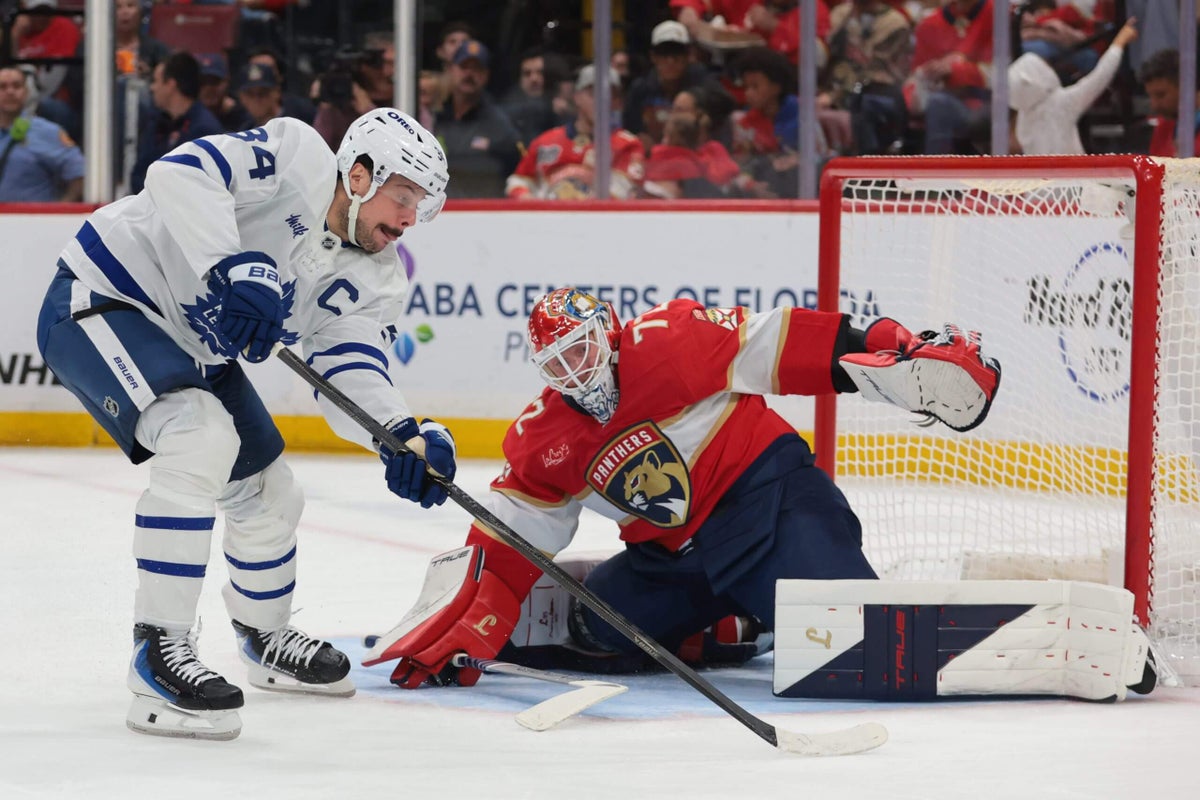
There are only five points separating the Pittsburgh Penguins in the first wild-card spot from the Ottawa Senators at 15th in the Eastern Conference.
The back-to-back Stanley Cup champion Florida Panthers need another late-season push — and much better goaltending — to make it back to the playoffs. In Toronto, the Maple Leafs have started to chain wins together but are still at risk of becoming the most disappointing team in the NHL. The close race between the New York Rangers, Philadelphia Flyers, Montreal Canadiens, New Jersey Devils and Columbus Blue Jackets is full of potential for drama right through the end of the season.
Somebody is going to have a heartbreakingly narrow miss, but which of these Eastern Conference teams should be legitimately worried? Who’s a good bet to make a strong push back into a playoff spot by season’s end?
Today we’re examining these teams purely by this season’s performance in actual games, not preseason expectations. Let’s break out the panic meter to analyze how concerned these organizations should be about their chances of making the postseason: 1 meaning not worried, 10 meaning full panic mode. Note that we won’t be analyzing the Blue Jackets or Red Wings because we covered them last week, nor will we dive into the New Jersey Devils, who are in seventh place in the Eastern Conference by points percentage.
Toronto Maple Leafs
Record: 14-11-4
What’s gone wrong: The Leafs look dramatically different than last year’s 108-point, Atlantic Division-winning version. There isn’t one clear problem ailing them; several concerns across various departments are jeopardizing their playoff chances.
Mitch Marner’s departure has been an enormous blow to the top of the Leafs lineup. Sure, Toronto’s overall offense has still been piling up goals, but Marner’s elite defensive play and overall two-way impact in all phases of the game are sorely missed. Meanwhile, the secondary middle-six forwards the club acquired last summer — Nicolas Roy, Matias Maccelli and Dakota Joshua — have combined for just 10 goals and look like non-factors on too many nights.
Toronto’s ability to control five-on-five play has taken a significant hit this year, as the club’s five-on-five shot attempt share ranks 30th in the NHL. The Leafs, who were renowned for their stingy defensive play last season, were surrendering Grade-A chances at an alarming rate through the first quarter of the season. Toronto’s blue line often looks slow and struggles to break the puck out of its own zone. These issues have been further exacerbated by injuries — most notably to Chris Tanev — that have left the club over-reliant on depth defensemen. GM Brad Treliving’s emphasis on adding heavier forwards with sandpaper means the forward group also lacks speed.
In net, Anthony Stolarz, the NHL’s save percentage leader in 2024-25, has regressed hard, dropping to an .884 save percentage before getting hurt. That combination of poor defensive play and subpar goaltending resulted in the Leafs allowing the most goals against per game in the Eastern Conference through the 20-game mark in mid-November.
Auston Matthews, on pace for just 68 points, has been merely good instead of a game-breaking MVP candidate. Part of Matthews’ deflated points totals are due to the Leafs’ woeful power play, which ranks 31st in the NHL.
Outlook: Toronto’s latest 4-0-1 run, which all came against quality opponents (Florida, Carolina, Pittsburgh, Tampa Bay, Montreal), was desperately needed to calm the panic in Leafs land.
The Leafs have tightened up defensively, permitting five-on-five high-danger chances at the 10th-best rate in the NHL during this five-game stretch. Toronto’s goaltending has been a massive driver for this recent turnaround as well. Joseph Woll has been stellar since his return (though he’s hurt now) and Dennis Hildeby has emerged as a surprise hero, rocking a .936 save percentage in nine games. Since Nov. 15, Toronto’s team save percentage ranks third-best in the league.
On the back end, Troy Stecher has been a fantastic waiver-wire pickup. The Leafs have controlled 55 percent of scoring chances and are up 10-4 during his five-on-five minutes. Tanev’s return could be on the horizon as well, which would further stabilize the defense corps.
These are all positive recent developments, but it doesn’t mean the Leafs are out of the woods yet. In our minds, they’ll need at least two or three of the five following X-factors to break their way in order to make the playoffs:
• The Leafs defend more as they did in the last handful of games rather than the first quarter of the season.
• Toronto’s goaltending performs at an above-average level.
• Tanev’s return and Stecher’s continually strong play stabilize the Leafs’ back end.
• Matthews returns to a superstar level (he’s looked better as of late).
• Toronto’s power play improves significantly.
Those areas definitely feel doable. Still, if some of them go wrong, the Leafs’ five-on-five floor won’t be high enough to automatically punch them a ticket into the postseason.
Missing the playoffs panic meter: 5/10
Ottawa Senators
Record: 13-12-4
What’s gone wrong: Goaltending has been one of the Senators’ biggest issues in the early going.
Ottawa’s team save percentage of .871 sits 30th in the league, ahead of only the Edmonton Oilers and Montreal Canadiens. Linus Ullmark has a minus-9.9 goals saved above expected rating, which ranks second-worst among all NHL goalies this season. We’ve watched several Senators games this year in which a soft goal against or two at the wrong time completely flipped the script, even when the Sens were otherwise playing fairly well.
The Senators’ penalty kill is clicking at just 70.7 percent, which ranks 31st in the NHL.
Thomas Chabot’s injury has also wrecked the club’s second pair. Tyler Kleven and Jordan Spence, who are playing in a higher-leverage role, each had awful turnovers that directly led to two of New Jersey’s goals on Tuesday night. Making matters worse is that Nick Jensen is in decline: his ice time is crashing and the Sens have been outscored 26-17 during his five-on-five shifts.
Shane Pinto’s recent injury has also been an enormous blow to the club’s middle-six offensive attack.
Outlook: There are still reasons to be bullish about the Senators’ playoff chances.
Firstly, they’ve been one of the stingiest defensive teams in the NHL since coach Travis Green was hired last season. They’re structured, protect the inner slot and do a terrific job of limiting high-danger chances. Ottawa has allowed just 2.19 expected goals against per 60 at five-on-five, the best mark in the league.
The Senators rank near the top of the league in most five-on-five play-driving metrics, clearly ahead of other Atlantic Division bubble teams such as the Leafs, Canadiens, Bruins and Red Wings. In other words, their even-strength structure and process look more encouraging than a lot of their rivals.
Ottawa’s penalty-kill results look disastrous results-wise, but under the hood, there are signs it could improve significantly in the second half. The Senators’ PK is surprisingly near the top of the league at limiting high-danger chances and expected goals against. This isn’t to solely blame goaltending, because they’ve still had some unfortunate defensive breakdowns, but better netminding would solve a lot of the short-handed woes.
Chabot is also expected back relatively soon, which will be a massive boost to the top four.
The Senators should make the playoffs so long as Chabot and Pinto return soon, and if their goaltending/PK rebound. That feels like a realistic ask, especially because Ullmark’s long-term track record as a starter is rock-solid.
Missing the playoffs panic meter: 5/10
New York Rangers
Record: 15-12-4
What’s gone wrong: The Rangers built a team that depended on a select group of veterans to produce offence, with limited secondary scoring options available, and then those veterans struggled. Now Adam Fox is hurt, out week-to-week with an injury to his left shoulder, and there’s concern the NHL’s 28th-ranked offense has taken a hit from which it can’t recover.
The Rangers score the seventh-fewest goals per minute at even strength despite spending the sixth-most time on the attack, according to NHL Edge data. They’ve defended well and transitioned the puck well enough to give themselves a shot at delivering enough offense to win, but haven’t been able to create time and space once inside the offensive zone. It speaks to the team’s dependence on a group of players well into their 30s who just aren’t driving results like they used to.
Opening up lanes takes explosiveness, whether in the form of speed, skill or brawn, but star veterans Mika Zibanejad, Vincent Trocheck and J.T. Miller are behind their typical scoring rates. Artemi Panarin has been productive but Miller is sitting on 18 points in 29 games after scoring better than a point per game for the Rangers last season. Trocheck missed time, limiting him to 14 points thus far, while Zibanejad is on pace for 63 points in 82 games — a new normal for the 32-year-old veteran after multiple seasons at or above a point per game. The next wave has yet to establish itself, too, with Alexis Lafrenière and Will Cuylle at close to half a point per game each but still miles ahead of the rest of the pack.
The concern about the Rangers’ overall direction compelled our Vincent Z. Mercogliano to ruminate on general manager Chris Drury’s lack of success since sending his infamous memo to rivals announcing certain players were for sale.
Outlook: There is cause to be concerned, given they’ve played more games and have a worse points percentage than five teams chasing them in the standings.
But it’s not entirely doom and gloom. The Rangers have bounced back from a brutal stretch of November hockey and are 5-3-2 in their last 10. Complaints about their lack of offense are valid, but the Rangers’ defense has held, even without Fox. Dig into the public analytics site of your choice and you’ll find that New York is a top-10 team in terms of the scoring chances it allows at even strength.
The Rangers’ goaltending duo of Igor Shesterkin and Jonathan Quick has also produced results, with Shesterkin bouncing back to .913 from a career-low .905 save percentage and Quick delivering a scorching .937 in seven games. Jesse Granger placed them atop The Athletic’s goaltending power rankings earlier this month.
New York desperately needs to get its offense going — and keep it going, in the case of recent point streaks from Zibanejad and Miller — lest it waste a surprisingly good defensive performance in front of some of the best goaltending on the planet. Even a mild improvement would do, given decent underlying numbers. Do they have the right horses? Do they have the right plan?
Those questions fade if the Rangers start turning zone time into goals, but that’s much easier said than done.
Missing the playoffs panic meter: 6.5/10
Montreal Canadiens
Record: 15-11-3
What’s gone wrong: After a dream 9-3-0 start, the Canadiens have won just six of their last 16 games.
Goaltending has been the Habs’ biggest issue. Sam Montembeault has been one of the worst goalies in the NHL this season, carrying a ghastly .857 save percentage in 15 games. Rookie Jakub Dobes has come crashing back down to Earth after a historic start, winning just four of his last 11 games. Montreal’s .870 team save percentage ranks 32nd in the NHL this year, worse than even the Edmonton Oilers.
Montreal’s recent problems span beyond just goaltending, though.
The Habs’ team defense has been a mess, with their five-on-five expected goals against rate ranking 28th in the NHL since Nov. 1. Their PK ranks 26th in the NHL. They desperately miss Kaiden Guhle’s steady shutdown prowess in the top four.
Montreal’s forward depth has also become an issue with Alex Newhook and Kirby Dach injured. In their last 20 games, the Habs have a minus-17 goal differential when the Nick Suzuki line isn’t on the ice at five-on-five.
Outlook: The Canadiens’ inability to control five-on-five play is a red flag — they give up far more shots and Grade-A scoring chances than they create. Their even-strength profile is a lot worse than a team like Ottawa’s. These issues were prevalent last season, too, but the difference is that Montreal’s goaltending was a strength rather than a weakness in 2024-25.
MTL’s 5-on-5 struggles
5v5 Shot Attempts
5v5 Expected Goals
5v5 Goals
47% (25th)
47.2% (26th)
43.7% (31st)
Guhle isn’t expected back for several more weeks, which will put continued stress on a top-four defense corps that’s struggling in its own end.
There are still enough game-breaking offensive pieces for this team to make the playoffs (especially because their power play is elite) but between their shoddy defensive play, porous goaltending and underwhelming PK, it’s fair to wonder if they’ll keep bleeding goals against at an insurmountable rate.
Missing the playoffs panic meter: 6/10
Florida Panthers
Record: 14-12-2
What’s gone wrong: Aleksander Barkov tore his ACL and MCL and could miss the entire regular season. Matthew Tkachuk has yet to play a game, although he could return later this month. Sergei Bobrovsky is posting the worst numbers of his NHL career.
Barkov and Tkachuk are two of the world’s best all-around players, with Barkov winning his third Selke Trophy last season as the league’s top defensive forward while scoring better than a point per game and Tkachuk generating elite offense from the cycle, generating a ton of turnovers on the forecheck. They’re both top power-play guys, with Barkov finishing second and Tkachuk finishing third on the team in power-play points last season. Barkov, meanwhile, played over a minute per game on last year’s 10th-ranked PK.
So yes, it makes sense that Florida is struggling so far this season.
The risk is that they’ve dug too deep a hole to climb out of once Tkachuk returns — especially given Bobrovsky’s struggles. His .881 save percentage would be the worst of his career — alarming, given Daniil Tarasov’s numbers are so much better behind the same defense. It may be overly reductionist to point at three players, but missing two of the top 20 players in the world is an enormous challenge.

Sergei Bobrovsky is on pace for the worst save percentage of his career. (Carmen Mandato / Getty Images)
Outlook: If any team is entitled to self-confidence despite their lack of playoff position, it’s the Florida Panthers. They’re the NHL’s standard-bearer for “get to the playoffs, sort the rest out later” — the team other outsiders point to as a sign that playoff success is possible from any seed.
The Panthers made it to the 2023 Stanley Cup Final as the No. 8 seed in the East, won their first Cup as the No. 3 seed and then won again last year despite finishing fifth in the conference. They’ve shown the ability to elevate their game at the most important time of the year, combining skill with snarl in a way no one else has been able to match.
Florida’s underlying five-on-five metrics remain encouraging, and we’d bet on Bobrovsky bouncing back in the second half.
They’re still in a deep enough hole to be worried about. The Panthers are tied with Ottawa for the second-worst points total in the Eastern Conference, five back of the New York Islanders for a wild-card spot but needing to pass six teams to get there. The sheer number of teams in the race creates risk — there are more competitors who might get hot at a moment’s notice — even if Tkachuk’s return elevates the power play and Bobrovsky starts looking more like his best self.
Missing the playoffs panic meter: 5/10
Buffalo Sabres
Record: 12-14-4
What’s gone wrong: Here we go again.
The Sabres are tied with the lowly Nashville Predators in allowing the most five-on-five goals against per 60 of any NHL team. Buffalo’s three-goalie system flat-out isn’t working, with Ukko-Pekka Luukkonen and Colten Ellis, in particular, underperforming.
Buffalo’s top forwards can’t consistently take over games; nobody is on pace to hit 75 points or more. The blue line, which was expected to be a strength, has underachieved. Bowen Byram’s defensive metrics are concerning, Owen Power is slumping offensively and still can’t defend at a high level, and newcomer Michael Kesselring has played fewer than 10 games due to injury. Josh Norris’ injury (he’s only played five games) was a devastating blow to the club’s center depth as well.
Outlook: The most frustrating part of this Sabres core over the years has been the way they fold under pressure. They can start winning games when they’re way out of the race and playing without any expectations, but the second the pressure turns on because it looks like they have a legitimate shot to get into the playoff race, they wilt. On Nov. 24, for example, they had momentum building after winning four of their last five games, which put them only two points back of a playoff spot with two games in hand. The Sabres immediately faceplanted upon getting within striking distance, with just one regulation win in their last eight games. That’s included multiple demoralizing blowouts.
Buffalo would need to play at a 106-point pace for the rest of the season to hit 95 points, which is the approximate range to qualify for a playoff spot in most years. That feels like a pipe dream for this franchise, despite some encouraging underlying analytics.
Missing the playoffs panic meter: 9.5/10