
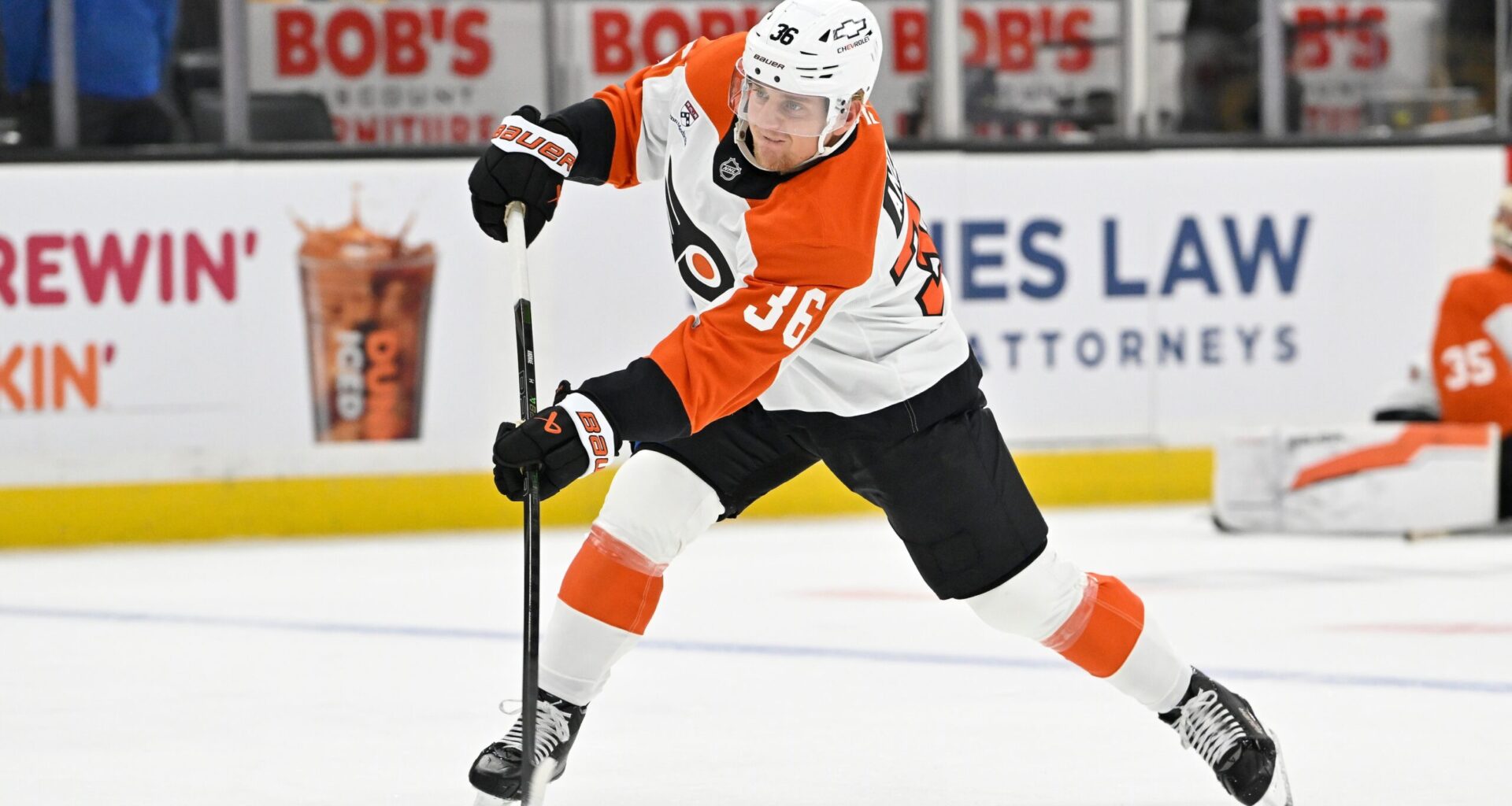
Flyers defenseman Emil Andrae has never met a challenge he hasn’t overcome. Last season the blueliner spent just over half a season with Philadelphia and, at times, looked like a bottom pairing defenseman. But after not being a lock in the top six — especially given the absence of Rasmus Ristolainen, Andrae could’ve wilted in his play, ending up on the fence in Lehigh Valley amid their bounty of defensemen. In the span of a week in late October and early November, Andrae was yo-yoed from the Phantoms up to the Flyers, then back down to Lehigh Valley and then back up to Philadelphia. But he took it all in stride. He’s done the hard work and slowly but steadily impressed on the third pairing. And he’s looking more and more like the guy who could take the second pairing and Jamie Drysdale’s game to another level.
Tocchet lauds Andrae’s quickness, thought process
During Thursday’s pre-game afternoon presser, Flyers head coach Rick Tocchet was asked about both Andrae and Drysdale, quickly praising the pair for their styles. Drysdale led all defenseman with 23:15 (13 seconds more than Travis Sanheim) while Andrae was third with 22:19. “I think for me, so we’ll go with Emil, I think just offensively, in the neutral zone, even on the blueline, he’s got some swagger,” Tocchet said. “He’s not afraid to make some plays. So I like that about him.”
The coach also acknowledged how the duo are also using their heads more than their bodies given their physical size. “Hockey IQ and quickness,” Tocchet said were the keys to the pair’s success. “They’re not going to go flying in there and hammer guys, Emil will try it sometimes and Jamie. But with their brain and their quickness. You can outthink somebody on a cycle. I saw Emil a couple of times cut off resets before the cycle even happened, that’s a huge play.”
Andrae surprisingly good in some key stats
Heading into Thursday’s game against Vegas, Andrae was in the 50th percentile when it came to hardest shot (86.81 miles per hour), maximum skating speed (21.18 miles per hour), and total distance skated (44.49 miles). So essentially no better or no worse than your average National Hockey League defender. However, in the other metrics, a few things stand out. Andrae was in the 91st percentile in terms of defensive zone time (36.9 per cent versus the league average of 40.4), the 77th percentile regarding neutral zone time (18.3 percent versus the league average of 17.9) and the 88th percentile concerning offensive zone time (44.8 percent versus the league average of 41.8). In short, Andrae isn’t spending as much time in his own end as some other blueliners. And he’s spending some more time in the offensive zone than his peers. That’s a very, very good thing.
Of course, one way to compare Andrae is to see where both Andrae and Drysdale were with other partners before Tocchet put the dynamic duo together. Here’s a look at some metrics for the current pair and the tandems both had earlier in the season.
Defensive pairsTime on iceCorsi For percentageFenwick For percentageGoals For percentageExpected Goals For percentageNick Seeler/Jamie Drysdale238:2653.5553.1135.0052.14Noah Juulsen/Emil Andrae95:5050.0048.1866.6741.91Emil Andrae/Jamie Drysdale154:1949.0647.4569.2347.94
Through 18 games prior to Thursday’s tilt with the Golden Knights, Andrae and Drysdale have faired okay in terms of some metrics but have an impressive goals for percentage thus far. Although the expected goals for percentage isn’t as strong as the Seeler/Drysdale pairing was, it is an improvement over the Juulsen/Andrae pairing. So Andrae might be benefitting a bit from being paired with Drysdale. Yet it seems he’s been learning the systems and schemes, cutting down on his mistakes and driving play a bit more than even some of his biggest fans anticipated.
Year over year
In terms of his own game, Andrae seems to have improved in some respects while the numbers have dipped a bit in others. Of course, being on the middle defensive pair would naturally result in Andrae facing some tougher competition versus being on the bottom pairing, so the percentages would be down a little bit. Yet it’s the offensive numbers which shine this year over last year. Here’s another table comparing what Andrae did all of last season versus what he’s done so far this season, as well as the High Danger Corsi For percentage (HDCF%) and the High Danger Goals For percentage (HDGF%)
SeasonCF%FF%GF%xGF%HDCF%HDGF%2024-2551.8553.0747.2755.1054.1151.432025-2651.1549.8665.2248.4950.4575.00
As you can see, the goals for percentages are dramatically up over last season, meaning Andrae is becoming more of an offensive threat. Last year he had one goal and six helpers in 42 games. Through 18 games this year, he’s matched the goal output and the assist output. At this rate, it’s conceivable that Andrae could see himself in the 30-point to 35-point range at season’s end barring injuries.
Andrae should be here to stay
The end result of this is two-fold. Should Andrae continue to excel, particularly with Drysdale as his partner on the second pairing, it’s highly doubtful Tocchet would want to break that twosome up. Both are looking quick with the puck, making reads to squash plays when needed, and being creative in the offensive zone to keep plays alive and generate scoring chances. Andrae has no fear at times driving the play with a deep rush, but he seems to have a much better idea of when to pick his spots to do that.
The other factor to consider is that Andrae will be extremely difficult to remove from the lineup when Rasmus Ristolainen returns to the lineup (Tocchet believes it will most likely be prior to Christmas). Given how nobody has picked up the mantle for the sixth spot, and Ty Murchison vaulting over Egor Zamula on the depth chart this week, Andrae’s game is beginning to look more and more appealing. As much as Tocchet loves Noah Juulsen, he’s probably not about to sacrifice Andrae and send him to Lehigh Valley to keep Juulsen in the lineup. At least we hope not. Juulsen is looking more like a seventh defenseman which would make Zamula almost expendable at this point.
When Cam York returns to the lineup, and Ristolainen eventually emerges from the practice rink to play, the Flyers might have their six defenseman to go to battle with in Sanheim, York, Drysdale, Ristolainen, Seeler, and Andrae. Although Andrae shouldn’t be dropped back to the third pairing if his play remains as consistent as it’s been of late, he should be sticking with the big club the entire season. He’s been quite strong, and playing a quick, thoughtful style that would make him getting crushed like he did last year by Columbus enforcer Mathieu Olivier extremely unlikely. He’s been one of the bright spots and deserves to stay.