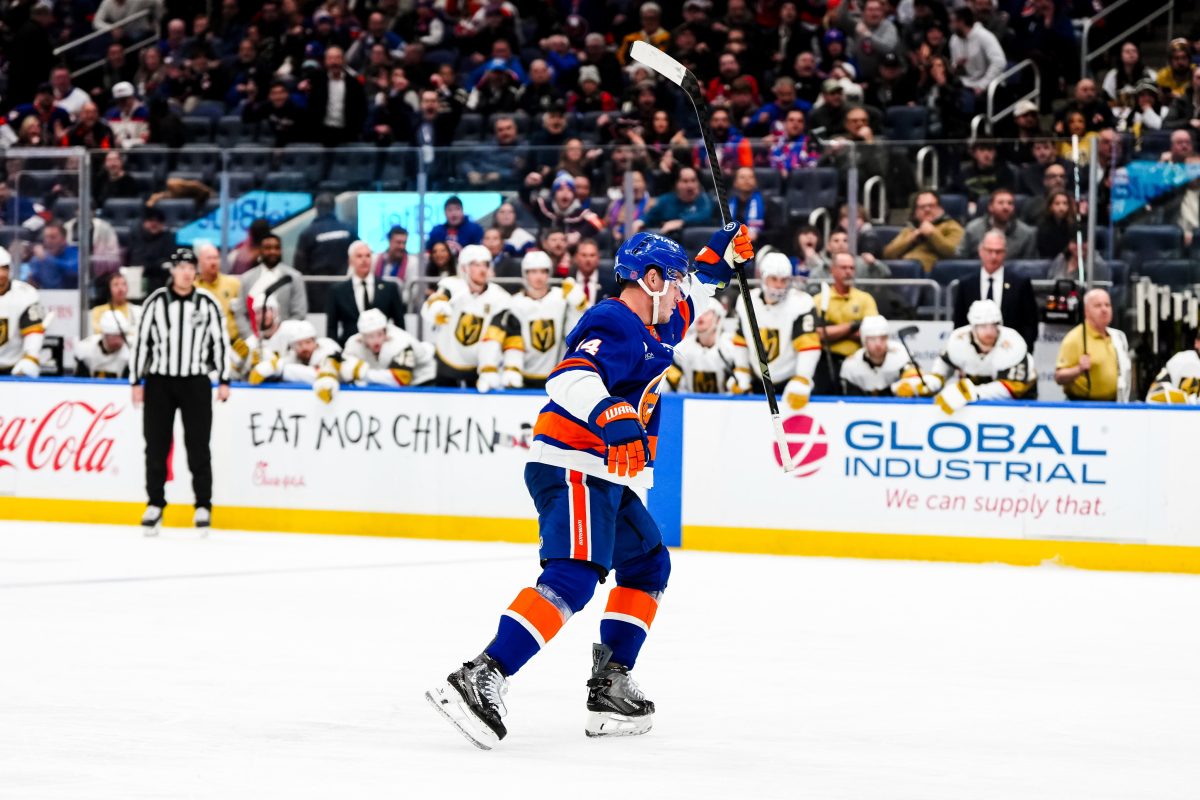
(Photo Credit: @NYIslanders on X/Twitter)
In each of the last two games in New York, the Golden Knights have found themselves down extremely late and rallied to come back and tie the game with a last-minute goal. These aren’t the first two instances of coming back and rescuing games. They did it in San Jose in the second game of the season and against Chicago at home in November.
Their five 3rd period comeback wins are tied for the most in the NHL and are a huge reason they currently sit in 2nd place in the Pacific Division with a strong .638 points percentage.
There’s no question the ability to come back and either tie or take the lead late in games is an excellent indicator of a good hockey game. It helps earn valuable points that will make the rest of the season a lot less stressful.
But, is it sustainable?
Multiple times this season, head coach Bruce Cassidy has used the term “chasing the game.” Two examples are following the losses to Montreal on Black Friday and Utah a few nights later.
Right now, we’re chasing a lot of games. It takes too much energy. We need to play with more urgency when it’s 1-0 or 0-0. -Cassidy on 11/28/25
You end up chasing the game. You can’t chase the game in the National Hockey League. -Cassidy on 11/30/25
There are all sorts of different ways to track the idea of “chasing the game” and the Golden Knights fall short in all of them.
First is simply looking at the length of time VGK are ahead, behind, or tied.
Leading – 513:39 (24th)
Trailing – 593:47 (20th)
Tied – 680:35 (14th)
This means the Golden Knights have been leading for just 29% of the total time in their 29 games thus far this season. Compare that to the league leaders, the Colorado Avalanche, who have held the lead for 52% of the time. The Avs have been behind for 250 fewer minutes than Vegas, a massive 15% difference.
Of course, Colorado is an outlier. But even a more average team like Chicago, who currently sit in the top wild card spot, has only trailed for 22% compared to Vegas’ 33%.
The next indicator is scoring first and the score at the end of periods. VGK have scored first in 13 of their 29 games this season. Scoring first in 45% of games has the Golden Knights ranked 25th in the league, tied with Toronto. This number is also way up as VGK have potted the first goal in each of the last four games. Before this streak, they had scored first in 36% of games, above only Nashville and tonight’s opponent, Philadelphia.
Despite conceding first more often than not, the Golden Knights are decent at getting out of the 1st period in good shape. They’ve headed to the locker room with the lead in 10 games while trailing in just 9 (the other 10 were tied). That’s 53%, the 15th-best mark in the league. The end of the 2nd period is not nearly as good. Vegas have led entering the 2nd intermission in just 41% of games, the 27th-worst mark in the league (ahead of PHI, BUF, SEA, VAN, and NSH… who all stink).
Finally, the Golden Knights have been to overtime 12 times this season. Of course, we’re all aware of their dismal 3-9 record in those games, but it’s how they got to OT that’s interesting.
In eight of the 12 OT games, the Golden Knights scored the tying goal to send the game to OT. As mentioned above, a few of them happened late, while the rest happened at some point earlier in the 3rd. On the flip side, VGK have allowed the game-tying goal just twice. The other two games were tied for the entire final frame.
In other words, they’ve had to chase games rather than letting them slip away. Or, another way to put it, if the tying goal never happened in any of these games, VGK’s overall win/loss record would be identical, just without as many overtime losses.
Add it all up, and there’s no question the Golden Knights have been behind far more often than they need to be. It’s a huge reason why they have more losses than wins for the just the second time in franchise history after 29 games, and it’s why it often feels like they aren’t playing well despite the statistics.
Even though they’ve been able to dig out of holes with consistency so far, it’s not a model they can follow all season if they want to win the Stanley Cup (or maybe even make the playoffs). Every Stanley Cup champion since Vegas entered the league has finished in the top 10 in time leading during the regular season. More than a third of the way through the season, VGK are over 120 minutes off that mark.
Everyone enjoys a heroic late goal to tie a game, and VGK have been awesome at delivering them. But, if they have any real aspirations this season, they’re going to have to spend a lot more time ahead.