
Two years ago, when the Philadelphia Flyers made a surprise playoff push that kept them alive until their final game, their penalty kill was a huge reason why. Termed a “power kill” due to their aggressive nature, the team led the league with 16 shorthanded goals, with Travis Konecny’s six also topping the leaderboard.
However, that unit dropped to 20th in success rate a year ago while its shorthanded offense stagnated. That brought it closer to the dismal level of the team’s power play, which hasn’t finished above 30th in the NHL since the 2020-21 season.
Through the first month of the 2025-26 season, those struggles seemed to be in the rearview mirror. The Flyers were a solid group on the man advantage for the first time since Claude Giroux was running the operation, and the penalty kill was back in the league’s upper half. Recently, both units have sagged again, with the power play falling from 16th to 23rd and the penalty kill declining from second to 15th since Nov. 15.
Penalty Kill
Last season, a huge red flag handicapped the penalty kill, one that couldn’t be overcome by better positioning or reads by the skaters or even the best coaching staff. The team’s massive goaltending issues extended to all areas of play, with only the Detroit Red Wings getting worse netminding while shorthanded. That hasn’t been an issue this season, with the Flyers ranking 15th in the league in save percentage (SV%) on the penalty kill, right in line with where they placed two seasons ago.
However, it hasn’t coincided with improvements to the team’s underlying play. In 2023-24, the Flyers didn’t fluke into most of their shorthanded goals, leading the league in expected goals per 60 (xGF/60) on the PK while ranking sixth in expected goals against, per Natural Stat Trick. Those placements fell to 10th and 14th in 2024-25, which could be explained by the goaltending failures. The team couldn’t take the same risks it had before, knowing a misread would almost certainly wind up in the back of their net.
But that aggressiveness hasn’t returned, even with the goaltending trap door fixed. The Flyers rank 21st in xGF/60 on the PK and are one of two teams in the NHL without a shorthanded goal. Personnel changes play a huge role in this. The team has traded two of its top penalty killers from the past two seasons, Scott Laughton and Ryan Poehling. Those deals were definitely worth it, but the residual effect they’ve had on the penalty kill appears real.
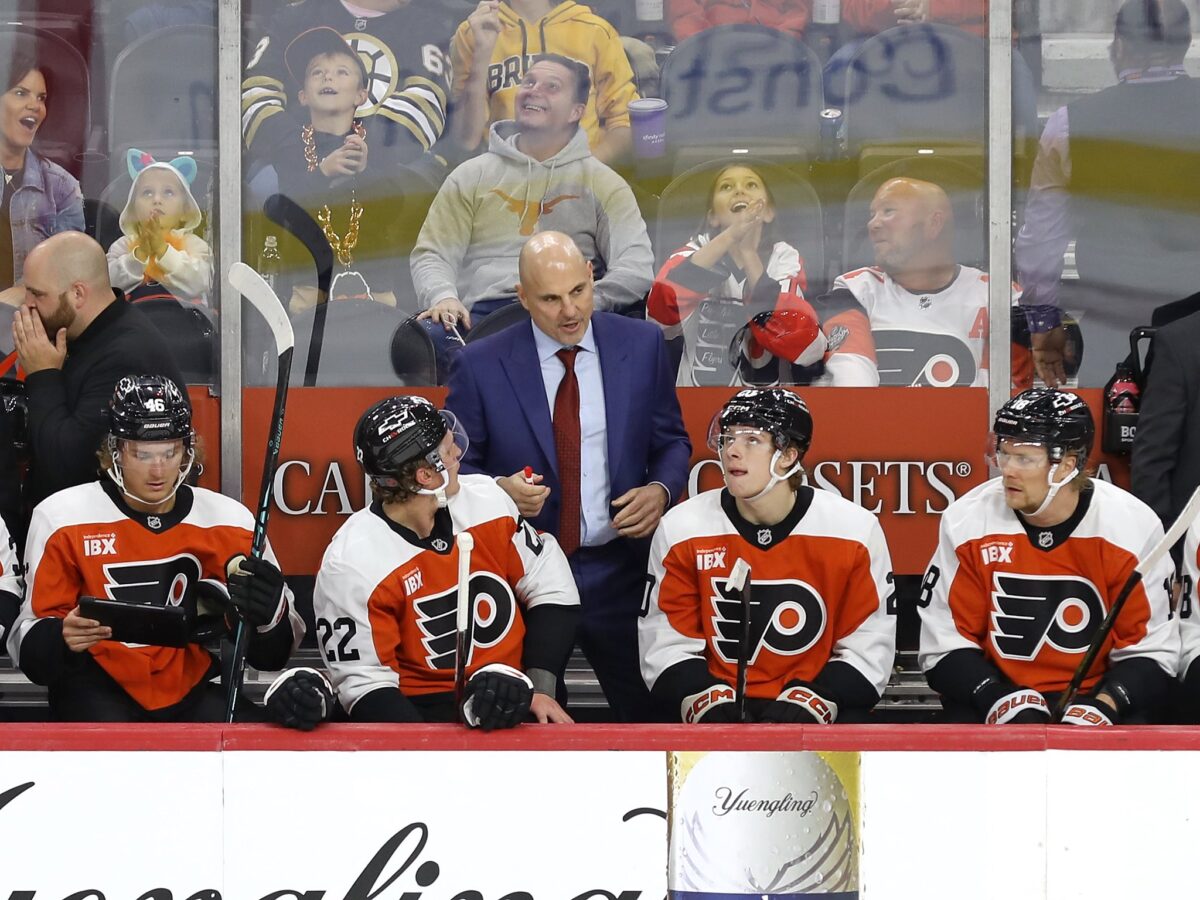 Rick Tocchet, Philadelphia Flyers (Amy Irvin / The Hockey Writers)
Christian Dvorak has produced offensively at a career-best clip. But his offense has never carried over much to his shorthanded play — Dvorak has just two shorthanded goals in nearly 600 NHL games. Garnet Hathaway’s offense has completely fallen off a cliff; he’s the only player with more than 20 games played yet to record a point. That’s left Travis Konecny, the main driver of that shorthanded scoring surge, without much support.
Power Play
As mentioned, trading Poehling was worth it because it allowed the Flyers to acquire a legitimate difference maker in Trevor Zegras. The NHL 23 cover co-star got off to a blistering start on the power play, registering eight points in his first 13 games as a Flyer. However, regression hit at the beginning of November, with Zegras held to just three PP points over his last 13 contests.
The team’s issues extend beyond one player going a bit cold, obviously. While the Flyers have taken solid strides in expected goals (xG) generation and shots for per 60, improving from 32nd to 23rd in both categories, generating A-plus chances remains a struggle. The Flyers were a bottom-four team in high-danger chances per 60 in the last two seasons and are still in that range this season.
It also doesn’t help that Philadelphia hasn’t had many in-game chances to improve things. The Flyers are 24th in power play opportunities per 60 at 2.79. That isn’t necessarily an excuse; three of the league’s top 10 PP units and two of its top three are among the eight teams below them in the number of PP chances on a per-game basis (although there also are a pair of bottom-four groups there as well).
Two Losses For the Price of One
While some of these struggles were beginning before Dec. 1, both units received a massive blow that night when Tyson Foerster went down with an upper-body injury that will sideline him for two to three months. The Flyers are a respectable 2-1-1 in the four games they’ve played since then, but special teams have been a major struggle.
Related: Flyers Will Suffer Long-Term for Cheating the Rebuild
The Flyers did connect for two PPGs in the opening period of their first game without Foerster, but have failed to convert on their last nine chances since, including a five-minute major. The penalty kill is a decent 9/12 in that span, but it’s fair to be concerned about how they’ll hold up. Foerster was on the ice for just 5.67 expected goals against per 60 (xGA/60), the best mark of any of the 11 Flyers who average at least one minute of shorthanded time per game.
He’s also second to Zegras with three power-play markers. His absence was especially notable when Rick Tocchet’s late-game line change failed to spark the group, opening the door for the Vegas Golden Knights to win in overtime. The Flyers played well at 5-on-5, winning the xG battle against one of the league’s top play-driving teams. Answers are needed quickly to prevent that from becoming a familiar refrain.
