
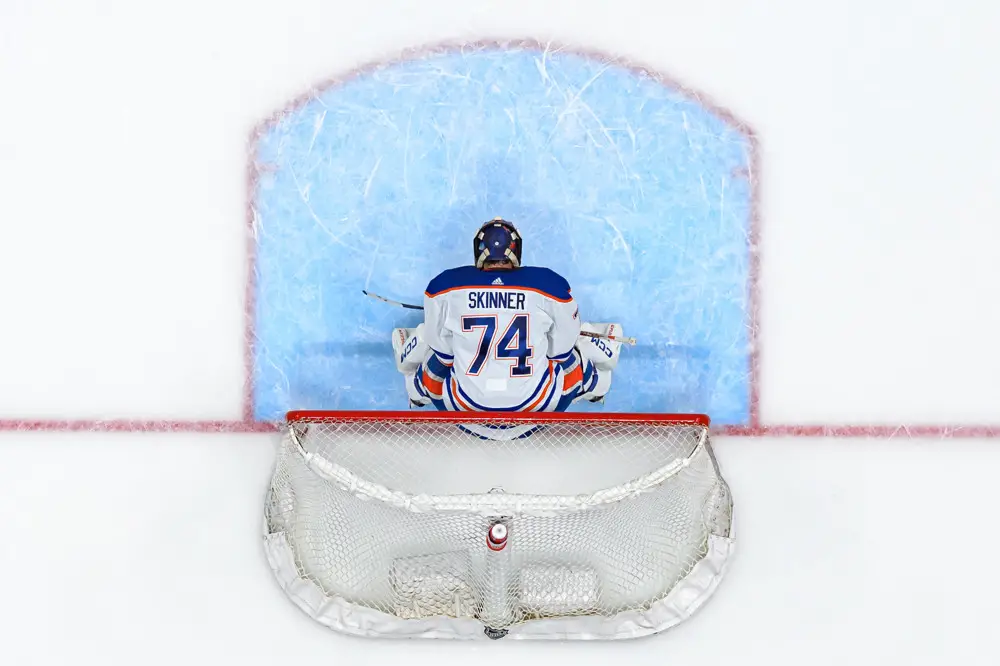
The Edmonton Oilers made a decisive move at the most fragile position on the roster this week trading goaltender Stuart Skinner to the Pittsburgh Penguins in exchange for Tristan Jarry.
From a transactional standpoint, Skinner was approaching a critical point in his tenure with the Oilers both competitively and contractually, while Jarry arrives with additional term giving Edmonton a clearer medium-term plan in net.
But according to reporting from Elliotte Friedman, the deal was driven by far more serious internal concerns and an environment that had become increasingly difficult to manage.
Team had lost confidence in Stuart Skinner per Friedman
What made the timing of the trade notable was that Skinner was not struggling when the move was made. In fact, he was in the middle of a solid stretch. However, Friedman made it clear that performance alone no longer dictated trust.
According to Friedman’s reporting, the Oilers’ decision stemmed from a gradual erosion of confidence inside the room.
Any mistake, no matter how isolated, brought back lingering questions about whether the team could rely on him when it mattered most. Over time, that reality became emotionally exhausting. The pressure was no longer confined to the goaltender. It spread to the bench, the defence and the broader organization.
“Stuart Skinner could, he was in a good streak, by the way, when he got traded. But the moment it went bad or he had a rough game or anything like that, all the old questions and concerns came up.”
Those concerns weren’t isolated to one corner of the organization.
“It was weighing on Skinner. It was weighing on the team. It was weighing on the organization and I think everybody here felt it was just time.”
At that stage, Skinner’s margin for error had effectively vanished. One off night carried disproportionate consequences creating a cycle that was emotionally draining for everyone involved.
“I think ultimately Stuart Skinner would probably agree, it was just time. It was weighing on everybody too much.”
Eventually, the Oilers reached the conclusion that even if Skinner could rebound again, the environment around him had become too heavy to sustain. At that point, the issue was whether the relationship between player and team could realistically move forward.
This reaction wasn’t limited to fans or outside noise. Internally, the cycle was affecting everyone.
Why Tristan Jarry became the answer
Edmonton’s comfort with Jarry extended well beyond his stat line. According to Friedman, the Oilers were reassured by Jarry’s intentions and personal connection to the city.
“The thing that had made Edmonton comfortable with Jarry is that he apparently behind the scenes made it very clear that if he knew his time in Pittsburgh was getting tight, he made it clear he wanted to go to Edmonton.”
That willingness mattered in a demanding market.
“He has a place outside of Edmonton. He comes back there in the summer. He played junior there, and the Oilers did their research into him and they felt they were comfortable with him because he’s an Edmonton-happy guy.”
For a team that had grown wary of fragile confidence at the position, that psychological readiness was a key part of the evaluation.
Brett Kulak and the cap reality
Brett Kulak’s inclusion in the deal was clearly not driven by performance concerns. The Oilers valued him and did not actively want to move him. However, cap mechanics left them with little flexibility.
His contract was the final piece required to make the trade viable given just how narrow Edmonton’s margin for error remains under the salary cap.
“The thing about Kulak is that I don’t think they wanted to trade him. But they had to do it to make the money work, and that was kind of like the final step.”
The result was a deal that surprised many inside the locker room.
“It was a big shocker. You could tell those players were surprised,” Friedman said.
Bet like a pro here with Bet99—Ontario’s go-to for elite odds and nonstop action.
 with Bet99—Ontario’s go-to for elite odds and nonstop action.
And outside Ontario, Canadians bet better
here with Bet99—bringing top-tier odds and action from coast to coast.
 with Bet99—bringing top-tier odds and action from coast to coast.
Stuart Skinner woke up to phone call that he was being traded
The personal impact of the decision was immediate. Skinner reportedly learned of the trade through an early-morning phone call to end his time with the organization that drafted and developed him.
“I heard Skinner was woken up with the phone call yesterday that he was going to be traded,” the insider shared.
Even after the transaction, the reality of change lingered in small almost surreal ways.
“The funniest story I heard today was from Adam Henrique. He said that Kulak, it was his responsibility on the road to make the dinner reservations. So the players were like, ‘I know Kulak’s been traded, but do we still ask him to make our reservations tonight in Toronto?’”
For Skinner, now, the move offers a clean slate in an environment free from the accumulated baggage of past doubts. Meanwhile for Jarry this is homecoming.
In the end, the reasoning behind the trade was not possibly that complicated.
It was simply time.
Photo by Derek Cain/Icon Sportswire
Like this:
Like Loading…