
Sidney Crosby spoke softly. Erik Karlsson was just this side of bewildered.
The Pittsburgh Penguins have blown third period leads in four of the last five games, and the one in which they didn’t, they instead absorbed an undeniable beating.
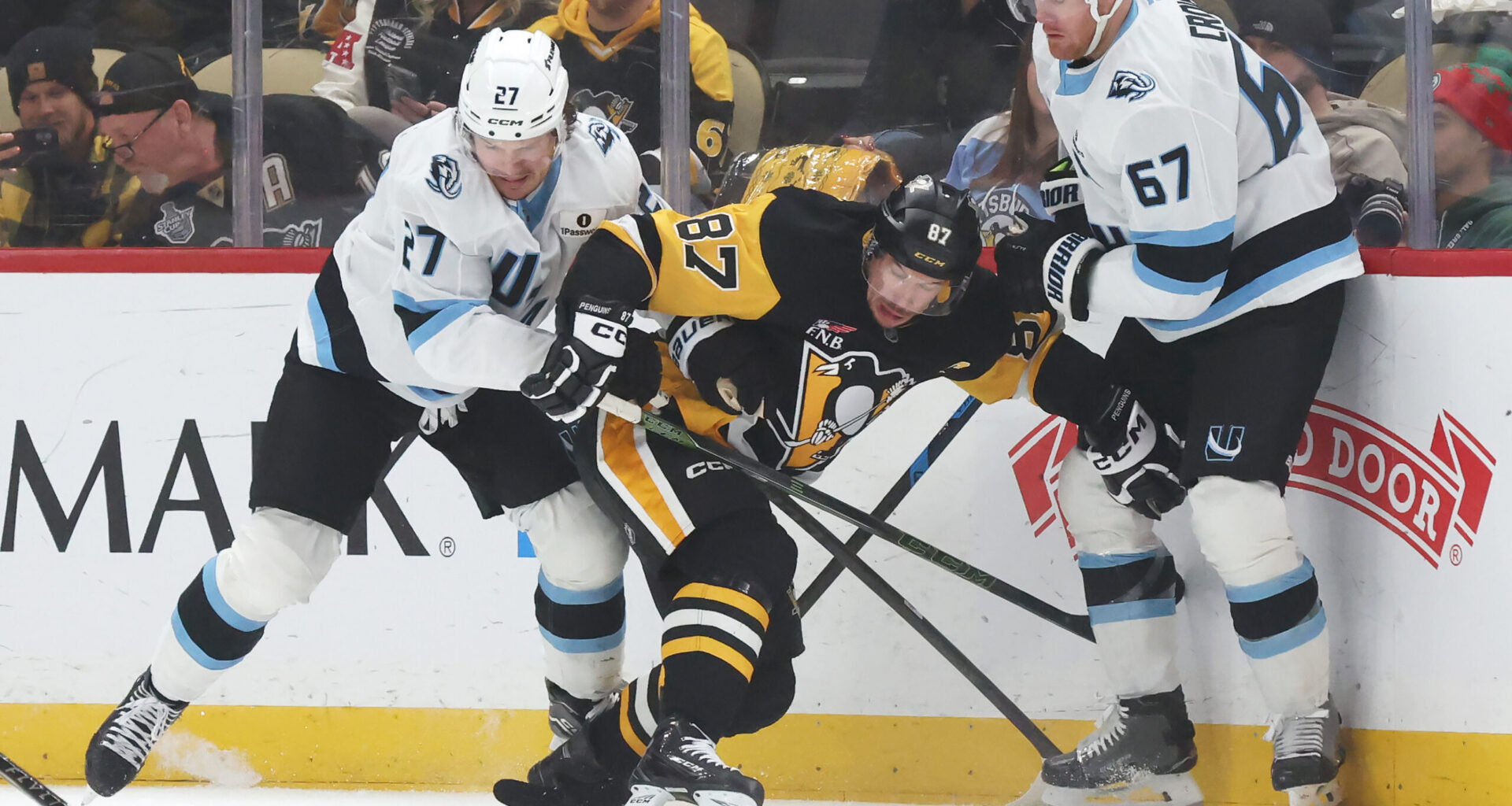
Saturday, the Penguins blew a four-goal third period lead. Sunday, they only wasted a three-goal lead en route to a 5-4 overtime loss to the Utah Mammoth at PPG Paints Arena.
“First of all, not in a million years that I think we’d be back here today, 24 hours later, having the exact same conversation,” said coach Dan Muse. “I’m probably going to sound like a broken record–it has been a little bit different each game, but like … it’s just … we get away from it. We aren’t able to get it back nearly as fast. And so the chances that we’re giving up, they’re big ones.”
The coach is baffled.
The players are befuddled. Never before has anyone been a part of a run of abject futility, trying to hold what should be insurmountable leads. A 5-1 lead against the San Jose Sharks? Vanished in just 10:49 Saturday.
A 3-0 lead? Gone in 7:06 Sunday to the Utah Mammoth.
By comparison, their jaw-dropping losses on Sunday and Tuesday, in which they allowed goals against an extra attacker to the Dallas Stars and the Anaheim Ducks, seem generic.
Crosby tried to explain. But answers are few. Things like this happen maybe once per season, or once every few seasons. Instead, the Penguins are making it a habit.
“We’ve got to find a way to get over the hump. We’ve done enough to win games and just haven’t closed it out,” Crosby said in a soft tone. “So I think we just need some plays that are going to do that.”
In other words, Crosby is hoping for some bounces or luck to go their way. That’s where we’re at with this inexplicable run.
However, while Crosby shook his head as he spoke, his voice betraying the team’s wounded psyche, Erik Karlsson had the same head shake, but was more blunt about the situation.
“I think we tried to play the right way, we tried to have the intensity and it was more a case of they beat us today and scored the goals, we didn’t beat ourselves which is a good sign, but then again, situations like this sometimes confidence plays a big role and obviously right now we’re lacking that,” Karlsson said.
“We’ve got to find a way quickly to try and get that back because early on in the season I think we did a great job playing with the lead and somehow we have fallen away from that, and a lot of it has to do with how you’re feeling out there when they score that first one,” Karlsson continued. “I think that’s just a mindset that we’ve got to be able to control in here if we want to be a good team.”
As the Penguins tried to put together the pieces of consecutive soul-crushing defeats, there was no talk of getting a point. No talk of playing well until that point. In fact, there was no talk of positives whatsoever.
Karlsson doesn’t see a schematic or structural issue. He sees the successive losses becoming a heavier and heavier emotional burden.
“We’re playing against the best players in the world, and we’ve got to remember that we’re part of that group and we’re more than capable of playing with anyone. So … it’s more of a mindset right now, and the good thing about that is it’s controllable. I don’t think it has anything to do with systems or Xs and Os, I think it’s just within ourselves, and we’ve got to find a way to regain that trust individually and as a team.”
How does a team change so dramatically with a lead?
How does a team with Crosby, Bryan Rust, Rickard Rakell, and Karlsson stink worse than rotting fish in overtime?
How does a team led by Crosby look so mentally weak?
A couple of times is an issue. A few times becomes a big problem. The Penguins are now well past that, both in blown leads and overtime failures.
They’re 1-9 when games go beyond 60 minutes.
For all of the hype surrounding rookie goalie Sergei Murashov, he too was a culprit Sunday, yielding big rebounds that he should not have. Crosby seemed to think them bad luck, but ultimately, a goalie kicking shots to dangerous areas will often become dangerous chances.
“We have to learn how to close games. This group has to take that step,” Muse said. “I said it last night. I’ll say it again. We’re sitting right back here. I have to do a better job of fixing that, helping to fix that. Right now, (we’ve got) a day off. We’ll come back–we don’t have a choice. We have to stick together as a group.”
Those are the things that were said.
No, it wasn’t a goal or two against an extra attacker that cost them Sunday. But a big lead was lost nonetheless. What was not said or discussed were solutions. The team, the players individually, and maybe even the coach are rattled. The mask of cliche to locker room questions couldn’t hide the despirited exasperation.
Penguins Report Card
Team: D
The team played with heavy legs. They didn’t have their best, but they found a way to get four goals. That should have been enough.
Giveaways and bad penalties were a factor, but their stalled ambition was obvious. The home crowd was murmuring through most of the second period, but it surely wasn’t the crowd’s fault. The Penguins had six, four, and six shots in the first, second, and third periods, respectively.
Sergei Murashov: C-
He made some big-time saves in the first 40 minutes, but he looked off. For a while, it looked like a skate issue as he had trouble moving and keeping his balance. In fact, on one first-period chance, he used the post to steady his position to make the save.
By the third period, he was popping big rebounds and going down too quickly. Make no mistake, his future is extraordinarily bright, but these are the growing pains.
Justin Brazeau: Welcome Back
Brazeau had been too quiet in the four games since his return. He had a pair of goals Sunday, and each was well earned. His first was a spinning backhand pass with a bit of a Savard-ian spin that was knocked into the net by a surprised defender. His second goal tied the game 4-4, and it was his puck retrieval and net-front presence that allowed him to deflect it past Utah goalie Karel Vejmelka.
Ben Kindel: A
He played a solid game. His breakaway goal was next-level anticipation, and he should do a lot more of that. Kindel had three points, one goal, and two assists.
Bryan Rust: Hustle
Simply, Rust gets after it. The Penguins didn’t have their best game, nor their freshest legs, but Rust created a goal by attacking Mikhail Sergachev’s puck possession following a faceoff. He simply creates space and opportunity, even on a bad day.
Kris Letang: D
A team-worst 22% Corsi confirms the story that eyes told. The Penguins’ second-pairing defenseman simply didn’t have the puck, didn’t play with the puck, and gave up the puck too easily.
Tags: erik karlsson Penguins Analysis Penguins report card Pittsburgh Penguins Sidney Crosby utah mammoth
Categorized: Penguins Analysis