
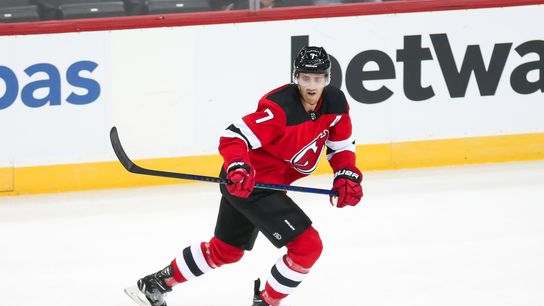
Over the last 48 hours, the Toronto Maple Leafs have been heavily linked to veteran defenders Rasmus Andersson and Dougie Hamilton via the trade market.
Insiders indicate that trade talks across the league have intensified following the blockbuster deal that sent Quinn Hughes to the Minnesota Wild. That move appears to have stimulated the market, with several teams looking to pull the trigger on major roster adjustments before the holiday trade freeze takes effect.
Despite the Maple Leafs’ recent struggles on the ice, the front office is surprisingly operating as a “buyer.” However, given Toronto’s limited draft capital and trade chips, finding a path to a high-value asset remains a challenge. That’s exactly why a “cap-casualty” target like Dougie Hamilton is becoming a serious point of discussion.
The Case for Rasmus Andersson
Rasmus Andersson is entering the final year of his contract and is widely expected to test unrestricted free agency this summer. His production this season has been stellar; in 34 games, he has tallied seven goals and 15 assists while logging a massive 24 minutes of ice time per night.
As a right-handed shot, Andersson fits the exact archetype Brad Treliving is hunting for, especially with both Brandon Carlo and Chris Tanev sidelined.
Versatility and Deployment
Despite his offensive upside, Andersson is a workhorse in his own end, starting 53.7% of his shifts in the defensive zone. His ability to kill penalties and anchor a power play makes him a true “all-situations” tool.
The Cost of Acquisition
The hurdle for Toronto is the bidding war. With a manageable $4.55 million AAV, the Calgary Flames could easily retain salary to drive up the return to a first-round pick plus a blue-chip prospect. For the Leafs, this would likely mean surrendering their 2028 first-round pick and top defensive prospect Ben Danford.
While reports suggest Andersson is open to a long-term extension in Toronto, and he holds a six-team no-trade list to help facilitate a move, the price tag remains a significant barrier unless the Leafs can recoup assets elsewhere.
The Dougie Hamilton Opportunity
On the other side of the coin sits Dougie Hamilton. Unlike Andersson, Hamilton is under contract for two more seasons beyond this one at a hefty $9 million per year. His production has dipped recently, with just eight points in 30 games, largely due to reduced power-play time. For an offensive specialist like Hamilton, those man-advantage minutes are the lifeblood of his game.
New Jersey’s Cap Crunch
What makes Hamilton a realistic target isn’t just his play, but the New Jersey Devils’ dire salary cap situation. The Devils are currently $6.5 million over the cap and must soon activate Johnathan Kovacevic from LTIR.
To get compliant, New Jersey needs to shed significant weight. Reports indicate both Hamilton and Ondrej Palat are officially on the block. This puts the Devils in a position where they might view a Hamilton trade as “addition by subtraction” just to balance the books for future extensions, including goaltender Jacob Markstrom.
Can the Leafs Capitalize?
This scenario presents a rare opening for the Maple Leafs to take advantage of a cash-strapped opponent. Toronto desperately needs production from the back end, and the Devils are currently plagued by injuries up front.
There is a potential “creative” deal to be made here, one where Toronto uses their forward depth to help a depleted Devils roster while solving their own blue-line identity crisis.
Final Thoughts
Ultimately, whether it’s the high-rental cost of Andersson or the long-term cap commitment of Hamilton, any move will come down to dollars and cents. If Brad Treliving wants to upgrade this roster before the freeze, he’s going to have to get aggressive with his remaining assets.