

At some point, the Calgary Flames were always going to have to confront the reality of their position in the standings. Despite internal resistance to fully embracing a sell-off, the numbers are beginning to dictate the franchise’s direction. At 13-17-4, Calgary sits sixth in the Pacific Division and remains well outside the playoff picture, trailing the wild-card cutline by seven points. With limited momentum and a crowded Western Conference race ahead, general manager (GM) Craig Conroy is increasingly positioned to move veteran assets in exchange for draft capital and young talent.
That reality has been accelerated by a blockbuster trade that Calgary was not directly involved in, but one that may significantly benefit the organization. The decision by the Vancouver Canucks to trade franchise defenseman Quinn Hughes to the Minnesota Wild has reshaped the NHL’s defenseman market — and in the process, dramatically elevated the trade stock of Flames blueliner Rasmus Andersson.
Why the Quinn Hughes Trade Changed the Entire Market
The Hughes trade was not just another high-profile move; it was a market-setter. Everyone knows Hughes is one of the best defensemen in the league. He controls the game, helps the offense, and can lead any team’s defense to compete at the highest level. When a player that good becomes available and gets a huge return, every GM has to rethink what players are worth and how fast they need to act.
Related: Flames News & Rumours: Andersson, Parekh, Bean & More
Vancouver trading Hughes way before free agency told everyone, You don’t have to wait until the trade deadline to make big changes anymore. But the biggest thing? What they got for Hughes set a new standard for what top-tier defensemen are worth in the NHL now. That standard sticks around after the trade. It becomes what everyone compares future deals to.
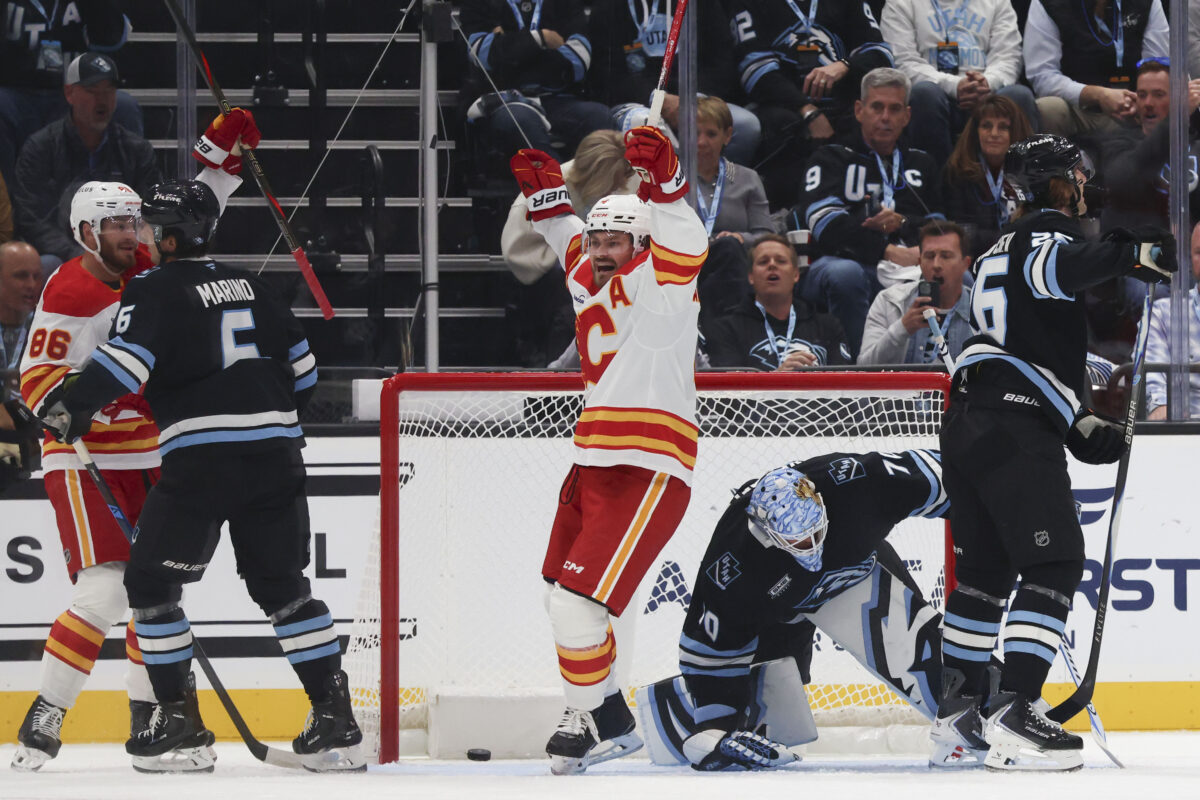 Calgary Flames defenseman Rasmus Andersson celebrates a power-play goal against the Utah Mammoth (Rob Gray-Imagn Images)
Now that Hughes is gone, the demand for players like him hasn’t dropped off. It’s actually gotten even bigger.
Rasmus Andersson Moves to the Top of the Board
After Hughes was out of the picture, teams started looking for the next best player, which seems to be Andersson. He might not record as many points as Hughes, but he’s got something just as important for teams trying to win: he’s a solid defenseman who can play a lot in any situation.
Andersson can handle tough players, help out on offense, and play good defense, making him great for playoff games. He’s played for years against top players and still does well when the pressure’s on. Good defensemen are hard to find in this league, and Andersson is one of the best ones that might be available.
People have been talking about trading him for a while, but now that Hughes is gone, those talks are getting serious.
Contract Value Adds to Andersson’s Appeal
One of the most underappreciated aspects of Andersson’s trade value is his contract. At a manageable cap hit with term remaining, he represents both short-term impact and long-term stability. In a cap-constrained league, that combination is gold.
Teams are no longer just renting players at the deadline; they are seeking controllable assets that fit multi-year competitive windows. Andersson checks that box far more cleanly than many other defensemen who might otherwise be available. Compared to pure rentals or aging veterans, Andersson offers certainty — something GMs crave when paying premium prices.
The Hughes Trade Raises the Price, Not Lowers It
A lot of people think that when a superstar gets traded, the market calms down. But usually, it’s the other way around. The Hughes trade set a high bar, and it wasn’t just a fluke.
If Hughes had been traded for cheap, it would have lowered what people expected the return for Andersson to be. But the Canucks got a big return, which shows that teams will give up good prospects and future draft picks for a top defenseman.
So, Calgary doesn’t have much reason to take a fair offer. They can now ask for a lot, based on what’s happened recently – maybe a first-round pick, a great prospect, and other stuff too.
Contenders Feeling the Pressure
The Hughes trade has placed pressure on contenders across the league to act decisively. Teams like the Dallas Stars, Vegas Golden Knights, Carolina Hurricanes, Tampa Bay Lightning, and Washington Capitals are all in win-now mode and acutely aware that standing pat could cost them a legitimate Stanley Cup run.
Dallas, in particular, stands out. With injuries on the back end and a clear desire to fortify their defense for the postseason, Andersson fits their needs almost perfectly. His ability to play heavy minutes while contributing offensively makes him an ideal playoff addition.
As more contenders enter the bidding, Calgary’s leverage only increases.
Calgary’s “Wait-and-See” Approach Pays Off
The Flames have been patient this season, not rushing into trades just to show they’re rebuilding. The Hughes deal proves that’s smart. Because they waited, Calgary now has a highly valuable defenseman when many teams want one.
 Calgary Flames general manager Craig Conroy (Sergei Belski-Imagn Images)
Instead of pushing to trade Andersson, the Flames can let teams make offers, which could start a bidding war. The longer competing teams wait, the more pressure they’re under, and the more they’ll pay.
This is just what Calgary wanted.
More Than Just Andersson: Market Impact on Flames Assets
While Andersson is the primary beneficiary of the Hughes trade, the ripple effects extend to Calgary’s other tradeable veterans. Nazem Kadri and Blake Coleman also gain value in a market where contenders are clearly willing to overpay for the right fit.
However, Andersson remains the centrepiece. Elite defensemen dictate playoff outcomes, and the Hughes deal underscored that reality in dramatic fashion.
A Rare Mid-Season Market Reset
Blockbuster trades of this magnitude rarely happen midseason. Hughes’ move broke the inertia that often defines NHL trade markets before the deadline. It reminded GMs that bold decisions can reshape competitive balance instantly.
For Calgary, the timing could not be better. The Flames now sit in a position of strength, holding an asset that is suddenly more valuable not because he changed — but because the market did.
Andersson’s Value Has Never Been Higher
Even though the Hughes trade didn’t have the Flames involved, it could still help them almost as much as it helps Minnesota. Since Hughes leaving shook up the market for defensemen, Andersson’s value went up. He’s not just a good asset; he could be a game-changer in a trade now.
If Calgary decides to trade him, they’re in a strong position to get a good deal. And if they hold off, teams that want to win will be even more desperate to get him.
These days, top-notch defensemen are key to winning championships, and Andersson is now one of the guys everyone’s talking about.
