
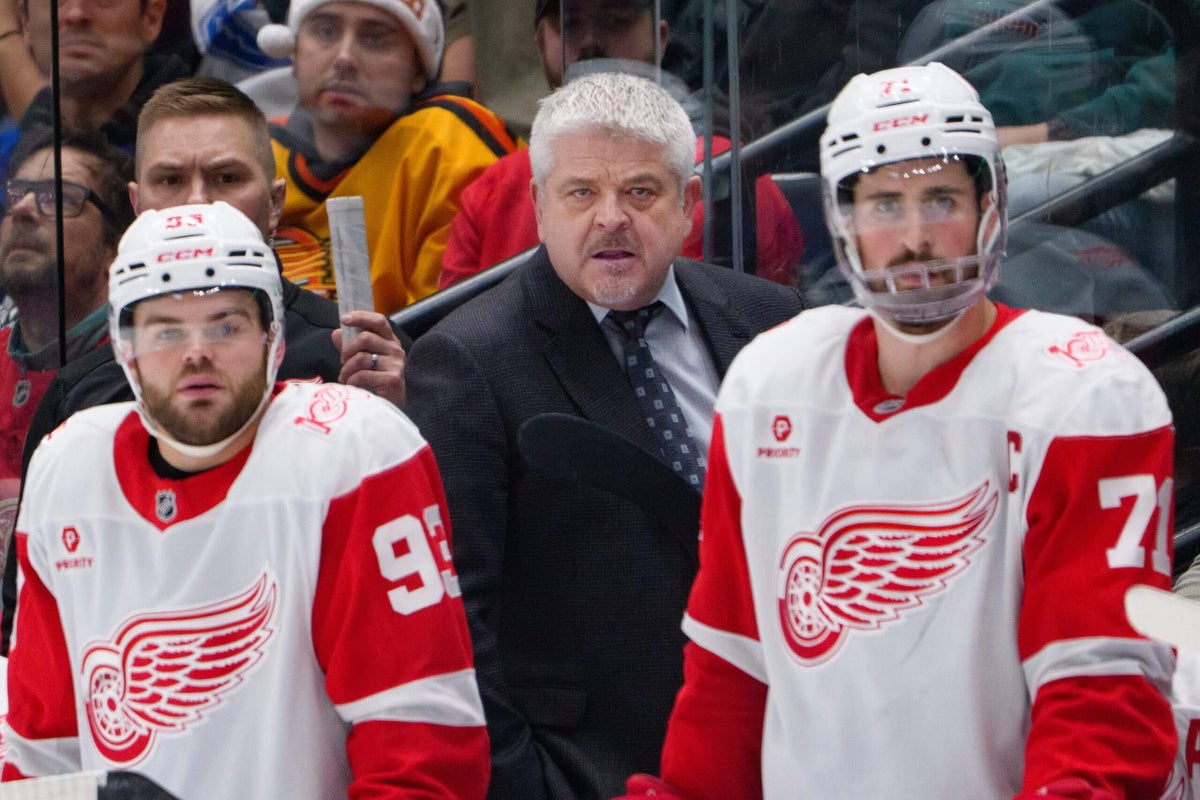
DETROIT — When Todd McLellan arrived in Detroit last Christmas, he was walking into a delicate situation.
A year after coming within a tiebreaker of the postseason, the Red Wings were off to a disastrous start. They had lost three in a row going into the holiday break, getting booed off the ice in a 4-0 loss to St. Louis in previous coach Derek Lalonde’s final game. Through 34 games, they sat 15th out of 16 teams in the Eastern Conference with a 13-17-4 record.
One year later, the Red Wings are atop the Atlantic Division at 21-13-3. That division — and the Eastern Conference — is remarkably tight, so there’s little breathing room. But it’s a stark snapshot of just how much can change in one year’s time.
“I think everyone’s feeling really good about themselves,” defenseman Moritz Seider said recently. “Obviously, the results kind of speak for themselves.”
McLellan has coached the Red Wings for 85 games, to the tune of a 47-31-7 record In his first 82, Detroit recorded 97 points — a mark that would have been enough to make the postseason in the Eastern Conference in each of the last three seasons.
For a franchise in the midst of a nine-year playoff drought, including late-season collapses in each of the last two, that stat offers optimism more than certainty. As Lalonde saw first-hand, going from the cusp of the playoffs in April 2024 to being fired eight months later, things can change fast in the NHL.
But compared to where the Red Wings were a year ago, optimism is a good place to start.
One of McLellan’s first observations was that his new team looked “mechanical,” wasn’t trusting its instincts and was zapped of “spirit.” These were the first buzzwords of the McLellan era — all building toward his very first practice, when he urged his players to “play f—ing hockey. You’ve done it your whole lives.”
After that comment, the Red Wings ripped off a seven-game winning streak. Two weeks after that streak ended, they did it again. They looked like a team transformed.
They haven’t won at that kind of rate since, and Detroit still missed the playoffs with another March meltdown last season. But it’s impossible to deny the shift under McLellan.
Seider and goaltender Cam Talbot both pointed to improved defensive structure, with Talbot noting the team is giving up fewer shots. Veteran forward Andrew Copp highlighted the presence McLellan has brought to the bench, and Seider mentioned the productivity of the Red Wings’ practices since he arrived. But perhaps the most telling sign of the Red Wings’ shift over the past year is in how McLellan’s own messaging has evolved from those early days.
“When he took over, I wouldn’t say we were in a bad spot, but we were obviously lacking confidence,” Seider said. “I think we were not having that kind of swagger that we used to have. And obviously, I think that’s what he meant by just playing free, trusting your instincts, and just really trying to take it day by day. And now I feel like we just have more to prove, and we want to become a real good team. And with that, you’ve got to be really solid defensively, I feel like.”
This is the desired direction for any team in the Red Wings’ position. Rediscovering confidence was a must a year ago. But few (if any) teams can survive on swagger alone. And as McLellan has shifted his emphasis toward managing the game, the buy-in has been there — and the swagger has stuck around, too.
“I think it’s important to trust your instincts also while knowing kind of what we’re doing within the system, and the way we want to play in those situations,” Patrick Kane said. “Yeah, it’s a little bit of a balance, but at the same time I think if you’re thinking systems first and let your instincts take over after that, it usually works out a little bit better.”
Taking over midseason last year, McLellan had only so much time for structural tinkering. So, alongside assistant coach Trent Yawney, McLellan focused much of his early efforts on the penalty kill, which finished last season at 70.1 percent, one of the worst in NHL history.
The coaches weren’t able to improve the kill by year’s end, with the success rate actually dropping slightly from when they took over. But this season, Detroit’s penalty kill has been a success. Entering Sunday, the Red Wings ranked just inside the top half of the league at 81.3 percent.
A full training camp helped, and a new season’s fresh start allowed for a proper installation of five-on-five structures, systems and philosophies. Though turnovers and defensive breakdowns have still bitten Detroit, many of those errors have been mental rather than structural.
“We can now hold players a lot more accountable for their responsibilities on the ice, positively and negatively,” McLellan said of the evolution of his message. “Are they getting the job done? You know, do our actions or inactions live up to what our stated goal is? Like I’ve heard guys on our team (say), ‘We have to make the playoffs. That’s what we want to make.’ Well, do our actions live up to that, night in and night out?”
Talbot also pointed to that accountability: “I don’t know if that was really done before, at least to a high enough standard. And I feel like they came in and they established that standard, and everyone knows what to expect now.”
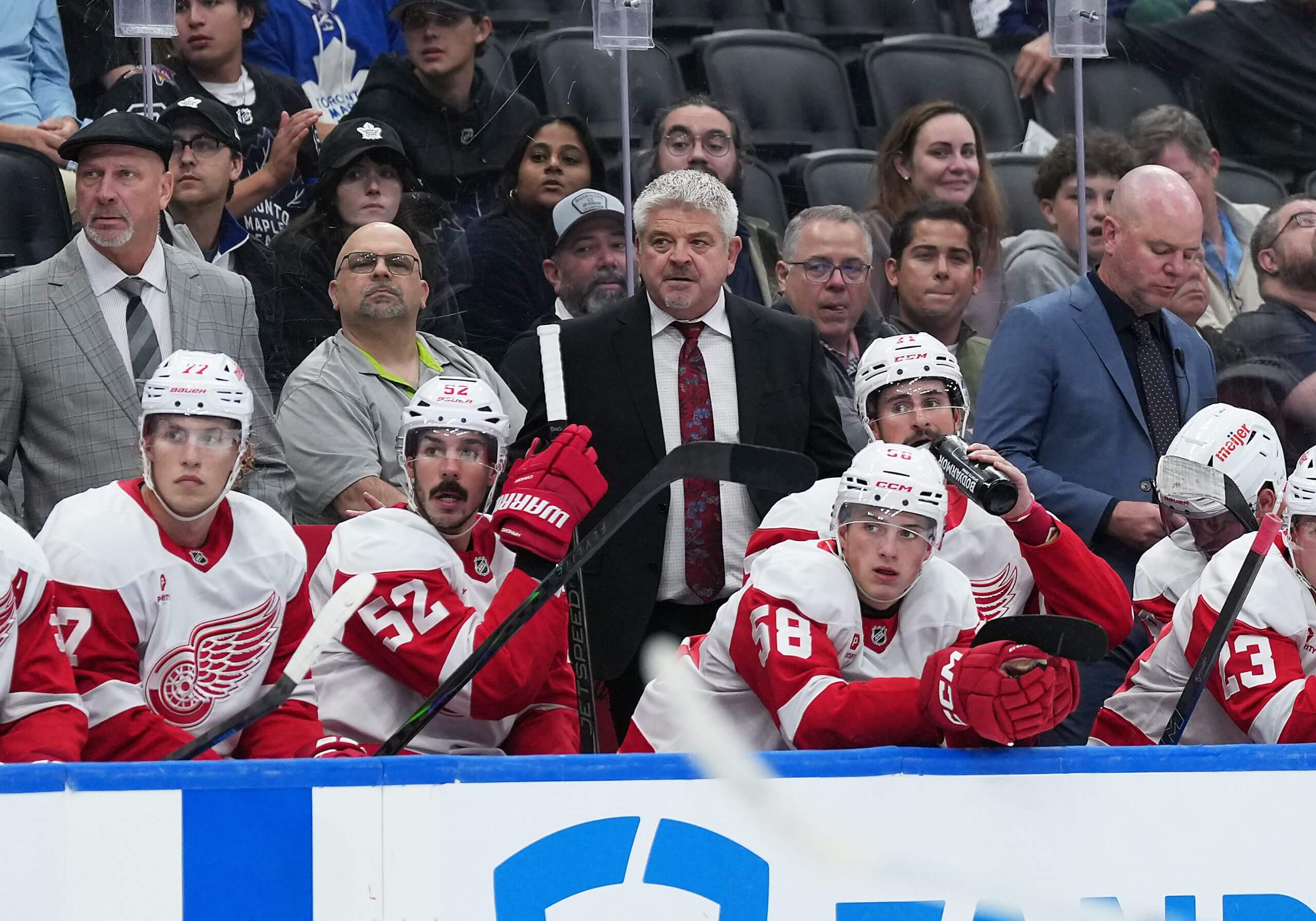
A full preseason under Todd McLellan has helped the Red Wings focus on smaller day-to-day details. (Nick Turchiaro / Imagn Images)
Setting that standard is easier said than done, especially while maintaining morale. McLellan hasn’t pulled punches on players, or the group as a whole, in media sessions or in practice. After the Red Wings allowed five third-period goals in a 6-3 loss to the bottom-dwelling Nashville Predators last month, an exasperated McLellan lamented that every time his team seemed to fix one issue, they let something else slip.
“It’s not a sign of a good team,” the coach said that night. “Good teams hold their lessons, and they build off them.”
It was a frank and accurate assessment, but harsh nonetheless, which is a tricky needle to thread in terms of messaging. A coach can’t bring the hammer after every loss and yet can’t be overly forgiving of sloppiness in a win.
McLellan has proven skilled at knowing when to push which button.
“I feel like that’s just experience on his part,” Talbot said. “He knows when to push and when to pull back, and even in meetings and stuff, there’s some times where you think he’s going to come in f—ing screaming at everybody, and like those are the most subdued ones, and we just go over the video instruction and stuff like that. And there’s ones, you know, maybe it wasn’t so bad, but he’ll come in and be all fired up because we should have won the game. There’s a good push and pull there.”
To their credit, the Red Wings have responded well to that. McLellan has emphasized mental fortitude, wanting his team to break out of funks quicker in games and throughout the season.
So far, Detroit hasn’t gotten stuck in as many prolonged skids as years past. The Red Wings lost more than two consecutive games just twice all season. By last year’s Christmas break, that number was doubled.
That all said, the Red Wings still face real questions beyond whether they can prevent their playoff drought from reaching a decade.
Though Detroit’s five-on-five expected goals generation has gone up by nearly half a goal per 60 minutes under McLellan, compared to the previous year, their actual goal scoring has stayed about the same. Positive regression is always possible, but McLellan’s Los Angeles Kings teams suffered from the same trend — perhaps suggesting the expected-goals increase is built on volume more than quality.
The trend also suggests that, outside of their top players, the Red Wings need to improve their finishing. Dylan Larkin, Alex DeBrincat and Lucas Raymond have been carrying the offense for most of the season, but when they’re quiet, Detroit still needs an answer.
Then there’s the matter of shelf life. As well as McLellan has walked the line between accountability and maintaining morale, NHL coaching tenures are stunningly short — under two and a half seasons on average. McLellan has surpassed that timeline at every stop, so there’s reason to expect he’ll do it once more. Still, most coaches only have so long with one team, which feels especially relevant for coaches of his demanding brand.
In any case, McLellan appears to be right in the sweet spot in Detroit: His team is bought in, growing and generally succeeding.
Through one year, that’s about all you can ask.
Now the focus turns toward bigger goals, and whether McLellan can help the Red Wings get over the hump and back to the playoffs.