
PHILADELPHIA — If you’re one of the many fans still hoping to find a long-awaited and sorely needed Vancouver Canucks rebuild gift-wrapped under the tree on Christmas this year, then you probably responded to general manager Patrik Allvin’s commentary during an intermission Amazon Prime broadcast on Monday night with a “Bah, humbug!”
Asked about the recent Quinn Hughes trade during that interview, Allvin launched into a description of the team’s overall direction.
That description, “retool (our team) in a little bit of a hybrid form,” for long-suffering Canucks fans, couldn’t help but evoke the dark spectre of the Jim Benning era from Christmases past.
Canucks GM Patrik Allvin joins the Prime Monday Night Hockey crew 👀 pic.twitter.com/6OUyILBnz5
— Sports on Prime Canada (@SportsOnPrimeCA) December 23, 2025
The idea of Vancouver’s direction being described as a “hybrid” of any variety is, obviously, difficult for those more dogmatic rebuild enthusiasts — among whom I’d happily count myself — to process. For someone who believes ardently that the Canucks should be laser-focused on grafting future-forward hockey value onto this roster mostly through the means of acquiring surplus draft capital, viewing established veteran players as depreciating assets to be managed (and behaving accordingly on the trade market), and gearing just about everything toward the goal of accumulating a critical mass of high-end NHL players — “We need an army!” — capable of opening up a five-to-seven year competitive window down the line during which this club might contend credibly for the Stanley Cup, well, that clearly isn’t a precise match for Vancouver’s intentions.
Allvin’s comments on Monday made that clear, but that’s also not a tremendous surprise for anybody familiar with how this organization typically functions. It’s also a genuine window into how Canucks president Jim Rutherford and Allvin, his chief lieutenant, are thinking about what’s necessary to turn this franchise around.
The Canucks aren’t planning to rebuild with an extreme focus on draft capital and talent accumulation that we’ve long advocated for at The Athletic. They are, however, well aware that this team, as currently constructed in the wake of the Hughes trade, requires a significant injection of high-end young talent and that they must be mindful of trading expiring unrestricted free agent players for younger pieces or draft picks. It’s understood that the team will be taking a step back in terms of competitive urgency for at least the balance of this season, and most likely the next one as well.
This “hybrid” label, then, refers not to the sort of monstrosity that the Greek gods might have created in stories of old to punish those kings that upset them, but to a middle-road sort of rebuilding approach in which the Canucks intend to mute the usual competitive urgency that has underpinned so many organizational mistakes across the past 10 years and keep an eye on the future, while avoiding a total teardown and maintaining a robust base of veteran players as mentors for their younger pieces.
In practice, that means that the Canucks aren’t going to emerge from the holiday freeze intent on shedding some of the long-term contractual commitments to their bevy of young veteran skaters in their late 20s. The club wants to maintain a credible base of NHL-level contributors, provided those veteran players are on board with the new direction and are engaged productively in working with the younger players (of which the Canucks hope to add more over the next 12-18 months) now dotting the roster.
It also means that regardless of how many wins the Canucks can compile with a relatively soft schedule coming out of the holiday break and no matter how close this team comes to a playoff spot, they won’t be buying veterans to give the roster a short-term boost. The first-round pick the Canucks acquired in the Hughes trade, for example, isn’t burning a hole in the organization’s pocket the way it usually has during Rutherford’s era. If it’s moved before the deadline, it will only be to acquire a younger piece.
Selling pending unrestricted free agents is still the plan for the Canucks between now and the trade deadline, and the club will be open-minded if not outright aggressive in doing so on the other side of the holiday roster freeze.
Depending on results at the pointy end of the season, if a top-five pick is in reach, you might see the club begin to be selective about Thatcher Demko starts. You will absolutely see the Canucks give opportunities to younger players further up the lineup — like taking a 10-15 game look at Zeev Buium on a pair with Filip Hronek — later in the season.
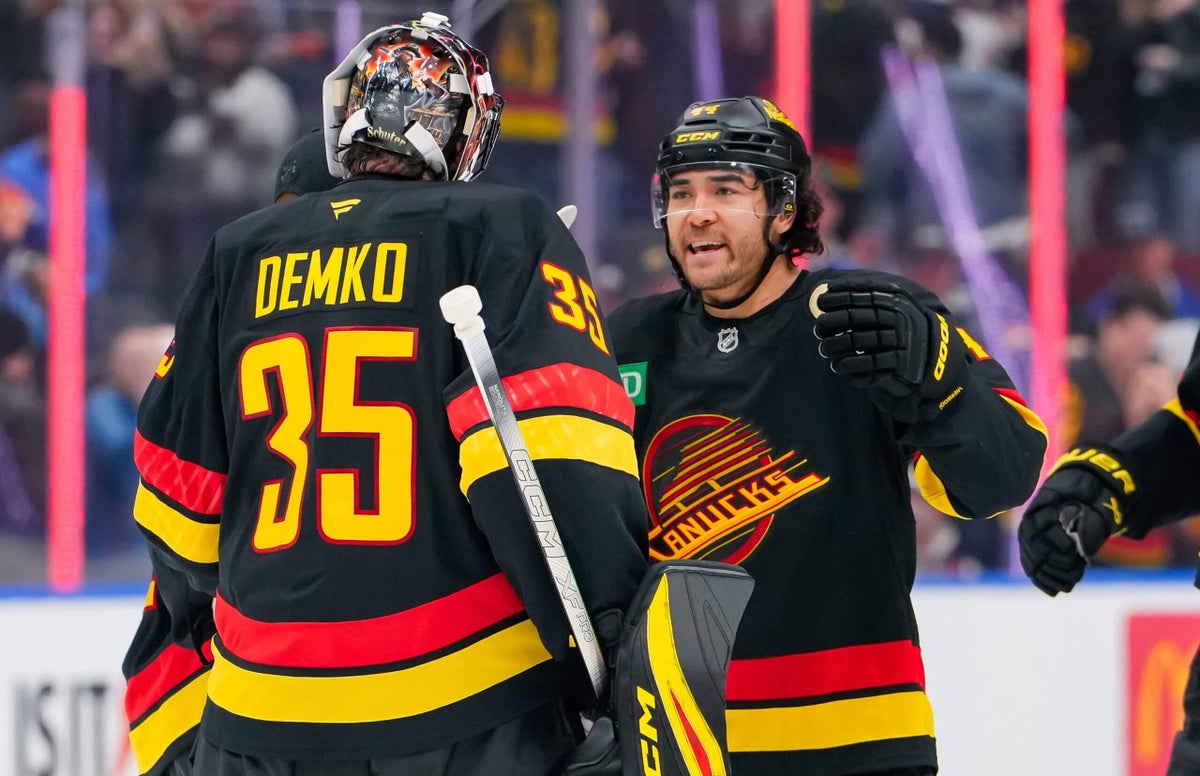
A teardown, however, isn’t happening, and we shouldn’t expect it to. Demko, for example, is widely and accurately viewed as the biggest threat to Vancouver’s tanking effort. An elite goaltender when healthy, the club believes that Demko is fully beyond the knee tear that he sustained during the 2024 playoffs. His value as a leader is prized organizationally, as is the commitment that he made to the organization when he signed a three-year extension this summer. The intention is to honour that commitment, unless something materially changes.
That contract carries a fair bit of risk given Demko’s injury history — the final two years of the deal are 75 percent paid out in signing bonuses, which are buyout proof — but the club feels that it’s well positioned in net. Vancouver is comfortable carrying $13 million in combined cap hits for Demko and Lankinen, even across a two-year stretch in which the team is unlikely to meaningfully contend.
It’s a similar story on defence, where the club views all of Hronek, Marcus Pettersson and Tyler Myers as good veterans who have bought into helping out Vancouver’s trio of young defenders in Buium, Elias Pettersson and Tom Willander. The club is intent on maintaining this hard-won level of blue-line depth, even if there’s an understanding that the team will be taking a short-term step back, and making moves with the future front of mind.
At some point in 2026, the club will even try mixing and matching its three veterans with some of its younger blueliners. As mentioned, seeing how Buium can fit with Hronek is a priority. Splitting up Willander and Pettersson for a stretch to give them an opportunity to learn with Pettersson and Myers, respectively, is also in the club’s plans.
Up front is where Vancouver needs more long-term help, and it’s where the balance of changes will come in the New Year.
Kiefer Sherwood is the club’s most marketable trade chip, and a deal before the trade deadline remains the most probable outcome. Sherwood has both played exceptionally well, practises like a true professional and has worked diligently to help Vancouver’s young players. In a perfect world, he’d be the sort of leader that fits with the “hybrid form” or “retooling” that the Canucks have in mind.
Clearly, however, the Canucks don’t live in that perfect world.
On pace to exceed 30 goals, Sherwood is going to have an opportunity to earn $4.5-$5 million per season on his next contract. He’s 30, and while he’s only played just over 300 NHL games, he plays a physically assertive, abrasive, speed-based style. The return Vancouver is likely to net for him is massive, towering over the sorts of assets the Los Angeles Kings netted for Phillip Danault and the Seattle Kraken brought back for Mason Marchment last week.
Evander Kane, the club’s signature offseason addition, will be the other player to monitor. It won’t be straightforward to net a return for Kane necessarily, and his market may be somewhat prescribed, but he’s a big-bodied scoring forward (he has outscored Marchment considerably this season) with a long track record of producing during the postseason. It will only take one team for Vancouver to be able to at least match the Marchment deal in total compensation.
Beyond those obvious pieces, however, the Canucks’ intentions are to try to win games. There’s a balance that Vancouver wants to be mindful of, a certain structural integrity that the club is intent on maintaining, even as the organization recognizes that it would be in its long-term best interests to net a top-five pick at the 2026 NHL Draft.
Canucks hockey operations won’t be moved by a short-term streak like what the club accomplished on this very fun, pre-Christmas, post-Hughes trade road trip in which Vancouver went 4-1-0. There’s at least some internal recognition that this team has to keep its eye on the future, no matter how tantalizingly close the club gets to the postseason across its final 46 games.
This team simply lacks the pieces to stick around in the Western Conference playoff race. As bunched up as it is in the NHL from the middle to the bottom of the standings, even when this team has won games of late, it doesn’t have the puck enough. The 5-2 goal in Philadelphia on Monday night, in which Buium zipped through the neutral zone with the puck, attacked down the wing and set up a scoring chance for Drew O’Connor from a high-danger area of the ice, stood out.
There’s a sense of how unlike the other goals Vancouver scored on this road trip that play was. It wasn’t a deflection or a quick counterattacking setup produced by the forecheck. It wasn’t a power-play goal, or a goal in which the linesman set a pick on the opposition defender. It was a skill play at five-on-five to set up a scoring chance, the only such goal Vancouver scored on this trip despite winning four of five games.
If you look beyond the results, the limitations of this team are abundantly clear. Demko might give the Canucks a shot to win game to game, and the club has found a higher structural level under Adam Foote over the past month. In the absence of elite, game-breaking level talent, however, the Canucks are going to need a whole lot of luck to crawl out of the cellar in the NHL standings.
Which, in itself, is the real reason to rebuild more aggressively than the club is currently prepared for. It’s why, in a league with no clear seller teams, the Canucks might be wise to zig, bottom out more intentionally (or recklessly, as the organization would see it) and benefit from the prices teams will pay for good, contributing veteran players, while everyone else is zagging.
Perhaps next Christmas, the Canucks will be prepared to go a bit further. This year, however, the club is at least going to spend the holiday with the future front of mind.