
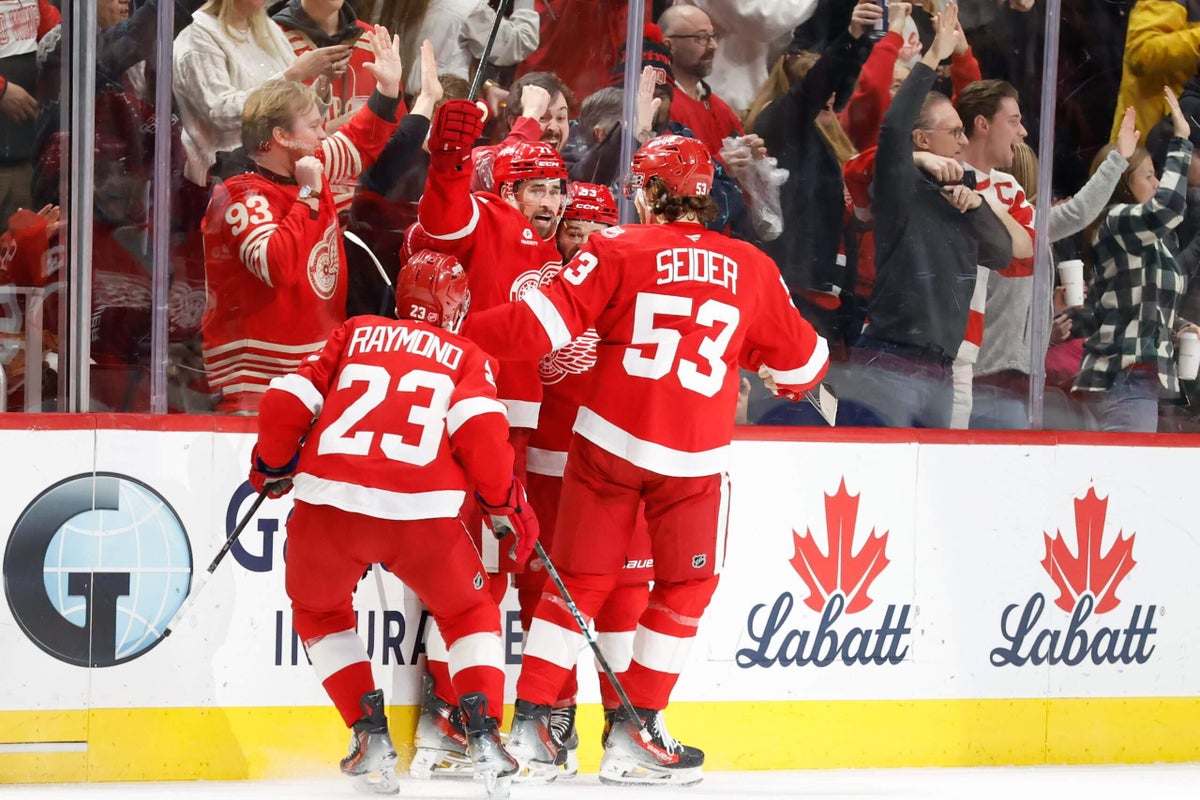
DETROIT — The story of this young Detroit Red Wings season was on display Tuesday in a measuring-stick game, if there can be such a thing in December.
Down 3-2 in the third period to the Dallas Stars, there was every reason for this game to get away from Detroit. The Red Wings had just taken a bad offensive-zone penalty right on the heels of a successful penalty kill and paid for it immediately. They had less than nine minutes to erase the deficit against one of the NHL’s true elite teams, and the momentum was not in their favor.
For Red Wings teams of recent years, it’s hard to imagine them finding a way back into this kind of game. For this year’s group? Well, you saw it.
First, it was the player who took the ill-timed penalty, James van Riemsdyk, making amends by setting up a Dylan Larkin goal to tie the game. Then it was Larkin carving through defenders in open ice, toe-dragging into the slot and beating Casey DeSmith for a walk-off, overtime winner.
On the night before the NHL’s holiday break, one year removed from being booed off the ice in what would be Derek Lalonde’s final game, the Red Wings pulled out a 4-3 win over the Stars to ride into the break atop the Atlantic Division — and tied for the Eastern Conference lead.
It was Detroit’s third straight win, and eighth in their last 10. How are they doing this?
Let’s look under the hood.
Improved resilience
The theme of Tuesday’s game was a familiar one. Dating back to the end of last season, head coach Todd McLellan has emphasized the need for the Red Wings to get more resilient when things aren’t going their way.
Tuesday’s situation certainly qualifies as a response to in-game adversity — although Larkin gave some of that credit to the Little Caesars Arena crowd for willing the Red Wings back into it after the bench started to sag. Detroit had started to stack penalties, with Lucas Raymond taking Detroit’s third minor of the period shortly after the Stars’ go-ahead goal.
Still, on a night that saw Detroit open with some of its best forecheck pressure of the year, the Red Wings never checked out, and when they got an even-up call to put the game four-on-four (and then give them an abbreviated power play), they capitalized.
“We got right back at it, and we didn’t let it kill us,” Larkin said. “We just stayed patient, we stuck together and waited for our chance, and we were able to put the puck in the net when we got our chance.”
van Riemsdyk’s pass from down low — a no-look, between-the-legs pass back to Larkin in the slot — is what made the goal. That it was Larkin on the finishing end felt fitting, too, after a quiet stretch individually of late.
“The timing of it, leadership factor where he kind of went out and got it done,” McLellan said. “That’s the resilience that he’s providing as a captain, and everybody seems to be following.”
More broadly, McLellan emphasized Detroit’s responses game-to-game, too: following up a loss in Edmonton with a dominant win in Chicago, a recent home letdown against the Utah Mammoth with an excellent road showing against the Washington Capitals and now three straight wins against top opponents.
“Our ability right now to respond when it hasn’t gone well has been exactly what we needed,” he said.
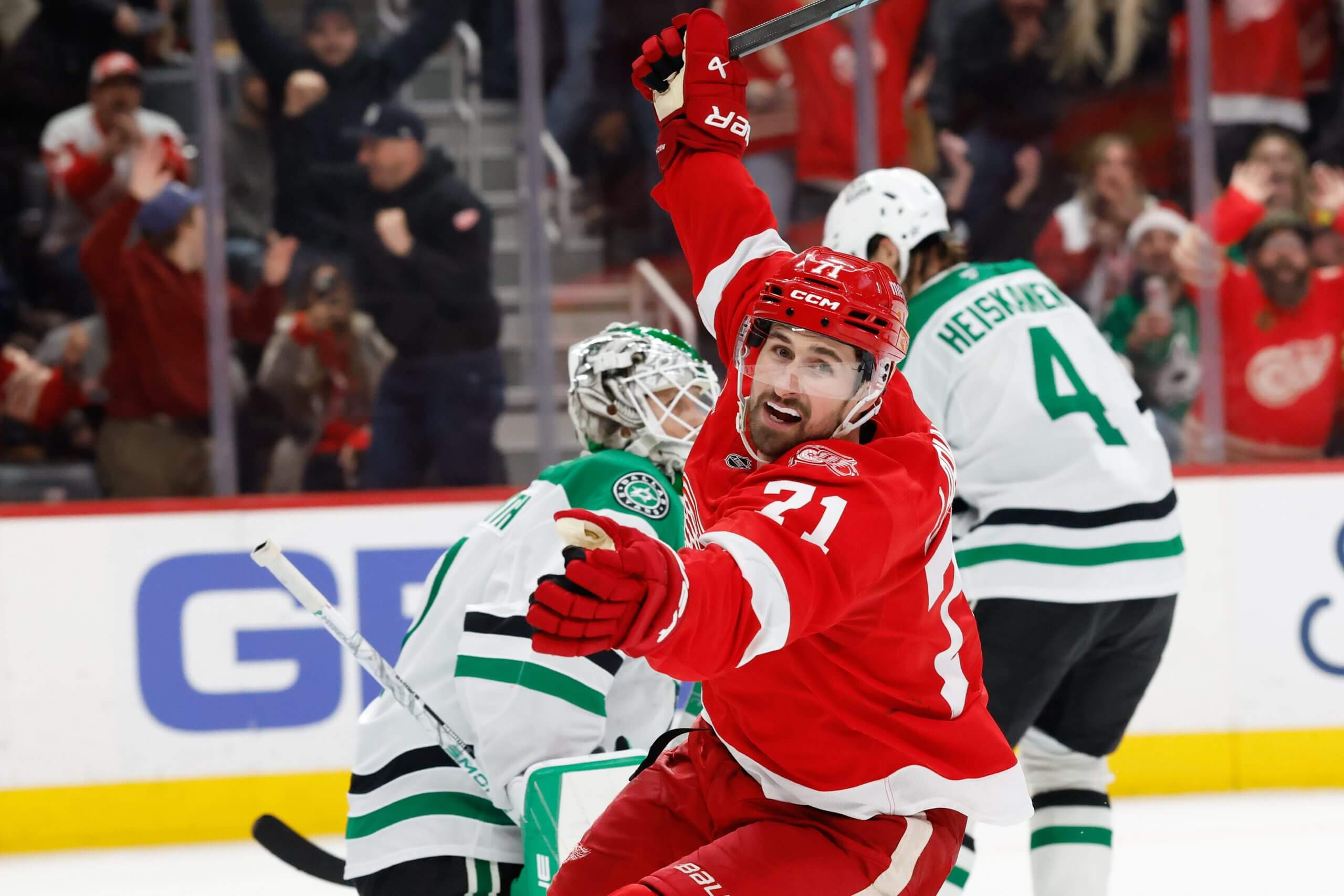
Dylan Larkin’s determination to get the Red Wings back into the game earned praise from his coach. (Rick Osentoski / Imagn Images)
Seider’s Norris push
There’s little doubt who the Red Wings’ best player has been over the last month as they’ve really taken off in the win column.
Moritz Seider is playing at an all-world level all over the ice: suffocating opponents’ chances in transition, jumping into the play offensively and doing everything you’d want to see out of a Norris Trophy candidate.
So often, that award is dictated by points, and Seider’s doing his part there for sure. He had two more assists Tuesday (and the game-winning goal against Washington Sunday), bringing his total to 29 points in 38 games this season, and 23 in his last 22.
That production isn’t really what makes Seider a contender to be named hockey’s best all-around defenseman this season, though. It’s more of his ticket in the door to get everything else recognized: the hits, the defensive stick, the ability to keep plays alive at the offensive blue line, the blend of poise and assertiveness to regroup in the neutral zone and start the attack anew.
“Some of the best hockey I think the league is seeing right now, as far as defensemen,” goaltender Cam Talbot said over the weekend after Seider’s game-winner. “You look around the league, I don’t know how you don’t put him in the top three for the Norris conversation right now. So good to have a guy like that on our team, and he just steps up time and time again in big moments like that.”
Pairing him with another excellent defenseman in Simon Edvinsson has helped, and the two clearly complement each other very well. Nearly halfway through the season, though, the Red Wings are getting a fully-realized version of Seider, and it’s been a game-changer for them.
Finding the depth contributions
Not too long ago, the narrative around the Red Wings revolved around just how much they were getting from their top players relative to the rest of their roster. Looking at the box score numbers, you can understand why: Seider has reached new heights, Larkin and Alex DeBrincat have 20 goals apiece and Lucas Raymond is top-10 in the league with 30 assists.
Recently, however, Detroit is finding its depth in numerous places.
Andrew Copp jumped to center the second line of DeBrincat and Kane, and has awoken offensively with 11 points in his last 11 games. Even with Kane out due to injury recently, AHL veteran John Leonard has jumped from the Grand Rapids Griffins to the top six and made an impact on that line.
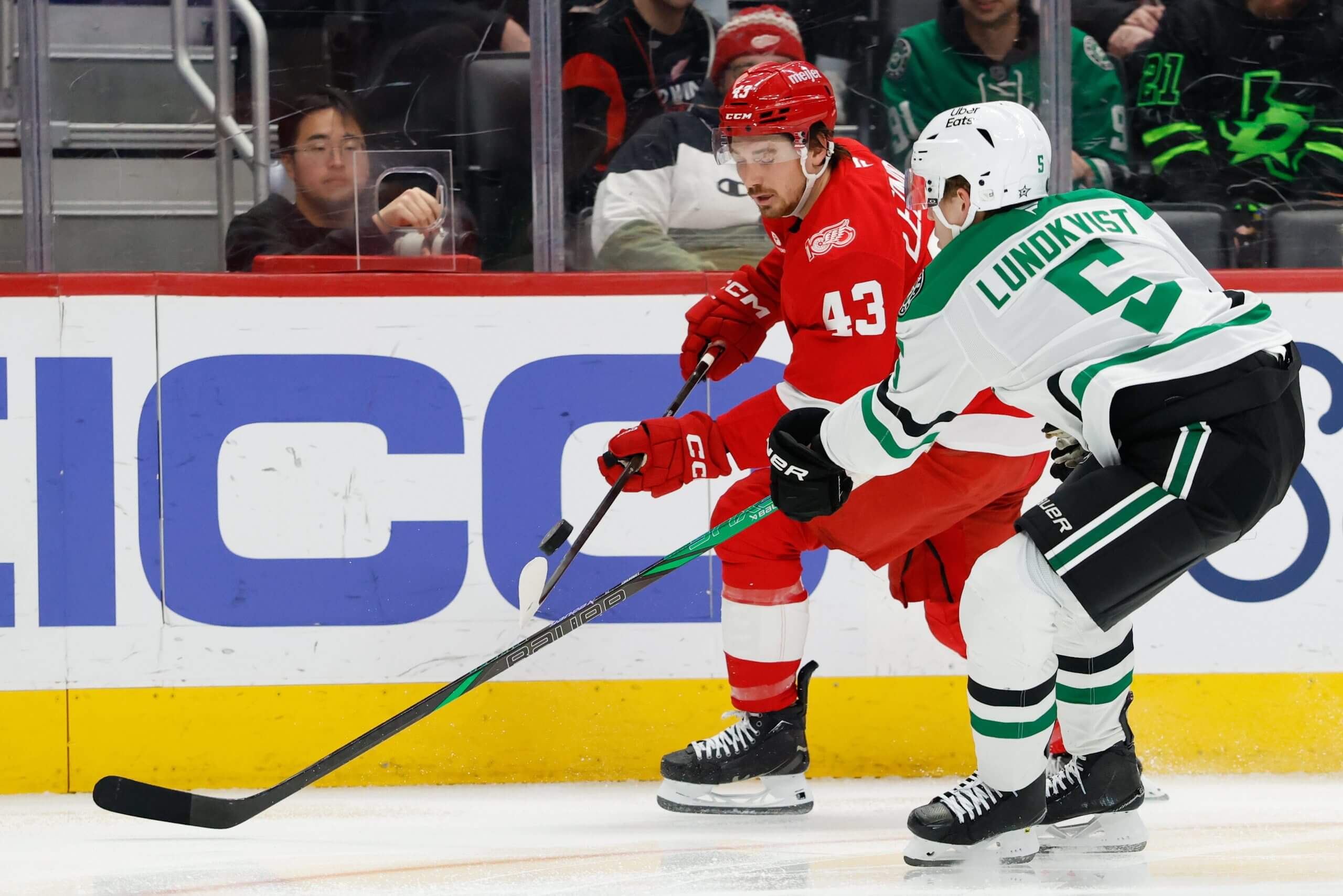
John Leonard is making his presence known after being called up from AHL Grand Rapids. (Rick Osentoski / Imagn Images)
van Riemsdyk started slow after missing training camp, but now has eight goals in his last 14 games after scoring Detroit’s first goal Tuesday and adding the assist on the equalizer. His line with J.T. Compher and Michael Rasmussen has found some chemistry, and Rasmussen — who had been a healthy scratch earlier this season — made a particularly strong play Tuesday using his speed and size to set up van Riemsdyk’s goal.
Then there’s Detroit’s youth. Breakout story Emmitt Finnie continued his strong first half with another goal Tuesday, bringing him to nine on the season while playing on the top line, and fellow rookie Nate Danielson nearly had one as well before it was waved off for a kicked puck. That came after a nice play between Danielson and Marco Kasper, who, despite going through a sophomore slump, has looked more like himself of late and has formed a good energy line with Danielson and one of Elmer Söderblom and Mason Appleton.
The Red Wings need their top players to be their engine, as every team does. No one goes very far in this league without depth, though, and Detroit’s starting to find some of that, too.
Gibson’s return to form
Seider may have been the Red Wings’ best player over the last month, but Gibson gets the nod for biggest improvement.
At the end of November, all the conversation was about how long Detroit could continue weathering his early-season struggles. Just three weeks later, he’s won eight straight starts and looks much more like the goaltender the Red Wings need him to be. Since Dec.1, his .927 save percentage leads the league in that span.
Some of that, of course, has been the team in front of him, as Detroit’s skaters have been more composed and responsible with the puck over that same stretch. But there’s no doubt Gibson looks like a different goalie right now than he did at Thanksgiving.
“Less erratic,” McLellan said Tuesday morning. “Not John as a whole, but the group in front of him in that 25, 50 square foot area around the net. Less erratic with (the) goaltender, less erratic with D-men, one save and done instead of two, three, four. I think that’s helped him. He’s just more confident, and sometimes it takes a little while to settle in.”
It’s hard to quantify just how significant that is for a Red Wings team that has been starved for a true No. 1 backstop for years.
It will be hard to sustain numbers that good, and (spoiler alert) Gibson is going to lose another game this season. The run he’s on in December, though, has to be encouraging for the Red Wings — just like a lot of things right now.
This Detroit team still has a lot to prove, of course. No team that has missed the playoffs for nine straight seasons can afford to feel too good about itself with so much left to play.
Still, especially compared to where the Red Wings were one year ago, there’s a lot to like about where they stand right now.