
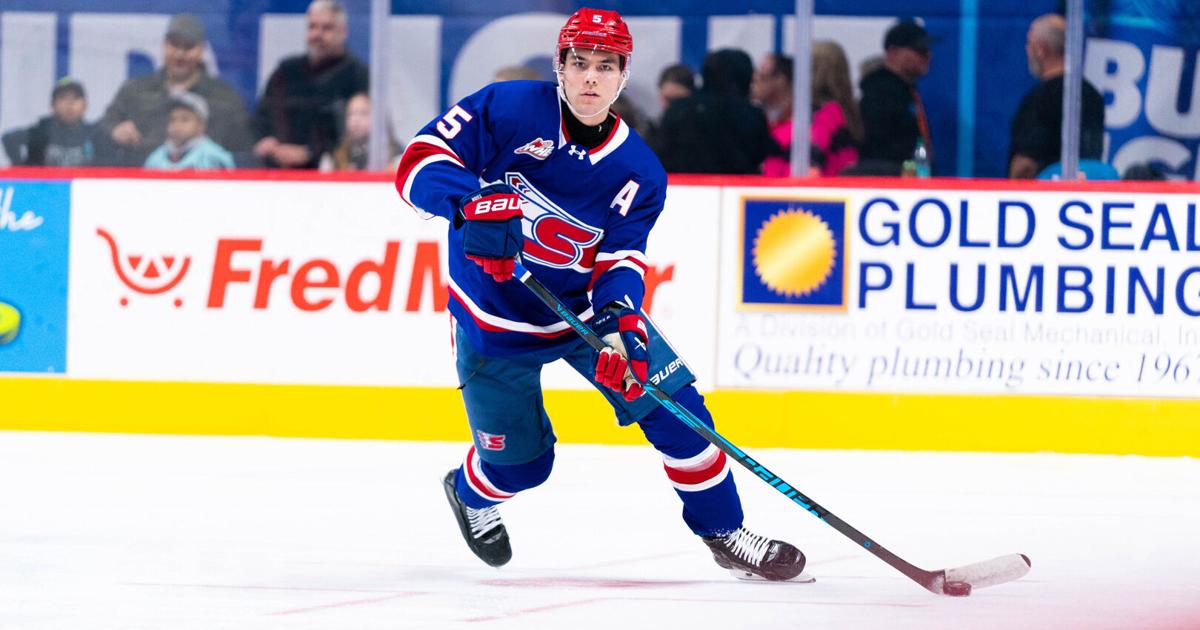


Chiefs defenseman Nathan Mayes was the final pick in the 2024 NHL draft.
Larry Brunt
A mere seven months ago, 19-year-old center Berkly Catton was zig-zagging through defenders on the ice at the Spokane Arena while leading the Spokane Chiefs to the club’s first Western Conference Championship and Western Hockey League Finals appearance since 2008.
Flash forward to December 2025, and the still-teenage Catton has been holding his own for the Seattle Kraken in the National Hockey League — already appearing in over 20 games (despite dealing with an injury) and notching five assists. The quick transition to hockey’s highest professional level on earth speaks to how abundantly talented Catton is on the ice. But it’s also the result of how the sport’s juniors-to-pros pipeline is set up, which may not be obvious to non-diehard hockey heads who root on the Chiefs.
Unlike the NFL and NBA, where players mostly get drafted out of college and see the field the very next season for their professional teams, the NHL focuses on drafting the rights to young prospects in the hopes that a year or two down the line they might be pro ready.
In Catton’s case, he was the eighth overall pick in the first round by the Kraken in the 2024 NHL draft. With that high of a pick, he was basically a lock to play for Seattle, but he clearly wasn’t ready to play with the full-grown men of the NHL yet, so they kept him with the Chiefs to continue growing, get stronger and develop his game amongst players his own age.
“We’re really excited that Berkly is in the NHL at 19,” says Spokane Chiefs general manager Matt Bardsley. “It’s not very common. He’s in a very, very small percentage group. But, you know, he was a pro when he was with us with his habits on and off the ice. So I’m certainly not surprised that he’s there. I mean, obviously he’s a special talent, but with that you also have to have the mindset and the preparation and all the proper habits to be able to stay there.”
While Catton is in the elite tier of this system, three of his former teammates who are still playing for the Chiefs in the current 2025-26 WHL season have also been drafted by NHL squads. Defensemen Will McIsaac (fifth round, pick No. 145, St. Louis Blues) and Nathan Mayes (seventh round, pick No. 225, Toronto Maple Leafs) were also 2024 draft selections, while center Owen Martin was taken by the Winnipeg Jets in the third round of the 2025 draft with the No. 92 pick.

St. Louis Blues draft pick Will McIsaac celebrates a Spokane goal.
Larry Brunt
When chatting with McIsaac and Mayes after a Chiefs practice, it’s still clear how much hearing their names called on draft night meant to the teenage hockey standouts… even if it was an especially long wait for one of them.
“Personally, I was the last pick in the entire draft,” Mayes says, “So at that point of the draft, I was kind of like a little checked out. Like literally the last pick, so I wasn’t really thinking I was gonna get drafted that year. And then obviously Toronto picked me, so it was just a surreal moment. I kind of just blacked out. I was with my family, so I got to celebrate with them. It was awesome.”
But getting picked is only the first official step on a players’ journey to the NHL. This is where player development coaches come in. In addition to the top-level junior hockey tutelage that Chiefs coach Brad Lauer and his staff can provide, when an NHL team drafts a Chiefs player, it assigns coaches to help the draftees with individualized strength, nutrition and training plans. This certainly requires drafted guys to hone their focus, but it doesn’t feel like a whole new experience preparing to play games for the Chiefs after being selected.
“There’s not really much difference,” says Mayes. “I have a player development guy who comes down and visits us every once in a while. Every once in a while you’ll have a guy [from the NHL team] watching you play, but other than that, it’s just like communicating with them weekly. But it’s pretty much the same.”
According to Mayes and McIsaac, the big league representatives are more focused on improving physical fitness and honing in on the fine details rather than totally reshaping them as players. They drafted them for a reason, after all.
“Whether that’s a workout plan or some drills to work on after practice, it’s just going through little things that you might not have access to here, like a nutritionist,” McIsaac says.
While some might assume having two organizations in a player’s ear about what they need to do to improve their game could be a headache, Chiefs GM Bardsley sees it as a total win-win scenario.
“I think that player development coaches are a real positive. They certainly don’t interfere. They’re not sending mixed messages. I think the biggest thing is the player development coaches from the NHL teams will communicate with us. Everybody wants to be on the same page,” Bardsley says. “Likewise, we get feedback from the player development coach when the players are at their NHL [training] camps about things that they’re looking for and areas to improve on. At the end of the day, everybody wants the same thing for the player — just for them to continue to develop. I’ve never had a bad experience with any NHL team on that player development side.”
NHL teams hold drafted WHL players’ rights for two years, after which the players can either get drafted again or enter into the free agent pool. An additional avenue for further player development opened in November 2024, when the NCAA amended its rules for the Name, Image, Likeness (NIL) era to allow junior hockey players at levels like the WHL to play collegiate hockey.
For now, the drafted Chiefs’ main focus is to rack up some more wins as a team. The Chiefs currently sit in seventh place in the Western Conference with a 17-16-0-0 record. While consistent winning hasn’t been easy for the defending conference champs, Spokane has won five of its last seven games headed into Christmas.
“Obviously we’ve had kind of a roller coaster to start for a season. Won some games, lost some games,” Mayes says. “But I think the past, like, two weeks, our team has really come together. Just getting kind of like that brotherhood mentality again. I think we’re getting some traction here.”