
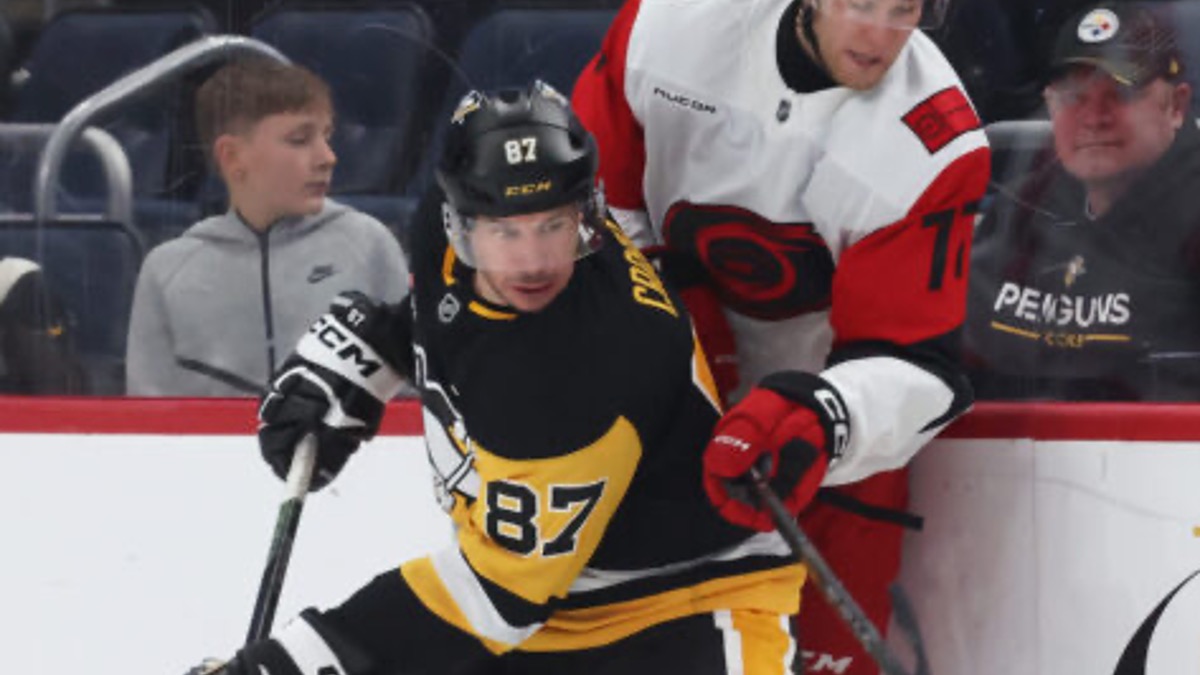
Considering the Pittsburgh Penguins‘ absolute failures against the Carolina Hurricanes both at home and away over the past handful of years, the Penguins’ resounding performance on Tuesday should stand as a guidepost on the team’s journey.
This–THIS–is what they can do.
Carolina has held the deed to the Penguins for years running. The Penguins had just six wins in their last 20 games against Carolina and six more overtime or shootout losses.
Further, Carolina has been a nearly unquestioned tenant in the penthouse suite atop the Metro Division this season. Yet, it seemed it was the Penguins who were the top team Tuesday, as they controlled, eventually dominated, and beat Carolina 5-1 at PPG Paints Arena.
There was no self-destruction, nor a hint of it. The Penguins not only held a lead, but they also played better with it.
“We just kept playing, and that’s what we want. I think when you start to get too far away from it in terms of–you go to the third period with the lead–and you suddenly change what you’re doing, it can go the other way,” said Penguins coach Dan Muse. “And so that’s been the message all year now. I mean, it hasn’t, at other times, looked that way, but that has been the message. I think, you know, we did a good job.”
Perhaps things are a little different with new Penguins head coach Dan Muse. It might not be a coincidence that Carolina overcame a third-period deficit to deliver a heartbreaking defeat to former Penguins coach Mike Sullivan and the New York Rangers Sunday.
But the Penguins have a uniquely different system now, and one that is something akin to an inverted version of Carolina’s high-zone man-to-man pressure system.
The frustration this time was Carolina’s as Muse, and the Penguins won their first battle with Rod Brind’Amour’s Hurricanes this season.
“I thought it was when it was time to defend, for the most part, we were in pretty good spots. We were doing the right things,” Muse said.
Anthony Mantha had a pair of goals. Justin Brazeau scored again and set up Mantha on a second-period beaut. Tommy Novak also had a goal and an assist. Bryan Rust and Erik Karlsson each had two assists. And Penguins captain Sidney Crosby set the tone with a goal just 3:46 into the game.
While the Penguins had plenty of performances worthy of high marks, the game was also an exposition of the Penguins’ new head coach and his chalkboard skills because the Penguins did a few things that carved Carolina like a holiday ham.
Penguins Analysis
Carolina doesn’t usually get thumped like that until the playoffs.
I kid, I kid.
The tactical breakdown is as cheery as it’s been all season for the often mistake-prone or sloppy Penguins. They were on point, and the plan was well-crafted.
First, the Penguins’ breakouts were precise. Defensemen did not succumb to the heavy Carolina forecheck; there were moments of pressure, but the Penguins’ defensemen properly moved the play forward either by skating or connecting sharp passes to the forwards.
“It was middle, towards the end of that third period, we had some really good exits, too. Just making plays coming out of the zone, rather than just flipping it out and throwing it out,” Muse said. “And sometimes, that is the play. Sometimes that is the last resort. But you don’t want that to be the first option. And I think we were making the right looks there.”
Check off another issue addressed.
Of note, Kris Letang may have been the most underrated Penguins defender of the night. He and partner Brett Kulak easily had their best game together, and it was one of Letang’s cleanest performances this season.
Once the Penguins generated forward momentum, Muse’s chalkboard plan put Carolina on their heels. The Penguins were able to play on the rush, but they didn’t merely skate on the perimeter; the Penguins were able to attack the middle of the ice.
“The last two games,” Anthony Mantha quickly asserted. “The first period obviously went well for us, and we know they’re a great team. They were getting pressure a lot, and we kind of created those chances off their errors. It worked out for us.”
Especially in the first period, the Penguins utilized center drives off the rush, clearing space for the weak-side forwards across the blue line to possess the puck and create. Of special note, the driver cut through the defensemen, creating a seam and isolating the D1, which created numbers behind the Carolina defense.
In other words, the Penguins played with speed into the offensive zone, but didn’t settle on the outside; they pressured Carolina, forcing one or two Carolina forwards to backcheck all the way to the net, or the Penguins had open men in scoring positions.
It worked quite well. It was also the culmination of parts of the game that Muse has been stressing for a couple of weeks: Take the middle of the ice and play with speed.
“You always look for things to continue to improve, but I thought some of it’s even just starting with the (zone) exits, you know? I think when the opportunity is there, it’s hard to defend the middle of the ice, and I think we have some guys that it just comes natural for in this group, but we were finding (the middle),” Muse said. “Then it’s also just that balance of recognizing when things aren’t there–I think we’ve got the ability to create off the forecheck and putting ourselves in good positions that way.
“So, finding that balance is important. And I thought it was a really good step in the right direction.”
Or as the Penguins did frequently in the first period, the puck carrier attacked the middle of the ice across the blue line, drawing defenders and creating open wingers who were able to get behind Carolina’s defense.
Either way, the results were the same. The Penguins forced Carolina to defend to the end wall and played behind the defense with speed all night.
Even though Muse downplayed their tactical superiority, he should sleep well on Tuesday when his head hits the pillow. Finally.
Defensively, the Penguins mostly stayed above the puck. Of course, there were breakdowns, and Carolina had chances. After all, Carolina is a good team, but by staying above the puck, the Penguins created layers in the neutral zone, which kept Carolina from generating speed.
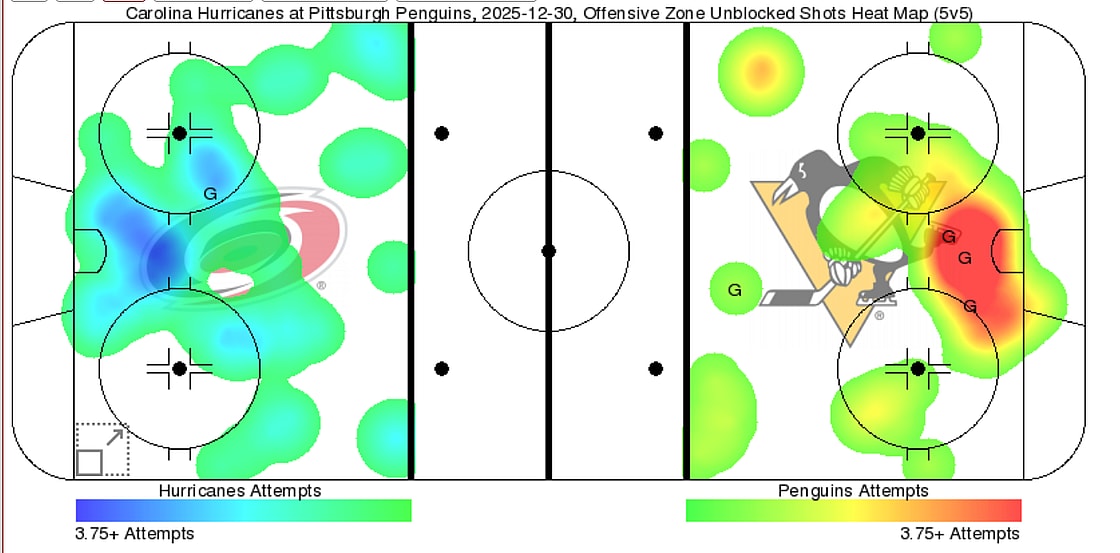
The Penguins locked down the neutral zone and controlled the middle of the ice in their own zone. Most of Carolina’s shots were from the perimeter. From NaturalStatTrick.com, the Penguins had a heavy concentration of shots around the net, while Carolina’s heat map is a lot of … nothing.
Penguins Report Card
Team: A+
Shocking may be a backhanded compliment, but the Penguins have scarcely shown an ability to outplay their opponent AND play a clean game. Mission accomplished Tuesday.
Between the tactical win and the aggressive play, it was the best version of the Penguins.
There were mistakes, and things for the team to watch on video Thursday morning, but the ghastly mistakes did not occur, and the smaller ones did not wind up in their net.
Dan Muse: A
The Report Card rarely grades coaches, but they were on target Tuesday. Not only was the game plan spot on, but it was also executed well, and the coach clearly got through to his players that the chaotic version of Hungry Hungry Hippos they had been playing could not continue.
Brett Kulak-Kris Letang: A
The pair, but especially Letang, deserves quite a bit of credit. The pairing was the Penguins’ best. No mistakes. Good movement. Good defensive zone coverage.
Letang played 22:32 in the win, and there was nary a peep on social media. That’s how good he was.
Mantha-Novak-Brazeau: A+
The trio was again the Penguins’ best line. When they go to the net and work behind the defensemen, they are lethal. Their puck movement and connectivity were fun to watch.
Other Notable Performances
The Fourth Line: Connor Dewar-Blake Lizotte-Noel Acciari buzzed in the offensive zone. They played about 15 minutes and were ever-present in the offensive zone. Unfortunately for them, Carolina netminder Frederik Andersen reserved his best saves for them.
Ryan Shea-Jack St. Ivany: The pair is strong. It wasn’t their best game, but it was a strong game. As one might predict, the Carolina forecheck pressured the pair, but they didn’t make mistakes or turnovers. They also took care of the net and low low-scoring zone very well.
Could Have Been Better
Erik Karlsson: He made too many mistakes in the first period. They were not costly, but a couple of turnovers and a bad pinch made his game look too undisciplined in the first.
Rutger McGroarty-Ben Kindel-Ville Koivunen: Just wasn’t their best. They didn’t generate a lot of pressure. Despite playing a fair amount against Carolina’s fourth line with Taylor Hall, Logan Stankoven, and Mark Jankowski at center, the Kindel line was outshot 5-2 and outchanced 7-4, according to NaturalStatTrick.com.
And in this case, the numbers matched the eyes. They didn’t generate a high-danger chance.
It was probably the last go-around for that version of the Kids Line, as newly acquired Yegor Chinakhov will be available Thursday. It would seem a natural fit to place him on that line, rather than break up the red-hot second line with Mantha and Brazeau.
Tags: Carolina Hurricanes Dan Muse Penguins game Pittsburgh Penguins
Categorized: Penguins Analysis