

I have been an admittedly harsh critic of the National Hockey League’s current playoff format since its inception during the 2013-14 season. It’s perennially vulnerable to unfair playoff seeding, and this season is no different.
In fact, if there were ever time to give the NHL’s playoff format a serious rethink, it’s going to be this upcoming off-season.
The NHL believes divisional rivalries attract more eyeballs and are what hockey fans want, which serves as the basis for the league’s current playoff format – one that guarantees four divisional matchups in the 16-team tournament, with each divisional two-seed playing each divisional three-seed. The two division winners per conference then end up drawing in against a wild-card team based on their finish in the standings.
Forcing these divisional matchups comes with a significant cost, however. Like most sports leagues, the NHL will routinely see cyclical talent imbalances shifting from one conference to another. However, by segmenting the teams a second time through the divisions, the risk of talent imbalances creating unfair seeding increases further.
After a gruelling 82-game regular season, you’d like to think a merit-based system rewarded the teams that performed best, but that’s rarely the case.
Because the likelihood of perfect parity across divisions is extremely low, you end up seeing first-round matchups each season that look askew. This regular season we are barreling down the path of the worst example yet.
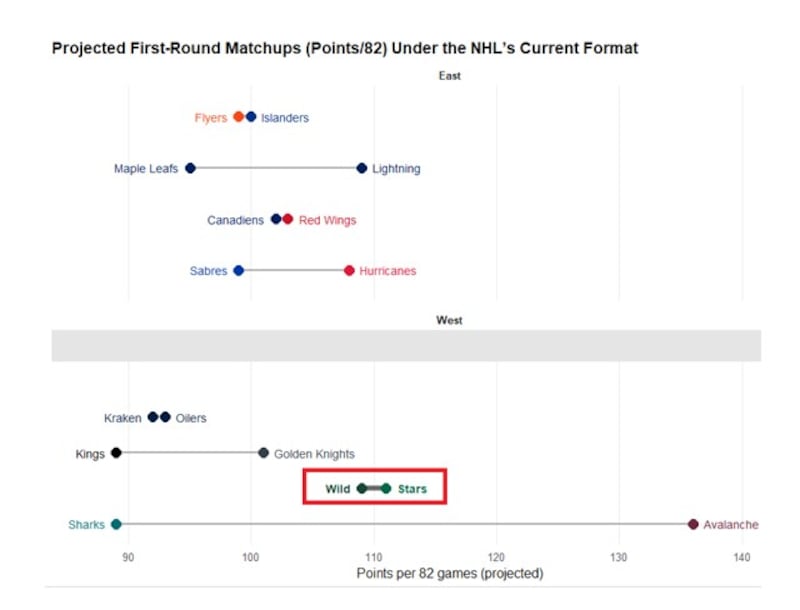
Now past the halfway point of the season, there is credible evidence the NHL’s three best teams all reside in the Central Division. While all eyes have been on the Colorado Avalanche’s historic season, the Dallas Stars (26-10-9 for a 111-point pace) and Minnesota Wild (26-11-9 for a 109-point pace) have been similarly dominant.
Both would be favourites to win any other division in the NHL, but because they play in the Central and trail the blazing Avalanche, the likelihood they must play one another in the first round increases by the day.
Said simply: The NHL’s second- and third-best teams, by merit, are likely to be first-round foes.
That, in turn, rewards much lesser teams with easier draws and paths to the Stanley Cup. Through Sunday, consider what these series may look like, and just consider how big of a gap there is here:
 Yost1
Yost1
There are so many ways to point out the absurdity of the format here beyond the Wild and Stars draw.
Teams like the Toronto Maple Leafs and Buffalo Sabres, on merit, are indiscernible from the Vegas Golden Knights; the former are desperately fighting for wild-card spots, where the Golden Knights are holding the top seed out of the Pacific and would have home ice until the Conference Final.
With the advancements of modern travel I’ve been a supporter of breaking the division and conference barriers altogether and seeding teams one through 16, though I acknowledge these teams play meaningfully different regular-season schedules, and perhaps preserving seeding by conference (which does benefit more from the NHL’s value of geographic rivalries) is the most appropriate balance.
But without any calibration of the format, the league is always going to be vulnerable to something like this occurring. And in a league otherwise feverish about rewarding hard work and proud of the competitiveness of the sport at the highest level, the divisional structure is becoming impossible to defend.
Data via Natural Stat Trick, NHL.com, Evolving Hockey, Hockey Reference
Related Stories