
The back half of January has become a seismic time of year in the Jim Rutherford, Patrik Allvin era.
In three consecutive seasons, the Vancouver Canucks have completed ground-shaking, terrain-altering transactions at roughly this point in the calendar — trading captain Bo Horvat to the New York Islanders in 2023, acquiring Elias Lindholm from the Calgary Flames in 2024 and sending J.T. Miller to the New York Rangers (then flipping the first-round pick they acquired to the Pittsburgh Penguins for Marcus Pettersson and Drew O’Connor).
Given how active the Canucks have been in recent seasons in late January, we figured we’d best get ahead of detailing precisely what we should reasonably expect the Canucks to accomplish at this nascent, fragile stage of a new era of rebuilding. Here’s our blueprint for what a perfect NHL trade deadline might look like for a Canucks team that should be aggressively looking to give their future asset holdings a significant shot in the arm.
1. Acquire a first-round pick, or equivalent value selling Kiefer Sherwood
Sherwood is the Canucks’ most straightforward and marketable trade chip to leverage ahead of the March 6 deadline. He’s scored at a pace of 24 goals per 82 games since coming to Vancouver, has racked up the second-most hits in the league in that time and is a fast, pesky forechecker. This is the exact kind of gritty middle-six goal-scoring winger that teams covet ahead of the deadline, and he should have extra appeal considering his minuscule $1.5 million cap hit.
Sherwood’s value as a pure rental is in an interesting middle ground. He’s clearly more valuable than recent rental wingers like Mason Marchment (second- and a fourth-round pick), Trent Frederic (second and a fourth), Brandon Tanev (second) and Anthony Beauvillier (second), who were all valued in the second-round pick neighbourhood within the last 12 months. However, Sherwood’s not quite as valuable as the three rental forwards — Brad Marchand, Brock Nelson and Mikael Granlund (who was producing at a 71-point pace at the time of his trade) — that commanded a first-round pick at last year’s deadline. Scott Laughton and Tanner Jeannot aren’t really fair comparables for Sherwood’s trade value, either, as Laughton had an extra year of term remaining, while Jeannot was a 25-year-old under RFA control when Tampa Bay acquired him.
There’s an added challenge for the Canucks’ pursuit of landing a first-round pick for Sherwood as well, because many Cup contenders have already traded their 2026 first-rounder: Dallas, Edmonton, Colorado, Tampa Bay, Minnesota, Vegas and Florida. Sure, there are plenty of other teams that still own their 2026 first-round pick, but those clubs are more likely to be in the mushy middle of the standings. And because they aren’t playoff locks, those clubs will probably be more hesitant to give up their first-round selections because their respective picks could end up landing in the teens, rather than being the late first that contenders are more willing to part ways with.
With that said, this is where the Canucks should explore creative strategies to juice Sherwood’s trade value into the first-round pick (or equivalent) territory. We’ve already outlined some of those methods in depth, whether it be retaining salary, adding a mid-round pick (eg, the Sharks bundled a third-round pick alongside Barclay Goodrow to acquire a first-round pick from Tampa Bay in 2020), or taking back inefficient money.
In any case, a perfect Canucks deadline would start with Sherwood fetching the Canucks an additional first-round pick, or equivalent value.
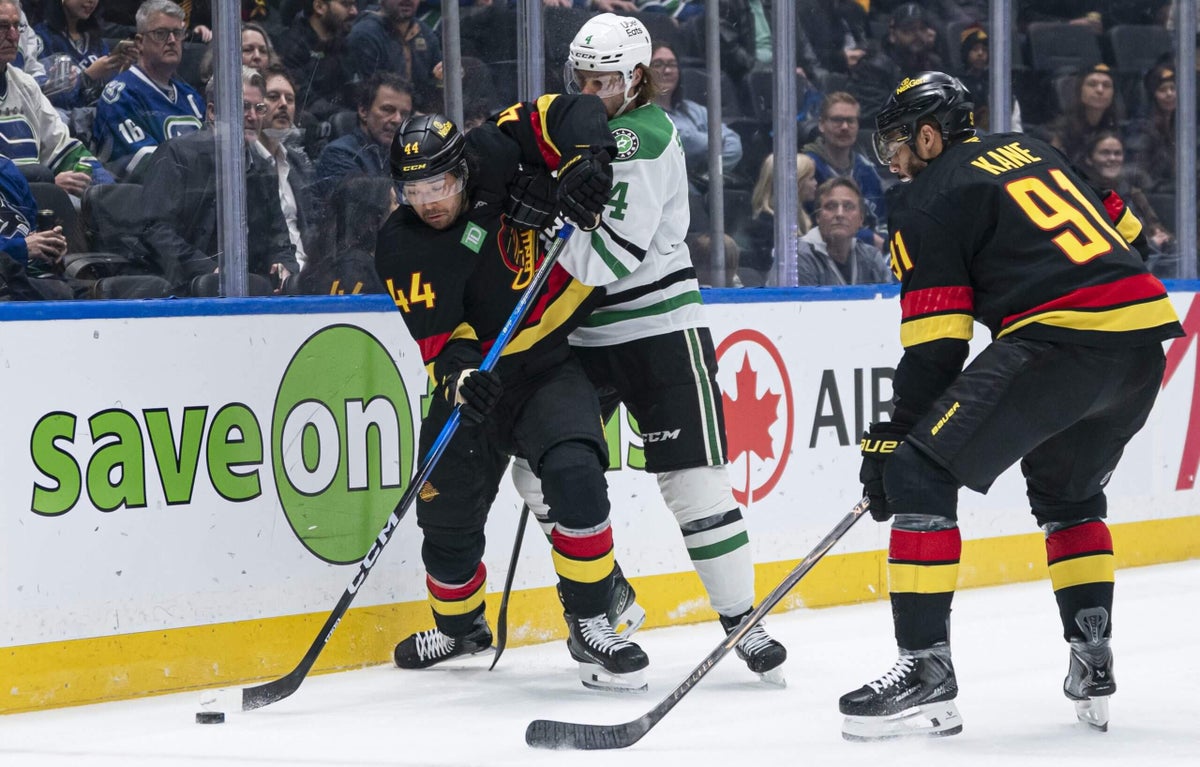
2. Add a second-round pick, or equivalent value selling Evander Kane
Kane’s Vancouver homecoming hasn’t worked for either side.
The Canucks were hopeful that Kane would help punch up their offensive attack, while adding a heavy element the club felt it needed up front. Kane’s physical impact, however, has been muted, and his offensive output and production have been pedestrian.
From Kane’s perspective, Vancouver looked like a comfortable place to compete for a playoff spot, attempt to earn an extension and continue his playing career, or at least put together a solid platform season before becoming an unrestricted free agent this summer. Instead, Kane’s two-way impact has been dismal, and his value has diminished.
As The Athletic reported last week, the market for Kane’s services on the trade market at the moment is largely lukewarm. If the club is able to recoup the fourth-round pick it paid to acquire Kane, while potentially retaining some of his salary in the process, that might simply represent the best that Vancouver can do.
If that’s ultimately all that the club’s efforts to monetize Kane can bring back, then so be it. It’s better than nothing. It says here, however, that the Canucks should and really need to find a way to do better.
As frustrating as Kane has been to watch this season, he’s still a big, playoff-tested veteran winger on pace for 37 points this season with minimal power-play time. He’s precisely the sort of player that teams with a slighter profile up front would presumably look at as filling a need at the heaviest time of the year. Even if he’s rarely brought that sort of physical intensity to the Canucks lineup this season, we all know that the playoffs are a different beast.
Perhaps it requires the Canucks to identify the one team that overvalues the sort of attributes that Kane possesses. Perhaps it requires retaining 50 percent of Kane’s contract. Perhaps it requires the club to bundle Kane with a mid-round pick or another veteran player. Perhaps it requires all of the above, and the Canucks also agree to take back an inefficient or expensive contract in the process.
Whatever it takes. If the Canucks don’t find a way to net a second-round pick (or equivalent value) in a Kane return, then the trade to acquire him will stand out as one of the most costly deals in franchise history — if not for the price the club paid in the original deal, then for the opportunity cost that adding a peripheral contributor and his $5.125 million cap hit for this critical season represents.
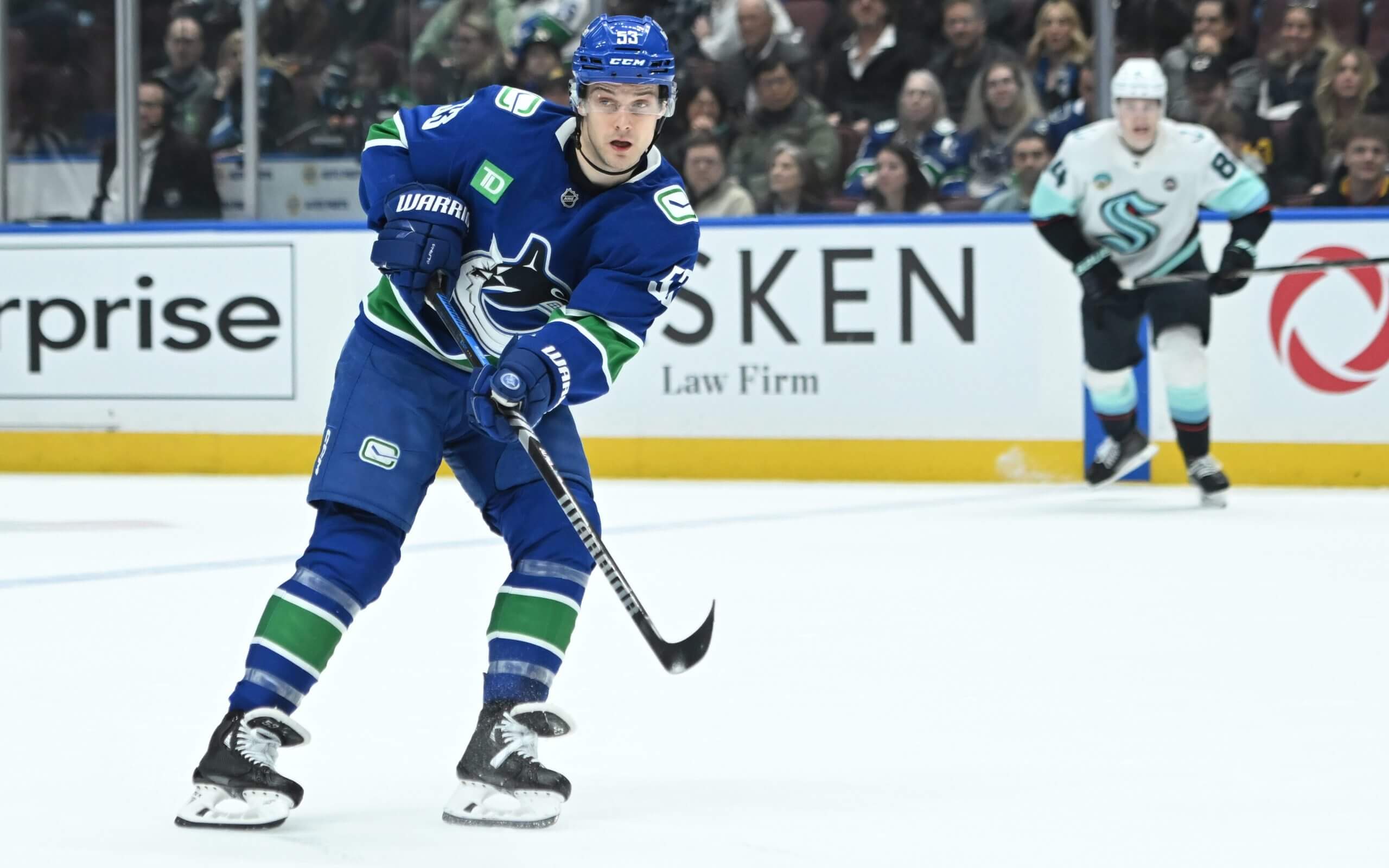
Canucks centre Teddy Blueger could be a depth addition for a contending team. (Simon Fearn / Imagn Images)
3. Recoup some modest future value for Teddy Blueger and David Kämpf
One of the most classic deadline moves is when a contender trades a mid-to-late-round pick to beef up their depth at centre or on defence. It’s important for the Canucks to capitalize on this and sell Blueger and Kämpf, who are each on expiring contracts, ahead of the deadline. We wouldn’t expect either one to fetch a significant return, but as reliable, playoff-tested, fourth-line centres capable of killing penalties and winning face-offs, they should be worth something.
Blueger’s value will likely be diminished compared to the last time he was a deadline asset (Vegas paid a third-round pick to acquire him at the 2023 deadline) because he’s only played two games this season, but he’s on the cusp of returning to the lineup, and should have half a dozen games or so to prove to potential buyers that he remains a credible NHL centre.
Trading Blueger and Kämpf isn’t just about recouping some modest draft capital, though. Moving these veteran pivots is also key to ensuring Aatu Räty has a meaningful opportunity down the stretch. Räty has been in and out of the lineup in recent weeks and was back to skating as an extra during Sunday’s practice, with Blueger taking his spot on the third line. This doesn’t even consider that Filip Chytil’s return may also be imminent, and that Marco Rossi will also likely return at some point.
In other words, Vancouver will face a glut of depth centres as it gets healthier; moving Blueger and Kämpf is the most straightforward way to solve that.
4. Shed at least one, and ideally, two long-term contracts for older veteran players
The Canucks have eight veterans on their roster who are 27 or older, make at least $4.5 million against the cap and are signed for at least three seasons after this one: Brock Boeser, Conor Garland, Elias Pettersson, Jake DeBrusk, Filip Hronek, Thatcher Demko, Marcus Pettersson and Kevin Lankinen.
We’re not advocating for Vancouver to trade all its veterans; it’s obviously impractical to ice an entire lineup of under-25 players. It may also not be straightforward to execute some of these moves before the deadline, since many of these players have partial (if not full) trade clauses, and some of these contracts might be more desirable for teams to take on in the offseason. However, exchanging older veterans with term for draft picks and prospects is one of the most basic, fundamental parts of any rebuild. Not only does this yield critical future assets, but it also ensures that these older players’ contracts don’t become a hindrance down the road when the team becomes an up-and-coming group again.
If the hesitancy around trading veterans is to ensure that Vancouver’s young players are surrounded by enough quality, experienced players who can lead and mentor, it’s important to remember that you can always recruit veterans on high-AAV, short-term free-agent contracts. The Sharks, for example, traded Jake Walman to the Oilers at last year’s deadline for a significant haul and then replaced his veteran experience by signing John Klingberg and Dmitry Orlov in free agency.
5. Open up at least 2 contract slots
As it stands at the start of the NHL business day on Jan. 19, Vancouver currently has 48 contracts against the 50-contract limit on their books.
Now we’d expect an active seller team to shed a contract slot or two, but given the complexity of some of the Canucks’ holdings, some of the deals that they’re likely to execute between now and the trade deadline may require the franchise to take back a salary or a player to facilitate the trade. When the deadline passes, however, the Canucks should be holding no more than 46 total standard player contracts against the 50-contact limit.
There aren’t too many silver linings to being overmatched every game in the NHL, but one genuine advantage that a tanking team accrues down the stretch run of the season is that its games don’t matter whatsoever. That’s historically served as a counterintuitive edge in recruiting NCAA free agents, since a clear non-playoff team can more easily offer undrafted NCAA free agents the opportunity to play NHL games immediately, which both permits them to earn an NHL salary for the balance of the season and burn the first year off their entry-level contract.
The Canucks have used this edge previously in the Rutherford era in recruiting players like Cole McWard and Akito Hirose out of the NCAA. Given how critical it is for the Canucks to add to their prospect pipeline, NCAA free agency is an avenue that the club should pursue aggressively this spring.
Proactively opening up opportunities in the NHL lineup and contract slots should be a spillover benefit of the club executing an ideal trade deadline this season.
6. Emerge from the deadline with 5 top-60 picks at the 2026 NHL Draft
One of the main takeaways from the skyrocketing NHL salary cap is that landing impact players outside of the draft will become increasingly difficult. Fewer top players will reach free agency each year because teams will be able to afford to extend them (eg, the Panthers last summer with Brad Marchand, Aaron Ekblad and Sam Bennett), and the trade market likely won’t be as robust either.
With this in mind, teams are recognizing that the draft, which was always important, is becoming even more essential to any successful rebuilding effort. If we agree that the draft is the best long-term strategy to accumulate talent, then it’s imperative for the Canucks to accumulate as much pick volume as possible. The draft, after all, is an inexact science and unpredictable — the more lottery tickets you have, the greater your chances of getting lucky.
Vancouver already owns three picks in the top 60 at the 2026 NHL Draft. Adding a fourth should be a layup once Sherwood is traded, and in a perfect scenario, the Canucks would find a way to add one more, likely by trading one of their veterans with term beyond this season. Five top-60 picks in one draft class would go a long way toward revitalizing the team’s prospect pipeline.
7. Acquire at least one first- or second-round pick in the 2027 or 2028 NHL Draft
Life moves fast in the NHL.
A second-round pick bought from a contender might seem like an afterthought asset on the day that it’s acquired, only to become a probable top-35 pick 18 months later. That’s exactly what happened to the Chicago Blackhawks, for example, when they acquired a 2027 second-round pick and took on Ilya Mikheyev’s contract (with Vancouver eating a bit of salary) in the summer of 2024.
What seemed like a tidy bit of business for Vancouver in clearing out some cap space, less than two years on, looks like a massive win for the Blackhawks. Chicago now owns a very valuable 2027 second-round pick and may have the opportunity to further monetize Mikheyev between now and the 2027 trade deadline as well.
In addition to accumulating significant capital for the 2026 NHL Draft, the Canucks should be open-minded about the potential upside involved in rolling the dice on the natural uncertainty of the NHL. If the opportunity presents itself for the club to acquire a future first-round pick (or even a second-round pick) in the 2027 or 2028 drafts, even if that pick feels likely to fall late in the order on the day that it’s acquired, then that’s an opportunity Vancouver should leap at. And even prioritize.
Vancouver can afford to be patient, but what this organization needs more than anything is upside. Future picks might come attached to a longer wait (and time, of course, is money), but there’s a level of upside to uncertainty that the club would do well to lean into in selling rental players and established veterans alike between now and the trade deadline.
8. Demonstrate the creativity and vision Canucks fans need to see in order to trust the direction of this management team again
The NHL trade deadline has not been an especially productive or fruitful time for the Canucks historically.
Last year, for example, the club was widely criticized for holding onto a pair of rental players in Boeser and Pius Suter despite rapidly dimming playoff hopes. The club missed the playoffs, allowed Suter to walk for nothing, and extended Boeser to a massive new contract that already looks regrettable less than one year into the deal. The critics had it right.
From the disappointment of the Radim Vrbata, Dan Hamhuis trade deadline, to the false start of the Roberto Luongo gets pulled off the ice deadline, to the organizational dysfunction that caused the club to miss their best sell window for Ryan Kesler; the past 20 years of Canucks history is littered with confusing deadline performances that have left fans, observers and people around the league shaking their head at the atypical, arbitrary way that this franchise has done business.
For Rutherford and Allvin, Canucks management simply cannot afford to leave this marketplace mystified when the trade deadline passes.
At the outset of this rebuild, Canucks fans are desperate to see this franchise make sharp, decisive, creative moves to maximize the value of their NHL-level assets and monetize them for the benefit of the future.
This is a critical test for the organization in rebuilding trust with the fan base. The Canucks have now explicitly said they’re rebuilding in the wake of the Quinn Hughes trade; now it’s time for the club’s actions to meet that moment.