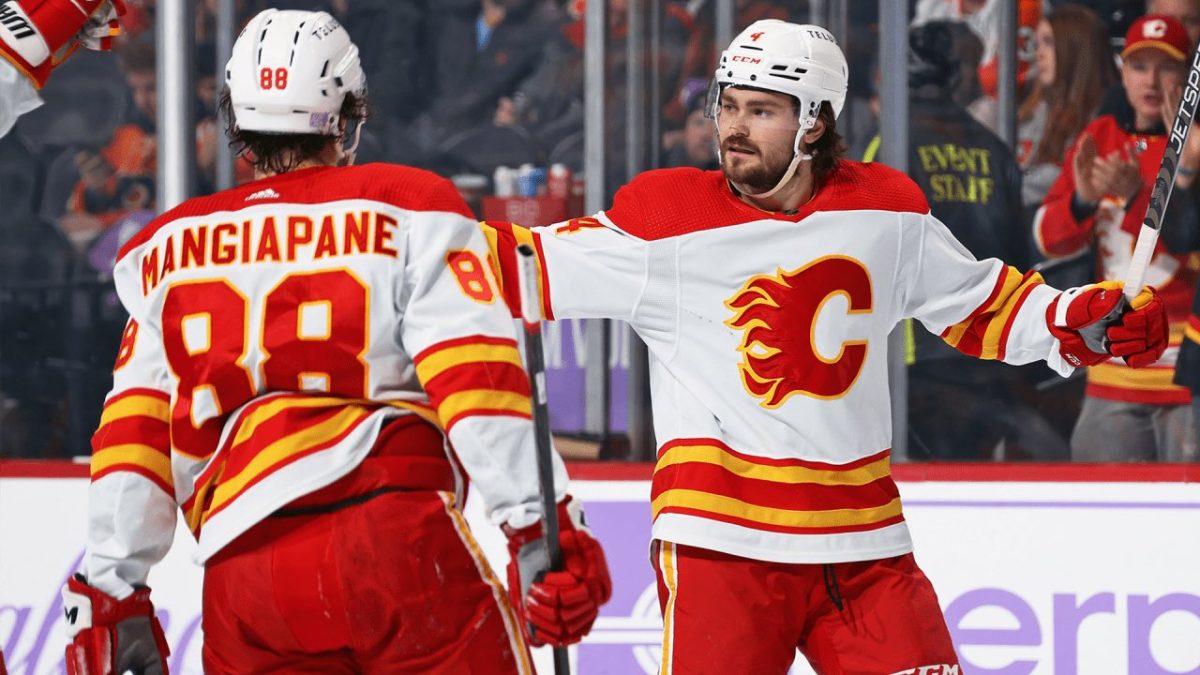
(Photo Credit: @RAndersson19 on X/Twitter)
The Golden Knights are at it again. They’ve pulled off yet another blockbuster trade, bringing in defenseman Rasmus Andersson in exchange for Zach Whitecloud, a 1st round pick, a conditional 2nd round pick, and prospect Abram Wiebe.
At first glance, it appears to be a major upgrade on the blue line in Vegas. Andersson has scored 10 goals and posted 30 assists this season, while playing a massive minute load of 24:14 per night. Over the past five seasons, he’s scored 45 goals and racked up 199 points, which blows Whitecloud’s 21 goals and 65 points out of the water.
Andersson is a +3 this season, while Whiecloud sits as a -8. He’s attempted 112 shots to Whitecloud’s just 33, and he has more blocks (90-63), more takeaways (18-9), and his 6.1 point shares blows away Whitecloud’s 1.3.
Changing teams can change the equation, though. In Calgary, Andersson was a #1 do-it-all defenseman for a team that’s limited on the blue line. He currently leads all Flames defensemen in total ice-time, penalty kill, 6-on-5, and 3-on-3 ice time, and is second in both even-strength and 5-on-6 ice-time. In other words, he’s the go-to guy in every situation, and it’s been that way for a few years now.
In Vegas, that’s not going to be the case.
First, and probably most importantly in terms of production, Andersson will definitely not be on the VGK top power play unit, which currently plays around 84% of the total power play time. He probably won’t even be on the second unit either. This will significantly impact Andersson’s offensive numbers. This season, he has scored four goals and 10 points on the power play. Over the past five seasons, 67 of his 199 points and 10 of 45 goals are on the power play. Thus, about a third of his points and a fourth of his goals will instantly vanish the moment he pops on a gold jersey.
Thus, just about all of his offensive numbers will have to come at 5-on-5. Over the past five seasons, Andersson has been scoring exactly 1 point per 60 minutes while playing a bit below 18 minutes per game. That means he scores about one 5-on-5 point every 3.3 games. To compare, over the same timespan, Theodore averages 1.45 points per 60 (1 every 2.3 games), while Noah Hanifin and Kaedan Korczak’s numbers are nearly identical to Andersson’s. Whitecloud’s number was a bit lower at 0.83, about one point every four games.
Hanifin has 13 even-strength points in 37 games this season while Korczak has 11 in 47. Andersson’s number should be expected to be similar, which is a far cry from the offensive impact that’s being touted by using his overall scoring numbers.
On the flip side, coming to Vegas has a strong chance of improving a lot of Andersson’s concerning defensive numbers. The simplest one is the -11 he’s posted over the past five seasons. Andersson was a dismal -38 last year, having been on the ice for a whopping 62 goals against at 5-on-5. This year, he’s a +3, but the goals against numbers have gotten even worse. He’s been on the ice for 2.74 goals per 60 at 5-on-5 this year. Every VGK defenseman aside from Ben Hutton has a better number, and Theodore’s is significantly better at 1.63.
It gets worse with the fancy numbers. JFresh Hockey’s stat card shows Andersson with a 6% WAR at even-strength defense. That means 94% of players in the NHL have more wins over replacement compared to Andersson. AFP Analytics has his overall defensive impact in the 32nd percentile, so better, but still bad. The deeper numbers from JFresh and All Three Zones show significant issues in entry defense, exit success, and puck retrievals, all areas that are key in the Bruce Cassidy defensive system.
This will all likely improve because Andersson’s competition numbers were off the charts in Calgary. Not only was he playing significant minutes in all situations, but he was playing them in difficult spots against the opposing team’s best players. In Vegas, likely paired with Hanifin, they’ll act as a second pair behind Theodore and McNabb. That will mean much more favorable matchups, including many more offensive zone starts.
Andersson currently boasts a 46.8% offensive zone start percentage which would be the lowest of any regular Golden Knight defenseman. Hanifin, who currently sits at 58.9% offensive zone starts and Theodore is at 54.2%.
The Golden Knights made this trade in an attempt to upgrade their blue line for this season and beyond. On paper, there’s no question that Andersson offers that over Whitecloud. But, without power play time, the impact is going to have to come at 5-on-5 and defensively, areas in which he’s not significantly better than Whitecloud.
There’s a great chance the “better player” improves his game coming to the better team, but it’s far from a guarantee due to the situation he’s stepping into with Golden Knights’ current makeup.