
If you’ve followed my work, read my guide to scouting or kept up to date on my draft rankings in the last few years, you’re probably already aware that I tend to look for a specific kind of player.
I like prospects who blend small area puck skill with the ability to dictate at multiple tempos. I believe that players who can control pace of play by situationally slowing the game down or speeding it up, are the most well-equipped to handle the constant pressure and traffic of the NHL. I am increasingly less concerned with athleticism, length, strength and physicality, which, while valuable, are not often the distinguishing traits between the game’s best players and the rest.
The top of the 2020 NHL Draft class is a tell-tale sign of a similar shift across the scouting world. Though Alexis Lafreniere’s strength on the puck and Quinton Byfield’s size are certainly among their defining traits, the skills that have separated Cole Perfetti, Lucas Raymond and Jamie Drysdale are not those of power or athleticism. They are skills of finesse, touch and technique.
But there’s one player near the top of my 2020 draft board that doesn’t fit the mold. All of those aforementioned tools that I’m paying less attention to are all of the ones that he uses to impact a game.
Evaluating Dylan Holloway’s play and projecting his upside has become a real fascination of mine. That’s because I’m quite high on his potential NHL upside, despite the difference. A decade ago, he would’ve been closer to the norm than to the exception. Today, he’s the reverse.
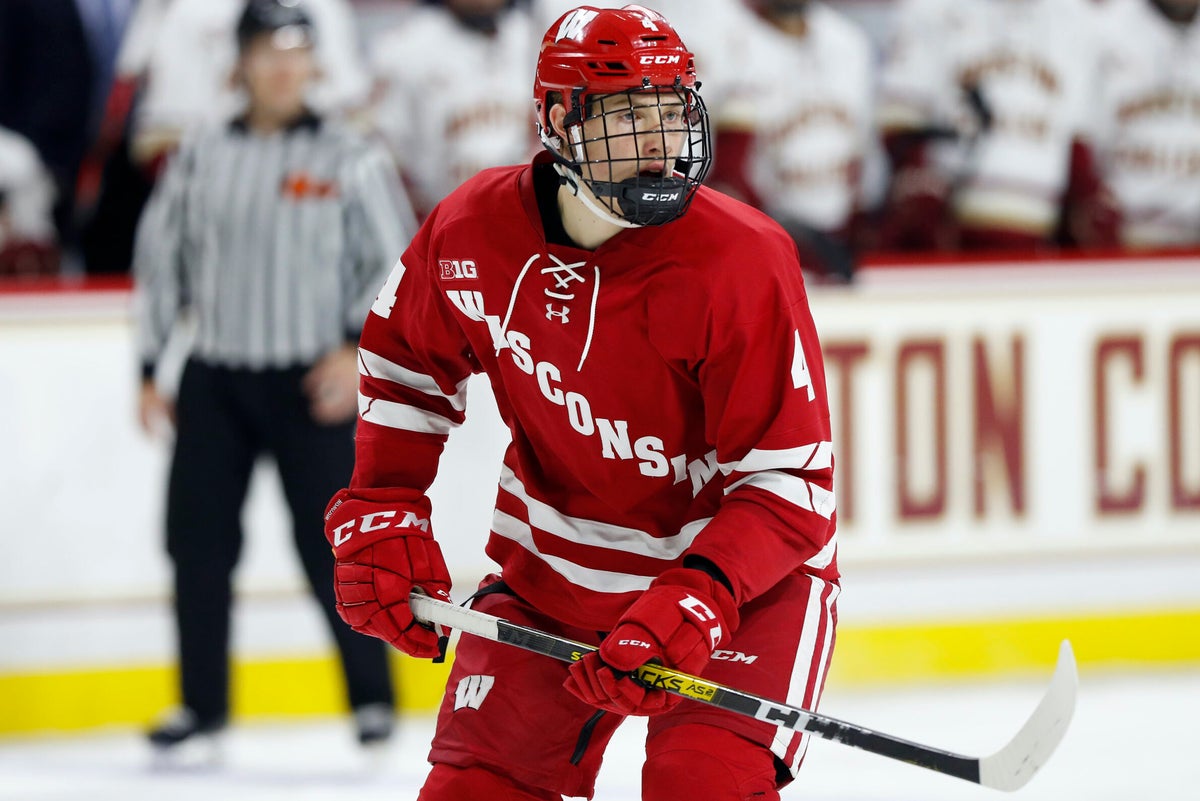
In February, when I embedded with the Wisconsin Badgers men’s hockey team for a feature on life as an NCAA hockey player, teammates and coaches talked about Holloway, the team’s youngest player, in unique terms.
“He seems like he’s 20. He gets it. Some of the other guys don’t quite understand how it is quite yet and I would say he fits in the best of any of them for how young he is,” said forward Mick Messner.
“He’s like a man,” added goalie Daniel Lebedeff.
There was the typical high praise you’d hear for a future first-round pick. Panthers prospect Owen Lindmark called him a “hell of a player.” Canadiens prospect Cole Caufield talked about his calm and said he’s never seen him nervous. As did associate coach Mark Osiecki, who highlighted Holloway’s steadiness and said the team hasn’t seen the typical highs and lows out of their draft-eligible player’s game as they do in most other freshmen.
But everyone always came back to the descriptors of physical prowess, strength and athleticism.
“He’s a man amongst boys. He’s so freaking strong,” said goalie Jack Berry.
After winning the AJHL’s most valuable player award a full year before his NHL draft year, Holloway was allowed to play college hockey as an 18-year-old. In fact, he was one of just two first-year draft eligibles to play Division I NCAA hockey in 2019-20.
Holloway said the decision to leave junior a year earlier was made on the basis of his physical maturity.
“Playing at a higher level gets you better as a player. I was ready to make the jump and I’m happy that I did because this year has taught me a lot and I feel like I’m better off for it,” Holloway said. “Coming from the AJHL to here, making decisions at a quicker pace is a lot different. I like to think of myself as a fast player but there’s a lot of them in this league.”
As the season progressed, Holloway really began to hit his stride. When I was there in the middle of February, he was the best player for the disappointing Badgers across their two-game set with top-ranked Penn State, with points on three of their six goals.
Here, through an analysis of more than 150 of his shifts across eight of his games, beginning with that weekend series against Penn State and ending in the Big Ten playoffs against Ohio State, I’ll detail why I think his athletic abilities are enough to make him one of the draft’s top forward prospects. Along the way, I hope to highlight how the tools that make him unique should still benefit him at the NHL level, even as players get faster and stronger.
The tape
There are little things that I picked up on in watching Holloway play throughout the year. Imperceptible details that I normally don’t notice with most players his age.
Like the fact that he always seems to be the player who comes out of scrummed faceoffs with the puck. Hockey tracks whether the centre won or lost the draw but I wonder, anecdotally, just how much a winger can influence those outcomes. I’m willing to bet Holloway is among the best in the draft at jumping in and tracking the puck out of the referee’s hand.
The more I watched Holloway, the more of an appreciation I gained for the way he imposes himself physically while he’s on the ice. You can forget, when you’re watching him, that he’s half a decade younger than some of the players on the other side at the college level. He doesn’t look it. He’s already 6-foot-0.5 and 203 pounds. And he certainly doesn’t play like it. There were games this year where Holloway was the most physically dominant player on the ice in a college game. You can’t often say that about teenagers at that level, let alone draft-eligible ones.
And while none of those little elements are the kind of skills that turn a prospect into a first-round talent, they do help to inform how the rest of his game fits into that — and how those little things begin to add up to produce positive outcomes — when you watch him play.
It can also be hard to identify athleticism. You can see it in the way they skate sometimes or the way they absorb contact, but it’s not normally something that leaps out in the same way as puck skill or the flash of a nice goal does.
In Holloway’s game, though, it’s easy to identify.
You can see it in the way he forechecks. Watch No. 4 in red chase the puck into the zone, stay with it and force a turnover that nearly helps create a chance in front, before tracking the play all the way back the other way to try to finish not one but two checks at the tail end of this sequence:
Holloway keeps a ton of plays alive by blending his physical on-ice presence with his plus-level speed and an admirable sticktoitiveness.
Below, Holloway does a good job hitting the trailer for a scoring chance before rotating into the slot for a chance of his own, but neither of those opportunities are created if he doesn’t win the original race for the puck into the zone by stretching out to get to it:
He rarely loses those races you expect him to lose or the ones other players pull up during and try to cut off the outlet pass out of instead:
In many cases, those won races result in scoring chances, too. The following sequence is a good example of that:
There, notice how Holloway engages with a bump to gain inside positioning and comes out of the ensuing contact with the opposing player without trouble, before fighting for positioning and a chance in front seconds later.
Sometimes, he just outmuscles people.
The skating I talked about off the top is evident in the way he crosses over to build speed and attack into the offensive zone in the sequence below. But look at the way he sheds his check below the goal line to maintain possession and get the puck to the point:
All of these things make him an excellent cycle player.
He absorbs a hit, stays with the play long enough to get the puck back and cut off the wall with possession to make something happen. Here, that was a backdoor pass:
Here, watch the way he keeps his feet moving to come off the opposite wall, draw contact and set up a chance with a smart drop pass:
And though the player who is winning those races or keeping those sequences alive by winning a 50/50 battle doesn’t always get credit when goals are scored off their plays, they can still be driving forces in on-ice outcomes.
It’s not uncommon for a Holloway shot or pass to be the elusive third assist on a goal:
Just like it’s not uncommon for Holloway to score a goal that substitutes timing and location for flash, like this tip goal from that weekend series against Penn State:
Ultimately, the natural instinct when you watch a player like Holloway play is that while his peers at the top of the 2020 class may project into top-six roles, he may become a third-line player. We can pigeonhole players like him as the Dirty Work Guy. I think he’s got more upside than that, though, and it’s not hard to imagine him putting these skills together as the third-best player on a first line. And third-best players on NHL first lines ought to be high picks.
Holloway isn’t just the cycle guy either. His ability to push tempo with his skating makes him a dangerous rush player as well.
He can transport the puck up ice as the carrier on his line (or a power play unit):
He can use his speed to pull up and find the trailer:
He’ll drop his lead shoulder and leverage his strength to drive at defenders and attack the net like he did here:
And here, this time with a sort of reckless abandon:
And he doesn’t just get going to a high-end top speed, but he can also adjust his pace with a quick change of tempo. Watch, here, the way he intentionally slows down, knowing he can beat the defender one-on-one with a quick burst (there’s that ability to absorb contact too):
His speed and physical presence on the ice also help him back off defenders. He does a good job hitting the line, creating some separation and then dropping pucks to his teammates for scoring chances.
Watch him attack the middle and bring defenders with him to set up this goal:
And then watch him execute a similar play before getting open to finish off the give and go himself with an excellent shot off his heels here:
And when those drops passes aren’t available, he’s also got enough touch with the puck to try to make something out of nothing. Just because he plays a simpler game than some other top prospects, doesn’t mean he lacks confidence in his ability to make something happen one-on-one when the play calls for it:
He’s got the talent to pull rabbits out of a hat in transition just like many of his peers do:
He also sees the ice reasonably well and consistently shows an ability to hit some tough seams, which helps his power play upside:
Over the course of a game, that on-ice awareness complements his presence on the cycle to help him make his fair share of small area plays. And though he’s never going to be able to play in traffic like some of the smaller, puck-dominant players in this class, he does have good hands. He also consistently makes plays off his backhand, like he did on this assist:
His strength also gives him a wrist shot that goalies often struggle to control:
But the bulk of Holloway’s offence comes out of his unique ability to drive at defenders, protect the puck on the cycle and keep offensive zone shifts alive.
Holloway doesn’t wait for others to get him the puck. He makes plays for others after winning pucks back for himself:
He puts together entire shifts, instead of short flashes, by staying involved, winning battles and making smart decisions with the puck. His best moments are more often the sum of 30 seconds of work, instead of the split-second highlight:
And he will create the odd highlight with his skill and skating, don’t get me wrong:
But just because Holloway’s tools are the throwback kind, doesn’t mean they can’t fit inside the modern professional game. They don’t mean he has to be a depth guy at the next level, either. Because when he hit his stride at the end of the year and finished the season with nine points in his final 10 games, he was doing the scoring and the playmaking too.
(Photo: AP Photo / Winslow Townson)