
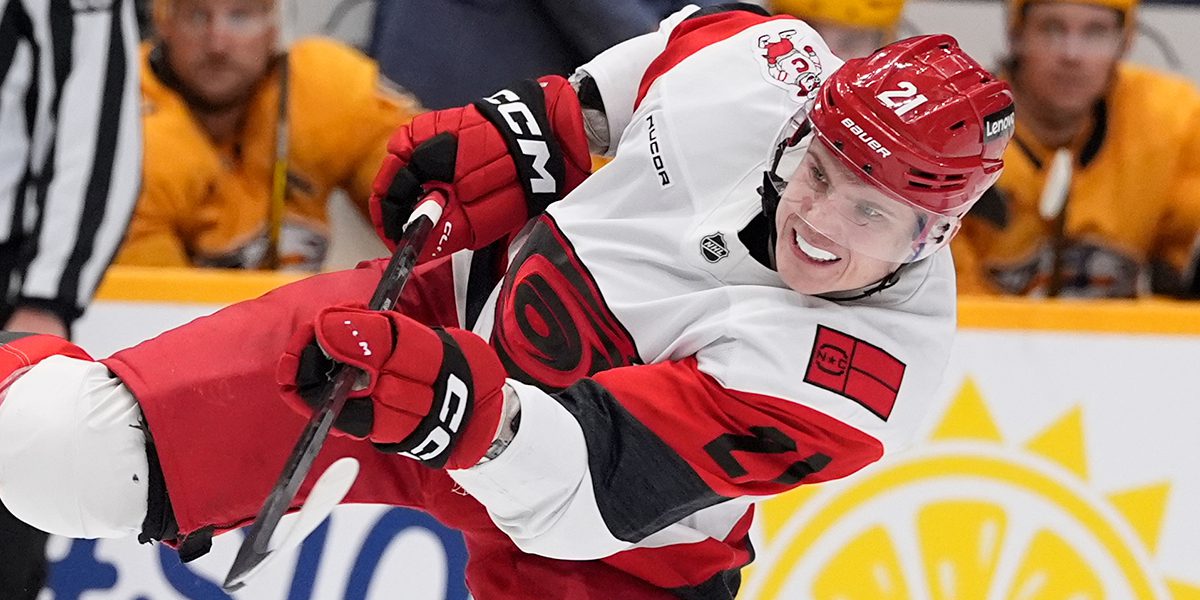
Hurricanes defenseman Alexander Nikishin shoots during a game against the Predators on Dec. 17 in Nashville, Tennessee. (George Walker IV / AP Photo)
RALEIGH — The Hurricanes have seen their usual lineup of players miss more than 100 games to injuries this season, most notably Jaccob Slavin being out 40 games due to a pair of ailments.
Despite that, Carolina finds itself right where it normally is: atop the Metropolitan Division standings with one of the NHL’s best records at 32-15-5.
In the first part of a two-part interview with North State Journal, Tulsky discussed the first 52 games of the season.
How would you assess the season so far?
There are a lot of ways we could be better. That said, we have dealt with the kind of injury trouble that can absolutely wreck a season, but we still sit in a tie for first in the conference and have a six-point lead in the division (Note: It’s now eight points after Saturday’s win in Ottawa). I can’t wait to someday see what this team looks like when it is healthy.
What improvement has this season’s team shown compared to what you saw from last year’s team?
The depth has really stood out this year. Last year, we were so tight against the cap that we had to run a very lean roster, and we were lucky to stay healthy for most of the year. But when we lost a couple of players in the playoffs, we really felt it. This year, we’ve had stretches where we were missing six or seven players and, well, of course we still felt it, but we were more equipped to get through it.
How do you think your two biggest offseason additions, Nikolaj Ehlers and K’Andre Miller, have fit in on and off the ice in their first months with the team?
They’ve been great. Coming to a new team and adapting is harder than people might think. A player can go over video and understand what we want them to do in certain situations, but hockey is an extremely fast game, and it takes time to get to the point where those decisions are instinctive and immediate. Both players had the physical tools to do what we need, and they have the mental drive to contribute at the highest level they can, and now you can see it in their game. And you asked about off-ice fit — they’re both just really good people who have fit well into our family.
The team was labeled as “boring” by some last season. I know those statements didn’t impact how the team wants to play, however, it does seem you rely more on rush chances this season than in previous years. What led to the shift from being a primarily dump-and-chase team to one that is perhaps leaning more on high-end skill?
That label always struck me as crazy. We pressure all over the ice and constantly attack, and I think that makes the game much more exciting than when a team just packs it in defensively and waits for a mistake. As for the play off the rush, we’ve just been steadily adding skill to the roster over the years. (Jordan) Staal and (Jordan) Martinook are still playing the same game they always have, but as we’ve added forwards like Ehlers and (Taylor) Hall and (Jackson) Blake and (Logan) Stankoven to the mix, we’ve become more and more dangerous off the rush.
Depth has been important this season with the number of injuries on your roster. How much of a focus last summer was getting deeper with signings like Mike Reilly and Cayden Primeau?
Yeah, that was a real goal for us last summer. Our cap situation left us room to have a little more depth than last year, when we spent most of the first half of the year with just 12 and six on the roster. We wanted to take advantage of that flexibility to add a little more veteran depth — we knew we had prospects like (Joel) Nystrom, (Charles Alexis) Legault, (Bradly) Nadeau and (Justin) Robidas who would be in the mix, but it is good to be able to ease them into the transition to the NHL.
Have you been surprised by the impact made by some of your young players who were perhaps not expected to make a big impact this soon, particularly your young defensemen?
Yes and no. I know Nystrom’s impact came as a big surprise to a lot of people, but internally we knew this was a possibility. Even going back to last year, if he hadn’t gotten hurt, he would have been in the conversation to play games when we had injuries in the playoffs. So I guess I’d say that we hoped he could step in and play like this, but it’s a positive to see things play out the way we hoped. And I’d say the same for Legault looking comfortable in early action before his injury.
Speaking of young defensemen, expectations were high for Alexander Nikishin. How do you feel he’s handled his first full NHL season?
He’s been very good. You make an interesting comparison about expectations. The public wasn’t talking about Nystrom much, and people who didn’t know much about him were surprised at how good he’s been. Expectations for Nikishin were sky-high, and even going back to last year, I’ve been trying to caution people that the expectations are fair, but the timeline might not be what they thought. There was a lot for him to learn — not just understand on paper, but like we said about Ehlers and Miller, it had to get built into his instincts so he can make decisions without hesitation. That takes time, especially for a rookie who’s learning so much about the way we play. He’s made a lot of progress in the first half of the year, and we just expect that to continue.
What’s your assessment of how the coaching staff has handled Nikishin’s development and how the player has reacted to that?
Coaches see a lot about the game that fans don’t see. There are always going to be things that you won’t pick up if you don’t know what to look for. On our first goal against Buffalo the other day, maybe you noticed (Sean) Walker stepping up in the neutral zone to break up an exit and create the chance for us. But if his gap is a little bit looser there and he can’t jump the pass, I don’t think many people will notice something like that. It just looks like a routine exit by Buffalo that you don’t think twice about. But the coaches would notice and would be talking to him about it and trying to help him improve. That’s not being unnecessarily hard on a player; it’s doing their job. We all know his potential is extremely high, and coaching him on the details of the game is part of how they help him reach his potential.